

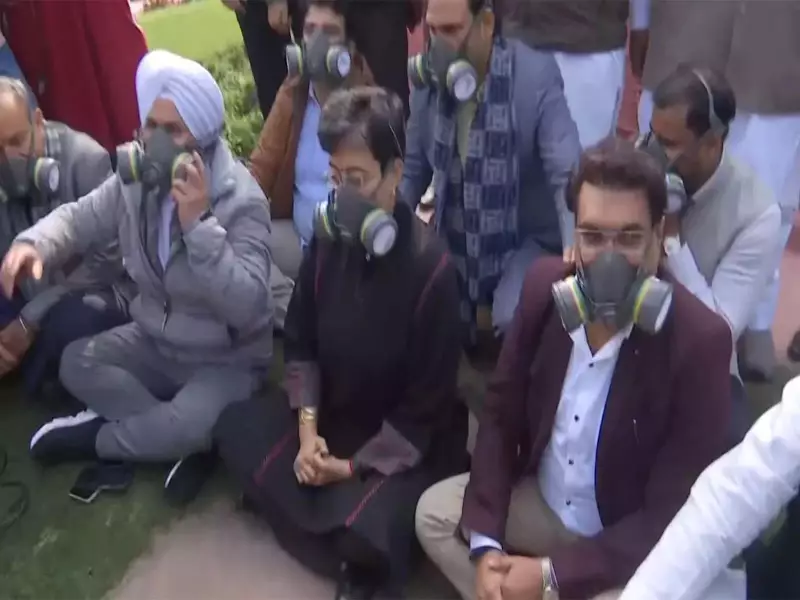
In a dramatic move highlighting the capital's environmental crisis, legislators from the Aam Aadmi Party (AAP) staged a demonstration inside the Delhi Assembly premises on Monday. The protest, spearheaded by Leader of Opposition Atishi, aimed to spotlight the dangerously deteriorating air quality in the national capital and demand immediate policy interventions.
Protest Demands and Public Health Concerns
The protesting MLAs voiced grave concerns over the severe impact of pollution on public health, particularly for vulnerable groups like children, the elderly, and individuals with pre-existing respiratory conditions. The party leaders called for stringent and urgent measures from the government to tackle major pollution sources. Their demands included curbing emissions from vehicles, controlling industrial discharges, and addressing the persistent issue of stubble burning from agricultural fields in neighboring states.
Capital Chokes Under 'Poor' to 'Very Poor' Air
Simultaneously, Delhi and several other Indian cities, including Mumbai and Guwahati, were shrouded in a thick layer of fog on Monday morning. The air quality across the national capital varied from 'poor' to 'very poor', causing significant disruption. Flight operations at Indira Gandhi International (IGI) Airport were hampered due to reduced visibility from fog and smog, leading to delays for several flights in the early hours.

Official data from the Central Pollution Control Board (CPCB) painted a grim picture. By 8 am on Monday, Delhi's overall Air Quality Index (AQI) was recorded at 260, in the 'Poor' category. Specific locations showed even more alarming readings:
- Akshardham: AQI of 294 ('Poor')
- ITO: AQI of 256 ('Poor')
- Anand Vihar: AQI of 320 ('Very Poor')
- Chandni Chowk: AQI of 337 ('Very Poor'), making it one of the worst-affected areas.
GRAP Curbs Lifted Despite Ongoing Concerns
In a related development, the Sub-Committee on the Graded Response Action Plan (GRAP) under the Commission for Air Quality Management (CAQM) had lifted Stage-III restrictions in Delhi on Friday evening. The decision was based on an assessment noting an improvement in air quality due to favourable meteorological conditions. However, Monday's protest and high AQI readings underscore that the relief may be temporary, and the underlying pollution crisis remains acute, demanding sustained and effective long-term action.






