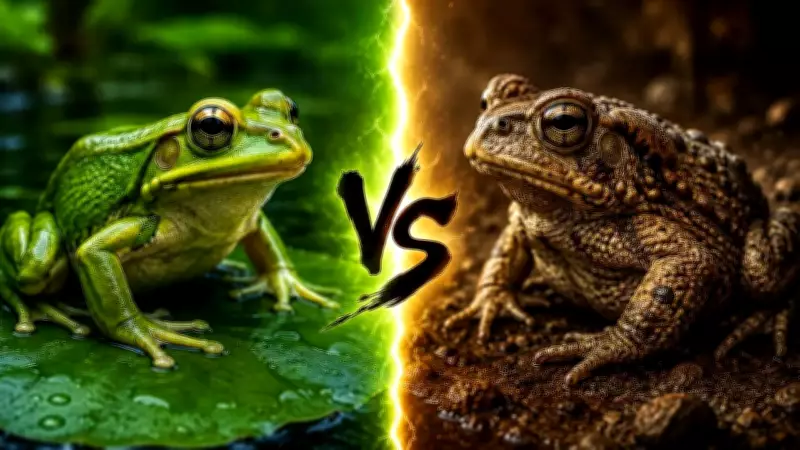
A frog on the edge of a pond and a toad crossing a garden path can appear remarkably similar at first glance. Both belong to the same amphibian order, Anura, and both begin life in water before undergoing one of nature's more unusual transformations. Yet the distinction between them has survived for centuries because their habits, appearance, and lifestyles often diverge in noticeable ways.
The confusion is understandable. Some frogs spend much of their lives away from water, while certain toads have surprisingly smooth skin. Even so, there are recurring patterns that help separate one group from the other. The differences are not simply cosmetic. They reflect how these animals move, breed, avoid predators, and cope with their surroundings. Looking a little closer reveals that the frog and the toad have followed slightly different paths despite sharing a common ancestry.
Frog vs Toad: The Traits That Separate Them
Skin Texture
The skin is often the first clue. Frogs tend to have a smooth surface that feels damp because moisture is constantly being retained on the body. Toads usually have thicker, rougher skin with a textured appearance. Those familiar bumps are not actually warts but specialised skin structures.

Body Shape
Many frogs have a lean build that suits an active lifestyle around ponds and wetlands. Their shape helps them swim and jump efficiently. Toads often appear heavier and more compact. The broader body is well-suited to spending longer periods moving across dry ground.
Hind Legs
A frog's back legs are usually noticeably longer than the rest of its body. They act like powerful springs. Toads possess shorter hind limbs that are less specialised for dramatic jumping. Their movement relies more on steady, practical locomotion than bursts of distance.
Movement
When startled, a frog often disappears in a single bound. The leap can carry it a surprising distance from danger. Toads behave differently. Rather than launching themselves through the air, they commonly make a series of shorter hops or simply walk away.
Preferred Habitat
Frogs are frequently associated with ponds, marshes, and stream edges. Their skin loses water relatively quickly, making damp conditions important. Toads can venture farther from permanent water. Gardens, woodland floors, and grasslands often provide suitable conditions for them throughout much of the year.
Water Retention
Because amphibian skin is permeable, moisture management is a constant challenge. Frogs generally require humid surroundings to avoid drying out. Toads possess skin that slows water loss more effectively. This adaptation allows them to tolerate conditions that many frogs would find difficult.
Egg Arrangement
Breeding season reveals another useful distinction. Frog eggs are often deposited in jelly-like masses that gather beneath the water's surface. Toad eggs usually form long transparent strings that drift through ponds and shallow pools, sometimes becoming tangled among aquatic vegetation.
Tadpole Development
The early life stages do not always follow the same timetable. Frog tadpoles may remain in water for extended periods before metamorphosis is complete. Toad tadpoles often develop more quickly. Rapid growth can be an advantage in temporary pools that disappear as conditions dry.
Feet
Many frog species possess webbing between their toes. This feature acts rather like a paddle and improves swimming performance. Toads generally have less webbing because they spend more time on land. Their feet are adapted for moving across soil, leaf litter, and grass.
Defence
A frog's main protection is often its ability to remain hidden or escape rapidly. Toads have another option. Many species possess glands behind the eyes that can release defensive substances when threatened, discouraging predators from attempting a second attack.
Why Frogs and Toads Are Often Confused
Despite these differences, frogs and toads remain close relatives. They share the same basic body plan, pass through a tadpole stage, and depend on moist conditions for reproduction. To an observer, especially from a distance, those similarities can outweigh the details. A quick glimpse beside a pond may leave little time to notice skin texture or leg length.

That resemblance is a reminder of their shared evolutionary history. Frogs and toads may have adapted to somewhat different ways of life, but they remain branches of the same amphibian family tree. The next time one appears in a garden or beside a stream, a closer look may reveal which path it has taken.
This article was written by the TOI Lifestyle Desk, a dynamic team of dedicated journalists who, with unwavering passion and commitment, sift through the pulse of the nation to curate a vibrant tapestry of lifestyle news for The Times of India readers. At the TOI Lifestyle Desk, we go beyond the obvious, delving into the extraordinary. Consider us your lifestyle companion, providing a daily dose of inspiration and information. Whether you're seeking the latest fashion trends, travel escapades, culinary delights, or wellness tips, the TOI Lifestyle Desk is your one-stop destination for an enriching lifestyle experience.