

Pune Medical Team Performs Miraculous Surgery to Remove Massive 18-Kg Uterine Tumor
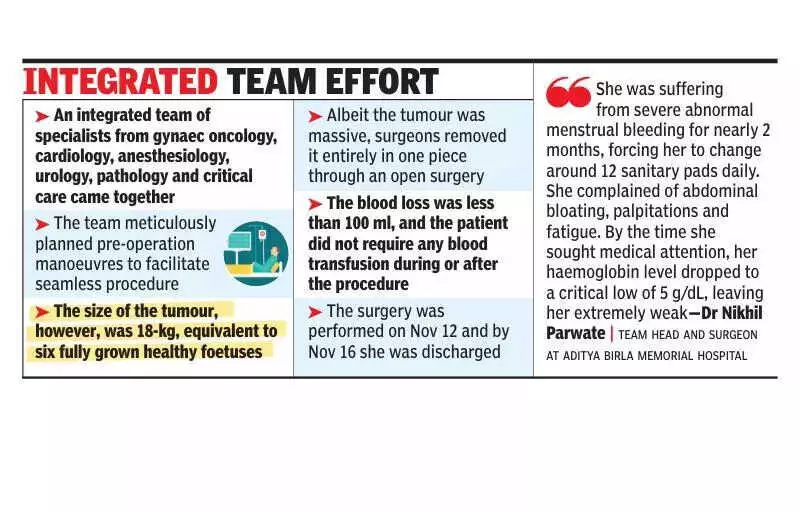
In a remarkable medical achievement, doctors at Aditya Birla Memorial Hospital in Pune have given a 51-year-old woman a new lease on life by successfully removing a rare 18-kilogram uterine tumor. This extraordinary case represents one of the largest tumors reported in recent medical history, with its size being equivalent to six fully grown healthy fetuses.
The Critical Condition and Symptoms
The complex and high-risk procedure was led by Dr. Nikhil Parwate, Gynae Oncology & Robotic Surgeon at ABMH. He revealed that the patient had been suffering from severe abnormal menstrual bleeding for nearly two months, which forced her to change approximately 12 sanitary pads daily. She also experienced multiple distressing symptoms including abdominal bloating, dizziness, palpitations, and extreme fatigue.
By the time she sought medical attention, her condition had deteriorated significantly. Her hemoglobin level had dropped to a critical low of 5 g/dL, leaving her extremely pale and weak. This severe anemia made the surgical intervention particularly challenging and risky.

The Surgical Triumph
Despite the tumor's massive size, the surgical team managed to remove it entirely in one piece through an open surgery. What makes this achievement even more remarkable is that the blood loss during the procedure was less than 100 ml, and the patient did not require any blood transfusion during or after the surgery.
The operation was performed on November 12, and by November 16, the patient was well enough to be discharged from the hospital. This rapid recovery timeline speaks volumes about the precision and effectiveness of the surgical intervention.
Medical Challenges and Team Approach
Dr. Parwate emphasized the complexity of the case, stating, "This was a highly challenging case because of the sheer size of the uterine tumor and the patient's compromised health condition. Through meticulous pre-operative planning, careful blood management and precision surgery, we were able to safely remove the entire mass without damaging surrounding organs."
He further highlighted the importance of early diagnosis and timely intervention in achieving such successful outcomes. The tumor was initially suspected to be cancerous based on imaging findings, but the post-surgery histopathology report confirmed it was not malignant, providing additional relief to the patient and medical team.
Multidisciplinary Collaboration
Dr. Rajesh Badani, Interventional Cardiologist & Electrophysiologist at ABMH, explained that the patient had experienced an asymptomatic increase in uterine size that reached enormous proportions in a short time span. "However, with close cardiac supervision and a coordinated team approach, we were able to safely support her through this extremely high-risk surgery," he noted.
During her last follow-up in December, the patient had completely recovered, demonstrating the effectiveness of the comprehensive medical care she received.
Institutional Excellence and Patient Care
Pamesh Gupta, CEO of ABMH, praised the collaborative effort that made this medical success possible. "Specialists from gynaec oncology, cardiology, anesthesiology, urology, pathology and critical care came together as an integrated team. Such cross-specialty collaboration is critical in managing complex, high-risk cases, where timely decision-making and collective expertise can be life-saving," he stated.
Gupta further emphasized that this case reinforces the importance of early detection and prompt intervention in ensuring the best possible outcomes for patients facing serious medical conditions.
This extraordinary medical achievement in Pune showcases how advanced surgical techniques, meticulous planning, and multidisciplinary collaboration can overcome even the most challenging medical scenarios, offering hope and renewed health to patients facing life-threatening conditions.






