Hyderabad Witnesses Progress in Early Eye Cancer Detection
In Hyderabad, the landscape of eye cancer detection is undergoing a significant transformation, moving from late-stage crises to earlier diagnoses. This shift is primarily attributed to enhanced public awareness and more efficient referral systems within the healthcare network.
Medical professionals at prominent institutions like the LV Prasad Eye Institute (LVPEI) and Sarojini Devi Eye Hospital emphasize that the apparent increase in cases reflects improved detection capabilities rather than a true rise in the incidence of the disease.
Current Statistics and Trends in Eye Cancer Cases
At LVPEI, doctors handle approximately 200 to 250 cases of retinoblastoma, a common eye cancer in children, each year. The total annual eye cancer cases at the institute range from 550 to 600. Meanwhile, Sarojini Devi Eye Hospital in Mehdipatnam reported around 250 cases of common eye cancers in adults and the elderly in 2025, with retinoblastoma cases numbering between 25 and 30, often diagnosed at advanced stages.

Historically, about a decade ago, roughly 10% of eye cancer patients presented at very advanced stages, where the tumor had spread beyond the eye. This figure has now decreased to approximately 5%, underscoring the positive impact of better awareness and streamlined referral pathways.
Persistent Challenges and Risk Factors
Despite these advancements, significant hurdles remain. Delays in recognizing symptoms and accessing specialist care continue to be major obstacles. Additionally, as cancer treatments improve, more survivors are living longer, potentially leading to hereditary cancers appearing in subsequent generations.
Dr. Swathi Kaliki, consultant ophthalmologist and head of the OEU Institute for Eye Cancer at LVPEI, highlighted several contributing factors to eye cancers. While some, like retinoblastoma in children, are genetic, others are influenced by environmental and health conditions. For instance, certain surface eye cancers are linked to high ultraviolet (UV) exposure, prevalent in tropical regions such as India. Weakened immunity or conditions like HIV can also elevate the risk.
Impact of Untreated Eye Cancers and a Success Story
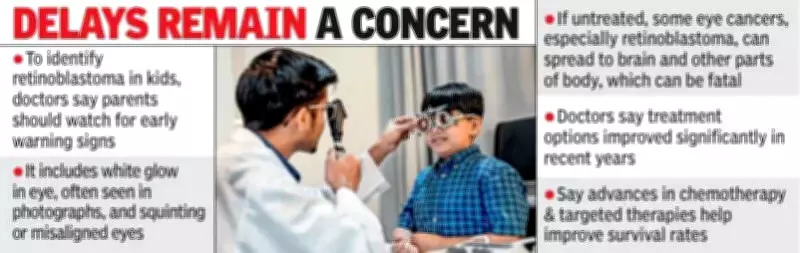
If left untreated, eye cancers, particularly retinoblastoma, can spread to the brain and other body parts, potentially proving fatal. Dr. Kaliki shared an encouraging case of improved awareness: a three-year-old child from a remote village in Andhra Pradesh, whose parents noticed an unusual eye appearance, received timely treatment after a technician at a rural vision center suspected retinoblastoma and facilitated a referral to a specialized hospital.
Ongoing Issues with Late Presentations
However, Dr. Modini Pandharpurkar, superintendent of Sarojini Devi Eye Hospital, noted that many patients, especially children with retinoblastoma from economically weaker sections, still arrive at tertiary hospitals in advanced stages. Retinoblastoma, considered rare with about one in 18,000 live births affected, often shows minimal symptoms early on, complicating detection.
In adults, common eye cancers include ocular surface squamous neoplasia (OSSN) and meibomian gland carcinoma. Eyelid tumors, visible as lumps or swelling, typically lead to earlier presentations and higher cure rates.
Early Warning Signs and Improved Treatment Options
To identify retinoblastoma, parents should watch for early signs such as a white glow in the eye in photographs, squinting, or misaligned eyes. Immediate medical attention upon noticing these symptoms can save both vision and life.
Treatment advancements have been substantial in recent years, with progress in chemotherapy and targeted therapies enhancing survival rates and preserving eye function when detected early. Dr. Kamal Babu, COO South at ASG Eye Hospital and Vasan Eye Care, pointed out that over the past decade, diagnostics, imaging, and specialized eye care expansion to tier-2 and tier-3 cities have improved. Yet, late presentations persist due to mild, painless early symptoms that delay care-seeking and referrals.
Routine pediatric eye checks and school screenings are recommended to detect cases earlier, though awareness gaps, particularly in smaller towns, remain a concern.