Your family is not rejecting tradition. You are simply trying to fit it between a 7:40 am school drop off, an 8:30 stand-up call, a tiny kitchen counter, and a temple that is forty minutes away and closes before you finish work. That is not laziness. That is diaspora life.
Building a Weekly Home-Temple Rhythm
A weekly home-temple rhythm works when it is small, repeatable, and safe. It also works best when you are honest about what you are doing. Some parts are canonical ritual (what shastra, scripture, and established temple practice describe). Some parts are family sampradaya (your lineage or sect’s way of doing it). Some parts are pragmatic adaptation abroad (what you do because you live in the US or UK, and you are making do). Below are the most common sticking points we see in NRI homes, and what to do instead.
Start Small: A Clean Altar Is Enough
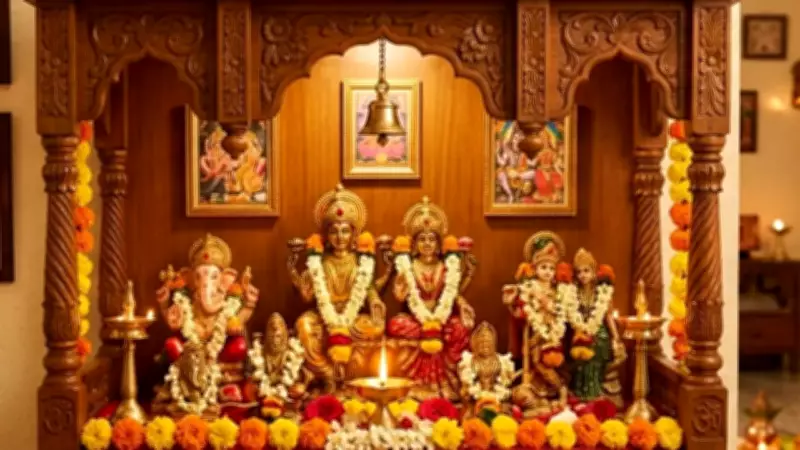
Many of us carry an India-sized idea of a puja room, then feel guilty when our reality is a rented flat, shared bedroom, or a living room that becomes a homework zone by 6 pm. Start with a compact altar you can keep clean and undisturbed. A small shelf, a tray on a high cabinet, or a corner table is enough. If you have toddlers, go higher than you think you need. If you share space with roommates or extended family, choose a spot that will not become a dumping ground for keys and mail. Keep it minimal. One framed image or murti (deity form), one diya (lamp), one small bell, one incense holder, one container for kumkum (vermilion) and chandan (sandal paste), and a notebook. The notebook matters because it holds your rhythm when your brain is tired. If you are building a new home practice, ask your elders what your family sampradaya expects. Some families keep a specific form of Ganesha first, some begin with a guru photo, some keep Shaligram (sacred Vishnu stone) rules that are strict. Do not assume. A five-minute call to an auntie in Ahmedabad can save years of confusion.

Keep the Flame Safe
A diya looks small, but it is still an open flame. In US and UK homes, smoke detectors are sensitive, apartments have strict rules, and kids and pets move fast. If you can safely light a diya, do it with guardrails. Use a heavy metal or clay diya on a steel plate. Keep it away from curtains, paper, and the edge of a shelf. Do not leave it unattended, even for a quick laundry run. If you use camphor (kapoor, a fast-burning offering), keep a lid nearby to smother the flame if needed. If you cannot use an open flame, do not force it. Some families switch to a battery diya for weekday mornings and reserve a real flame for weekends when an adult can watch it. That is a pragmatic adaptation, not a claim of equivalence to agni (sacred fire) in canonical ritual. If your family tradition insists on a real flame for certain days, keep those for when supervision is possible. Also, consider the smoke reality. Incense can trigger allergies. A simple unscented diya and a clean altar can feel more sattvik (pure, balanced) than a room full of perfume that gives your child a headache.
Build a Rhythm You Can Repeat
Consistency beats intensity. A weekly rhythm works when weekdays are short and weekends are deeper. Here is a simple structure that respects real schedules.
Step 1: Choose Your Non-Negotiable Minute
Choose one minute that happens most days. It could be right after brushing teeth, or just before leaving for school, or after the last Zoom call. Stand at the altar, fold hands, and say one line. Even “Om” (sacred sound) three times counts. This is not a full puja. It is a daily touchstone.
Step 2: Set One Longer Weekday Pause
Pick a day that already has some meaning in your household. Monday for Shiva, Tuesday for Hanuman, Friday for Devi, as per some traditions. Keep it to ten minutes. A diya, a short mantra (sacred chant), and one offering like fruit or a spoon of milk. If you do not know mantras, do not invent Sanskrit. Use a simple nama japa (name repetition), like “Om Namah Shivaya” (salutations to Shiva) or “Om Namo Narayanaya” (salutations to Vishnu), if that fits your family practice.

Step 3: Make the Weekend Your Home-Temple Slot
Pick Saturday evening or Sunday morning. Keep it predictable. This is when you can do a longer aarti (lamp offering with song), read a short story from a text your family respects, or watch an online satsang (spiritual discourse) together. If you do visit a local temple, let the home rhythm support it rather than compete with it. Many diaspora temples are busiest on weekends, parking is tight, and kids melt down. A home rhythm means you can still feel connected even when you skip a week.
Check Timings for Your City
In the diaspora, timing is where people get quietly discouraged. A vrat (religious fast) date in India can shift by one day in the US or UK depending on tithi (lunar day) and sunrise. If you are doing Ekadashi (the eleventh lunar day fast) or any tithi-based observance, use a city-specific panchang (Hindu calendar). Some online calendars now publish global parana (fast-breaking) timings for devotees abroad, and you will find Ekadashi 2026 date lists and parana windows that vary by location. One widely circulated listing places Apara Ekadashi in 2026 on May 13, with parana timing to be checked by sunrise in your city. Treat that as a prompt, not your final answer. Confirm with a local temple calendar, or a panchang that lets you select London, Birmingham, New York, New Jersey, Chicago, Seattle, or your nearest city. Diaspora temples often publish their own annual calendars too, because they are coordinating priests, hall bookings, and community schedules. For example, some US temples release downloadable 2026 calendars for their region. If your nearest temple has one, use it. It is built for your timezone.
Use Online Practice as a Bridge
A livestream is not the same as being in the garbhagriha (sanctum). The smell of camphor, the crowd energy, the darshan (seeing and being seen by the deity) feeling, it is different. Still, online can carry your week when you cannot drive. Use audio and video in a disciplined way. Put one playlist on your phone that is only for prayer. Keep it short. A Suprabhatam (morning hymn) track, one aarti, one stotra (hymn). If you have kids, let them choose one track for the week, then keep it consistent so it becomes muscle memory. If your family has a guru parampara (lineage), check whether the matha (monastic seat) or temple streams daily rituals. Many do, and timezones are manageable if you pick one weekly slot. UK families often find India morning streams land around midday. US families may prefer evening India streams that land in their morning. This is a pragmatic bridge. It supports bhava (feeling, devotion), but it does not replace temple attendance if your tradition requires specific samskaras (life-cycle rites) with a priest.
Adapt Without Pretending Equivalence
This is where clarity helps your heart. You can adapt without pretending. Gangajal (Ganga water) is the classic example. Many diaspora homes do not have it, or they save a tiny bottle for years. If you have it, use it sparingly. If you do not, many families use clean water, sometimes with a tulsi (holy basil) leaf, as a practical stand-in. Do not announce it as scripturally identical across all sampradayas. If your family priest insists on Gangajal for a particular rite, plan ahead. Some temples and Indian grocery stores in the US and UK stock small bottles, and some families ask visiting relatives to bring sealed bottles. Same with flowers. Fresh marigolds are easy in parts of the US, harder in many UK towns. A simple fruit offering and a clean altar can be better than stale flowers that drop petals everywhere and attract insects. If you want a scaled-down yagya (fire offering), be careful. A full homa (Vedic fire ritual) has rules, mantras, and safety requirements. A pragmatic home version can be as simple as lighting a small ghee diya, offering a pinch of rice mentally, and chanting a short mantra with focus. Call it what it is, a home prayer with a flame, unless your priest has given you a specific method.
What Changes and What Does Not
Canonical ritual stays canonical. If your tradition says a naming ceremony, thread ceremony, wedding, or funeral rite requires a qualified pandit (priest) and specific steps, treat that seriously. Plan travel, coordinate with a local temple, or bring a priest to your home if your community offers that. Family custom stays precious. The way your grandmother did Friday Lakshmi puja, the particular bhajan (devotional song) your father sings, the one sweet your family offers on Janmashtami (Krishna’s birth festival), these are not “small.” They are how children learn belonging. Pragmatic adaptation is real, and it is allowed, but it is not the same category. Battery diyas on weekdays, online aarti, using local apples instead of the mangoes you grew up offering, moving a puja to Sunday because of school, these are adjustments so practice can continue. Keep the honesty. It protects your respect for tradition.
Put the Rhythm on the Family Calendar
If it is not scheduled, it will not happen. Put your weekly home-temple slot on the shared calendar the same way you put piano lessons. Make it visible. Choose a time that works across households. UK families often find Sunday mornings get eaten by sports, birthday parties, and grocery runs. Try Saturday early evening. US families with long commutes might prefer Sunday right after breakfast. Keep it short enough that teens will not revolt. Keep it steady enough that younger kids expect it. Let them help. One child rings the bell, one offers fruit, one switches on the audio. Then, once a month, plan a temple-visit alternative for the week you cannot go. Dress a little nicer at home. Cook one prasad (offering food) item. Call grandparents on WhatsApp after aarti so kids can show the altar for thirty seconds. Small, but it holds. When you are done, leave the altar tidy, wipe the plate, and set the next week’s matchbox or lighter in the same place, ready for the next Saturday, when the house is loud and the world is busy and you still light one steady flame.
About the Author
AstroDevam is a premium organisation providing ancient and authentic knowledge of Astrology, Vastu, Numerology, and Innovative Corporate Solutions with a contemporary perspective. AstroDevam, having patrons in more than 100 countries, has been promoted by Achary Anita Baranwal and Achary Kalki Krishnan, who not only have Master's Degrees in Astrology, but are engaged in teaching Scientific Astrology, Vastu, and Numerology for more than three decades.