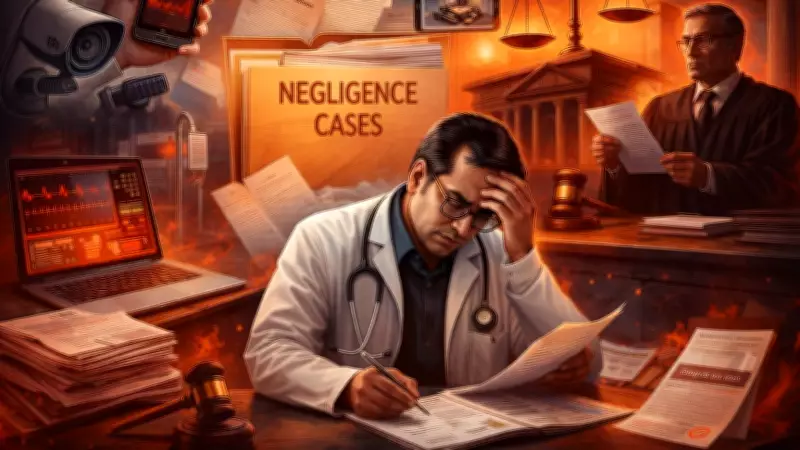
65,000 Medical Negligence Cases Filed in 2025: A Litigation Surge in Healthcare
India's healthcare sector witnessed a staggering 65,000 medical negligence cases filed in 2025 across State High Courts, the Supreme Court, and the National Consumer Disputes Redressal Commission (NCDRC). This data, presented by Supreme Court advocate Mahendra Bajpai at the 18th Annual MedLegal Review held at Dr. DY Patil College of Law, Navi Mumbai, on February 6, signals a sharp rise in litigation that extends far beyond traditional consumer forums.
Shift in Litigation Focus: From Clinical Errors to Administrative Failures
Bajpai emphasized that the focus of medical negligence litigation has decisively shifted away from clinical errors. Paperwork lapses, administrative failures, and gaps in digital records are now increasingly triggering compensation awards and even criminal proceedings. "Every piece of paper, every digital record, is potential evidence," he stated. Courts are no longer limiting scrutiny to surgical mistakes or misdiagnosis; instead, ICU charts, consent forms, discharge summaries, and administrative records often play a decisive role in establishing liability.
Digital Evidence and Privacy Concerns Gain Prominence
Digital material, including audio recordings, mobile phone videos, and CCTV footage, is now routinely accepted as primary evidence in these cases. Confidentiality breaches are also drawing closer judicial attention, with doctors held accountable for sharing patient information without consent. Telemedicine practices face heightened risks, as remote instructions are closely examined and, in some instances, initially treated as serious criminal liability before higher courts intervene.

Citing recent rulings, Bajpai provided examples:
- An audio clip of a 91-year-old pleading to go home influenced a case outcome.
- A mobile video showing a patient lying unattended after a fall led to liability.
- CCTV retention policies were contested, with higher courts siding with hospitals.
Increased Scrutiny on Hospital Administrators and Emerging Trends
Hospital administrators are under greater scrutiny, though courts have clarified that liability applies only if they directly authorize a wrongful act, ignore a foreseeable risk, or fail in non-delegable duties. Telemedicine cases have highlighted this distinction, with one matter seeing criminal charges quashed after higher court intervention.
Former Bombay High Court judge Justice M.L. Tahalyani noted that litigation is rising even as unqualified practitioners, or "quacks," often evade legal action due to their scattered presence in informal settings. Another emerging trend involves disputes where doctors themselves are patients; courts have ruled that specialists must still provide proper counseling and follow-up, not relying solely on consent forms.
Statutory Reporting and Confidentiality Disputes Add to Legal Burden
Bajpai flagged prosecutions linked to statutory reporting obligations, such as failing to report pregnancies in minors, even when ages are misrepresented. Confidentiality disputes are gaining traction, with courts reiterating that maintaining secrecy is a doctor's duty and a patient's right. Despite these protections, cases against doctors continue to rise in consumer courts, adding to the overall litigation burden.
Growing Anxiety Among Medical Professionals
Dr. Shreekant Shetty, editor of Medical Law Cases for Doctors, expressed growing anxiety within the profession. "Doctors are struggling with loopholes in the law. What was once considered a clinical judgment is now treated as negligence," he said. The fear extends beyond losing cases to reputational damage, criminal prosecution, and the burden of defending oneself in multiple forums. Concerns also arise about disputes spilling onto social media, where narratives can be easily manipulated, especially with AI.

Data Insights: Underreporting and Public Trust
Data from the government's e-Jagriti consumer portal shows that by mid-November 2025, 1.35 lakh cases were filed and 1.31 lakh disposed of across sectors, including medical, insurance, and banking. Of these, 68,048 cases were filed during 2025. Medical disputes constituted only about 2.2% of this total. However, when cases from High Courts, the Supreme Court, and the NCDRC are included, the number jumps to 65,000 in 2025, indicating that consumer portal data underreports the true scale of litigation against doctors and hospitals.
Bajpai concluded, "Public trust in healthcare systems is fragile; courts must guard it without crushing the very hands that heal." This comprehensive review underscores the evolving legal landscape in India's healthcare sector, driven by administrative lapses and digital advancements.