

Telangana's Jeevandan Program Expands with Pioneering Hand Transplant Initiative
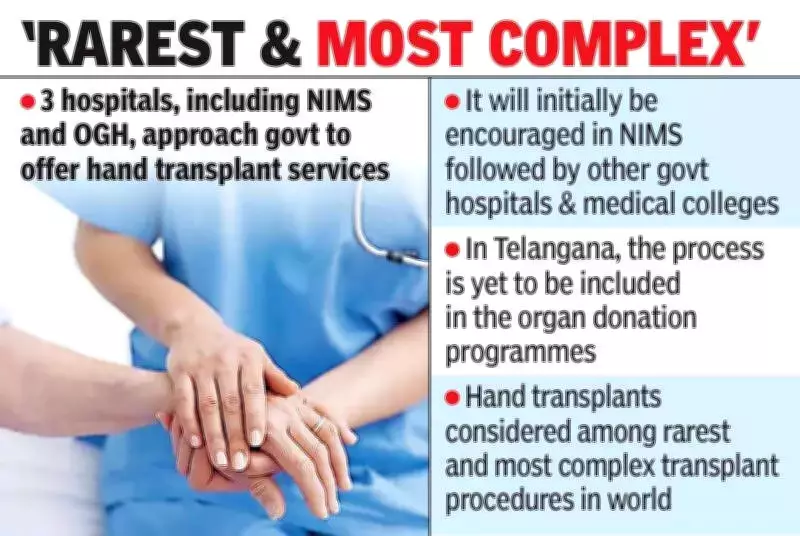
In a significant development for medical services in the region, the Telangana government's flagship organ donation program, Jeevandan, is poised to introduce hand transplantations this year. This move comes amid rising demand and ongoing deliberations to potentially include pancreas transplantation in the future, marking a major expansion of the state's healthcare capabilities.
Government Hospitals Gear Up for Complex Procedures
According to official sources, three prominent hospitals, including Nizam's Institute of Medical Sciences (NIMS) and Osmania General Hospital (OGH), have formally approached the government to offer hand transplant services. The initiative will be initially encouraged at NIMS, with plans to extend it to other government hospitals and medical colleges across Telangana. This expansion will follow protocols successfully adopted in neighboring states like Kerala and Tamil Nadu, though hand transplantation has not yet been integrated into Telangana's existing organ donation programs.
A senior doctor familiar with the matter emphasized that Jeevandan has been actively urging government hospitals to participate as organ retrieval centers. "It happens frequently in other states. NIMS, Osmania, and some private hospitals are not registered so far. Doctors approach us. Once we start doing it, it will happen more. Each organ donation can potentially save up to eight lives, yet a significant number of organs go unused," the doctor noted.

Hand Transplants: A Rare and Complex Frontier
Hand transplants are recognized as among the rarest and most complex transplant procedures globally, requiring highly specialized surgical teams and extensive long-term rehabilitation. Dr. Gopinath Bhandari, a hand and micro surgeon at Apollo Hospitals, explained that hand transplantation involves a composite tissue graft, unlike single solid organ transplants such as hearts or kidneys. "A hand transplant includes bones, muscles, nerves, blood vessels, skin, and tendons, each behaving differently. The hand has nearly 25 muscles, all of which must be repaired, making it a highly time-consuming and demanding procedure," he added.
In India, the country has emerged as a global leader in hand transplantation, performing over 70 such procedures due to factors like higher accident rates and a large population. This number represents the highest worldwide, with fewer than 200 hand transplants conducted globally to date. At Apollo Hospitals alone, 15 patients are currently registered for hand transplantation, including cases of single-hand loss and bilateral amputations.
Telangana's Impressive Organ Donation Record
In 2025, Telangana achieved a notable milestone in organ donation, recording 205 deceased (cadaver) donations under the Jeevandan program. This performance translates to an organ donation rate exceeding five per million population (pmp), significantly above the national average of 0.8 pmp. These donations facilitated the transplantation of 758 organs and tissues, including:
- 291 kidneys
- 186 livers
- 95 lungs
- 32 hearts
- 154 corneas
While Tamil Nadu leads nationally with nearly 150 hospitals involved in organ donation, Telangana has fewer than 25. "Despite this, considering our population of around 4 crore, our performance is encouraging," the senior doctor observed.
Challenges and Alternatives in Upper-Limb Care
Doctors have also highlighted the limitations of upper-limb prostheses, which often feel heavy even when designed to be lightweight, leading to poor usage rates. Dr. Bhandari pointed out that "Unlike lower-limb prosthetics, hand prostheses lack sensation, which makes functional use difficult. Hands are the eyes of the upper limb—without sensation, function is incomplete." The cost of upper-limb prostheses varies widely, ranging from approximately ₹60,000 to ₹40 lakh, depending on the type and technology employed.
As Telangana moves forward with these advanced transplant services, the focus remains on enhancing accessibility and efficiency in organ donation, potentially saving more lives and improving patient outcomes across the state.






