

Gurgaon's Healthcare System Strained as Civil Hospital Replacement Stalls
In Gurgaon, a critical public healthcare crisis is unfolding as the city's only civil hospital remains demolished without a replacement, forcing residents to rely on an overburdened alternative facility. The situation highlights systemic failures in infrastructure planning and patient care.
Patient Struggles Amid Hospital Demolition
Ramesh Prasad, a resident of Basai, recently faced this crisis firsthand when his 34-year-old wife, Kamla, developed influenza-like illness symptoms persisting for 20 days. As a shop worker in Sadar Bazar with limited means, Prasad brought her to the Sector 10 district hospital at night, hoping for specialist care. However, the facility, overwhelmed by demand, referred Kamla to Delhi's Safdarjung Hospital due to suspected pneumonia and other lung diseases, citing no available beds.
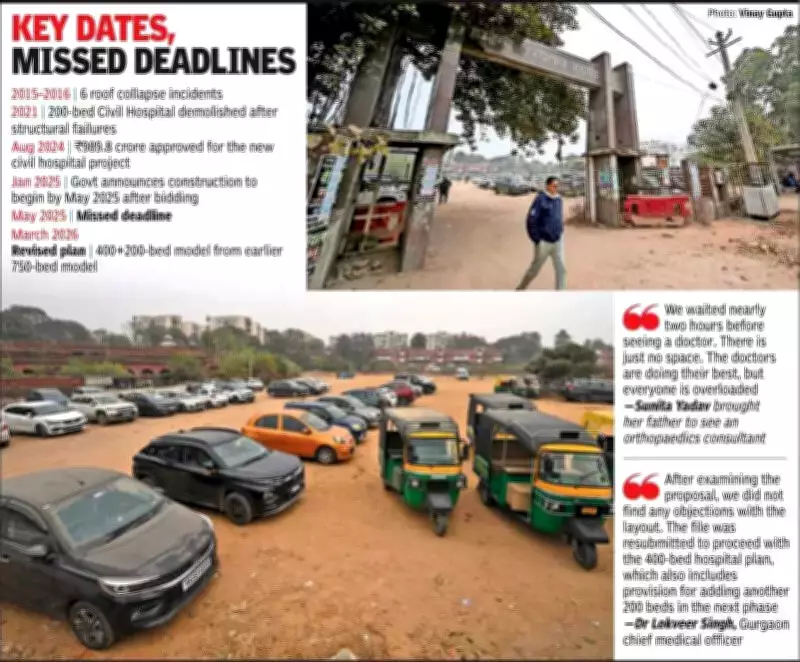
Originally, the family would have sought treatment at Gurgaon's Civil Hospital, a government-run institution intended to serve as the backbone of public healthcare. But that hospital, once spread across 7.73 acres in Civil Lines, was demolished in 2021 after repeated structural failures, including roof collapses in the maternity ward and ICU between 2015 and 2016. The site now lies in ruins, reduced to a chaotic parking lot filled with vehicles from Sadar Bazar, construction debris, broken concrete slabs, and stray dogs, with vendors informally occupying corners during the day.

Four-Year Delay in Reconstruction
Despite announcements by the Haryana government to replace the 200-bed facility with a new hospital, construction has not begun even four years later. The project, first proposed in the 2019 state budget as a 400-bed facility and later expanded to 750 beds, has settled on a phased 400+200-bed model. In August 2024, the state government approved Rs 989.8 crore for the project and released Rs 60 crore as the first instalment, with architectural plans including a multi-block complex with CT-MRI facilities, oncology and radiology departments, and specialized laboratories.
However, timelines have repeatedly slipped. In January 2025, a revised schedule indicated work would start by May after bidding, with the central public works department as the executing agency. Earlier, health officials had tentatively pointed to the end of 2025 for construction commencement after design approval and an increase in floor area ratio to accommodate higher capacity. None of these deadlines have materialized, leaving the project in limbo.
Sector 10 Hospital Overwhelmed by Dual Load
With services from Civil Lines shifted to the Sector 10 government hospital over a year, this facility, originally a 100-bed unit, now effectively accommodates two hospitals in one, serving a city it was never designed for. Doctors report handling up to 3,000 outpatient department patients daily during peak seasons, with severe infrastructure and staffing mismatches. Gurgaon lacks a government burn ward, forcing even moderate cases to be referred to Delhi, and has no dedicated dengue ward, exacerbating seasonal disease surges.
Ultrasound services shut after 3 PM daily, leaving patients returning without scans after hours of waiting. A sanctioned 100-bed block on the premises, approved in 2020, remains incomplete after design alterations from four to five floors without financial approvals. Dr. Lokveer Singh, Gurgaon's chief medical officer, noted that referrals have increased, and departments function with limited depth as specialists rotate across facilities, with a partial handover hoped for by March 2027.
Patients and Experts Voice Concerns
Sunita Yadav, who brought her father for orthopaedic consultation, described waiting nearly two hours due to overcrowding, noting that doctors are overloaded despite their best efforts. Amitesh Singh, accompanying his 62-year-old mother for post-fracture follow-up, highlighted exhausting routine visits with long lines and no seating for elderly patients. Hospital data shows about 106 doctors for roughly 130 functional beds, but the patient load far exceeds capacity.

Former Haryana director of health services DB Saharan emphasized that the problem has been years in the making. "The city has grown, but public healthcare has not," he said. "Sector 10 was never meant to function as the main civil hospital. Gurgaon demolished its only civil hospital. The replacement is not built. And the one government hospital that remains is packed every day."
This ongoing crisis underscores a broader failure in public health infrastructure, leaving residents like Prasad and Kamla with limited options and highlighting urgent needs for accountability and action in Gurgaon's healthcare system.





