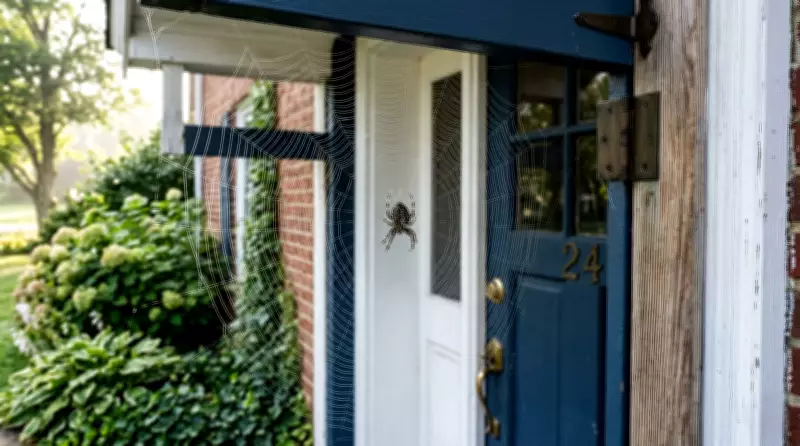
You step out in the morning, coffee in hand, and walk right into a spider web perfectly stretched across your door. Again. You clean it out, and in a day or two, for some reason, there is another one. It starts to feel personal.
It is not personal, but it is deliberate. Just not in the way you think. Spiders are not just accidentally stumbling into your entryway. This is a calculated move, and your front door, as commonplace as it is, may be one of the most strategically valuable real estate spots in your entire yard.
Your Front Door Is a Buffet for Spiders
The fact is that spiders build where the food is. This is the entire logic, and your front door ticks a surprising number of boxes. Front doors are natural choke points, constricted spaces where air, light, and movement all flow. Flying insects, especially moths, gnats, and flies, tend to follow lights and air currents. You might not realize that if you have a porch light, a lit hallway, or even a bright window by the entrance, you are running an insect welcome sign. A study published in Peer J found that orb-weaving spiders living in artificially lit areas captured significantly more prey, and that the larger the web, the more prey was caught. This means that a spider hanging around your porch light is not just chilling; it is taking advantage of the insects your lighting attracts.

This makes your threshold one of the most efficient hunting grounds for the spider. It is not open wilderness; it is a narrow ecological funnel that insects are already moving toward.
A Doorway Is Actually Great Hunting Ground
Apart from the food factor, your door frame is actually solid infrastructure from a spider's point of view. The classic spiral-type orb webs are not just sticky traps. These are tensioned structures and need strong anchor points to be effective. Door frames, corners, siding edges, and even decorative trim provide rigid attachment points where webs can hold their shape and absorb impact without tearing. Research on anchor threads has found that webs with good access to anchors catch more impacts and absorb significantly more energy than those with limited anchoring. In real terms, that means a spider using your door frame is building a more effective trap than one hanging between two branches.
Those daily gusts when you open and close the door? Not as big a deal breaker as you would think. Spiders respond to air currents by changing the geometry and tension of their silk. A small draft does not shut down the entire operation; it just requires a recalibration.
The Web Is a Trap, but It Is Also a Listening Device
This is the part that really makes you rethink spider webs. They are not just passive. When a bug strikes the silk, vibrations are transmitted along the structure back to the spider. The web is an extension of the spider's senses, a way of detecting motion before anything can be seen. A doorway is a rich sensory environment, with air moving through it and small creatures constantly passing through. To fill that space with silk means the spider is not just waiting for something to blunder in; it is watching a live feed of everything that crosses that line. The web is both a trap and an early warning system, all in one.
So, Is There Something Wrong with Your House?
Not quite, but close enough to mention. If you see a spider repeatedly showing up at your front door, it is probably because there is enough insect activity there to make it worth the effort. That could mean standing water nearby, heavy landscaping near the entrance, or outdoor lighting that stays on all night. You can reduce insect attraction by using yellow or sodium-vapour bulbs on porch lights. Shrubs at the doorway should be trimmed back so that protected passageways are not provided for insects and spiders. Sealing small gaps in door frames reduces the micro-drafts that can make an entryway prime hunting territory.

The Spider Is Not Haunting You
A doorway web is an easy omen to read, especially at Halloween, but the biology is pretty simple. Your entrance has good anchors, good airflow, proximity to light, and a steady flow of flying insects. For a spider, that is not a door; that is prime hunting ground. The web going up again and again is not stubbornness or spite. It is just a little predator that has a very accurate read on its environment and finds that your front door keeps passing the test.