Vijayawada Municipal Corporation Launches Aggressive Road-Washing Campaign to Combat Air Pollution
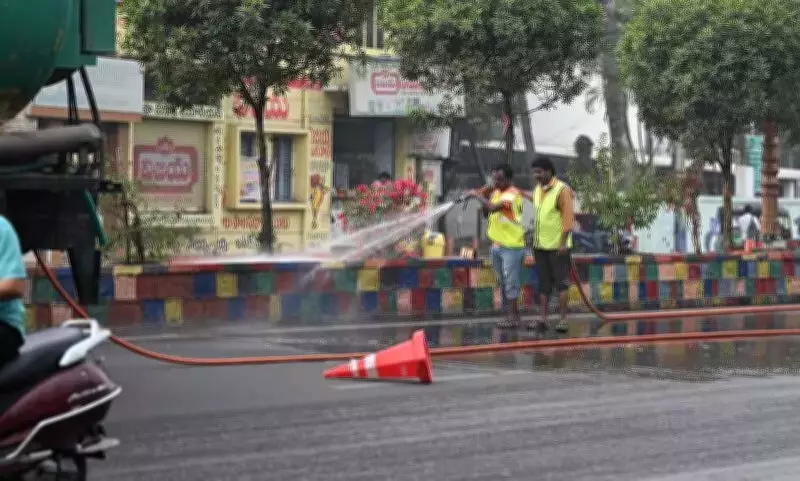
In a decisive move to address escalating air pollution concerns, the Vijayawada Municipal Corporation (VMC) has rolled out an innovative road-washing initiative targeting the city's busiest thoroughfares. This strategic intervention aims to maintain the Air Quality Index (AQI) within satisfactory parameters by actively suppressing dust particles and various atmospheric pollutants through systematic cleansing operations.
Targeting Pollution Hotspots on Major Corridors
The municipal body has identified and prioritized key junctions along MG Road (commonly known as Bandar Road) and Karl Marx Road (referred to as Eluru Road) for intensive washing protocols. These arterial roads experience exceptionally heavy vehicular traffic, including frequent VIP movement, contributing significantly to particulate matter accumulation.
"Beyond the primary corridors, our teams have extended operations to other high-traffic zones including Swathi Road and Sitara Junction," confirmed Dr. K Arjuna Rao, VMC's Chief Medical and Health Officer. "This comprehensive approach ensures we address multiple pollution hotspots simultaneously."

Operational Details and Resource Deployment
The VMC has mobilized a specialized fleet of water tankers specifically for this environmental initiative. Currently, four dedicated tankers with 4,000-liter capacities operate continuously, with capacity occasionally expanded to eight vehicles during peak requirement periods. These tankers perform regular washing cycles along designated routes to minimize dust resuspension.
"Commissioner HM Dhyanachandra has emphasized that regular road cleaning using water suppression represents our most immediate and effective strategy for air quality improvement," Dr. Rao elaborated. "We've developed a structured action plan to ensure all 64 municipal wards receive attention at least once every two weeks."
Data-Driven Response to Seasonal Pollution Patterns
Municipal officials revealed that this initiative emerged from meticulous analysis of winter air quality data. During December and January monitoring periods, Vijayawada's AQI frequently deteriorated into the 'poor' category, primarily due to elevated concentrations of fine particulate matter (PM2.5) and carbon monoxide (CO).
"The winter months presented particular challenges with pollutant accumulation," explained a VMC environmental officer. "Our data clearly indicated that road dust combined with vehicular emissions created hazardous conditions requiring immediate intervention."
Expansion Plans and Measurable Outcomes
The corporation is already planning infrastructure enhancements to amplify the program's impact. Proposed upgrades include increasing the tanker fleet size and enhancing individual vehicle capacity from 4,000 to 8,000 liters, enabling broader geographical coverage and more frequent washing cycles.
Preliminary results demonstrate promising effectiveness. For the past fortnight, Vijayawada has consistently recorded 'satisfactory' AQI readings, with February monitoring showing no significant spikes in PM2.5 or CO concentrations—the city's two primary pollutants.
"The correlation between our washing operations and improved air metrics is becoming increasingly evident," Dr. Rao noted. "While long-term solutions require multi-pronged approaches, this immediate measure is delivering tangible benefits for public health and environmental quality."
This proactive municipal response represents a model for urban centers grappling with similar air quality challenges, demonstrating how targeted infrastructure maintenance can yield measurable environmental improvements when implemented systematically and monitored rigorously.