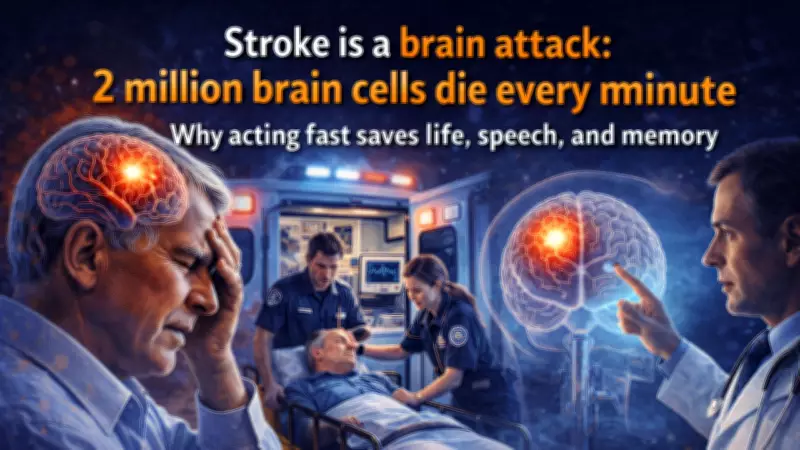
Stroke: A 'Brain Attack' Where Every Minute Counts
Imagine your phone rings unexpectedly in the afternoon. On the other end, a friend's voice sounds slurred and confused, filled with panic but unable to explain what's happening. This sudden, terrifying scenario is often how a stroke announces itself—a medical emergency that leaves no time for hesitation. When you call for help, you're not just responding to an event; you're racing against one of medicine's most aggressive timers.
The Fragile Brain: A Cellular Catastrophe
Dr. Vikrant Setia, Consultant in Neurosurgery and Neurointervention at Manipal Hospital, Gurugram, emphasizes that a sudden stroke should be treated as a 'brain attack.' He explains, "Just as a heart attack starves the heart of oxygen, a stroke occurs when the blood supply to a specific part of the brain is suddenly cut off." The brain's dependence on blood flow is absolute, with no tolerance for interruption.
When a blood clot blocks an artery or a vessel ruptures, the result is devastating. During an acute ischemic stroke without treatment, the brain loses approximately 4 million neurons, 12 million brain cells, and 15 billion synapses every minute. This isn't a slow decline; it's an immediate, catastrophic loss. A large-scale study from the American Stroke Association quantified this damage, showing that in a typical large vessel ischemic stroke, each minute results in the loss of:

- 1.9 million neurons
- 13.8 billion synapses
- 12 km (7 miles) of axonal fibers
Dr. Setia crystallizes the impact: "During a stroke, nearly two million brain cells die every single minute. This rapid damage directly attacks our most vital functions, potentially causing sudden loss of speech, memory clouding, or paralysis on one side of the body."
The Narrow Window: Hours, Not Days
Stroke treatment operates within a narrow therapeutic window, making urgency a lifeline. The sooner treatment begins after symptoms start, the better the outcome. For hemorrhagic strokes, where a blood vessel ruptures, the situation is even more critical, often requiring immediate surgery to stop bleeding and save lives.
Dr. Setia states plainly: "Stroke recovery is dictated by the clock. Modern treatments like mechanical thrombectomy or surgery are highly effective but have a very narrow window. Delaying means losing the ability to walk, talk, and live independently."
Irreversible Loss: Why Time is Brain
Unlike a heart attack, where muscle can heal, brain cells do not regenerate once they die. This irreversible loss underpins the emergency medicine mantra "time is brain." Every minute without treatment translates to permanent damage. A person treated 30 minutes after stroke onset may have a vastly different outcome than someone treated four hours later, with potential losses including speech, mobility, or recognition of loved ones.
Immediate Action: Your Most Critical Decision
Doctors and paramedics stress the importance of calling for medical help immediately upon noticing stroke symptoms. Look for sudden signs such as:
- Balance issues
- Vision loss
- Face drooping
- Arm weakness
- Speech difficulty
- Time to call emergency services
Remember the acronym BEFAST to guide your response. Dr. Setia advises, "Recognizing warning signs and acting instantly is crucial. Every moment saved preserves a piece of someone's personality or capability. Treat a stroke with the same urgency as a heart attack—time lost is function lost."
The difference between recovery and lifelong disability often hinges on minutes. That single decision to call for help immediately, rather than waiting, can determine whether someone regains full function or faces permanent challenges.
Expert Insights
This article incorporates expert inputs from Dr. Vikrant Setia, Consultant—Neurosurgery and Neurointervention at Manipal Hospital, Gurugram, highlighting the critical importance of medical promptness in stroke response to save lives and prevent disability.