

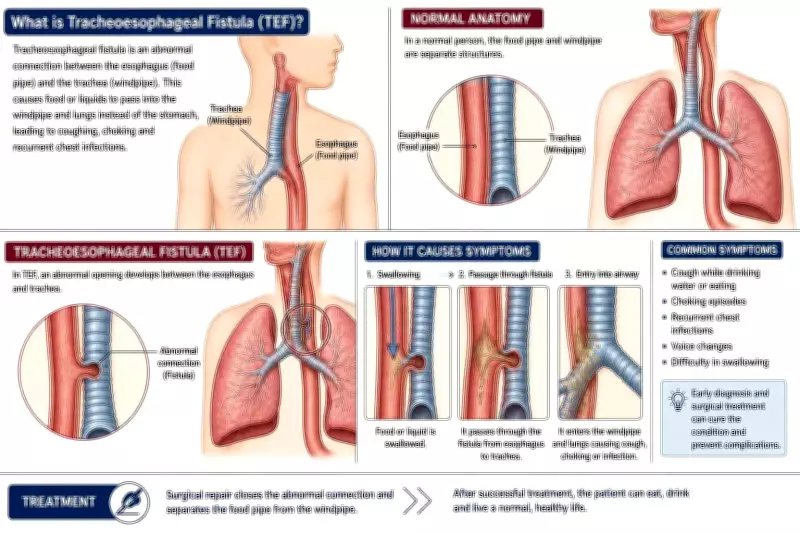
A 32-year-old man in Pune, who had been experiencing a persistent cough and a sensation of choking when drinking water, was diagnosed with a tracheo-esophageal fistula. This condition is typically observed as a congenital defect in newborn infants, and its occurrence in an adult is considered exceptionally rare, according to medical experts.
Rarity of the Condition
Some doctors noted that this rare congenital condition is usually diagnosed within the first two years of life. However, this man managed to survive into adulthood without detection. General and laparoscopic surgeon Dr Chetan Mhaske of Mhaske Hospital, who performed the surgery, explained: “The man appeared physically robust and was able to perform daily activities without difficulty. When a basic task like sipping water became distressing, he finally came to our hospital. We examined him and performed a gastroscopy immediately. The diagnosis of a tracheo-esophageal fistula was shocking. Simply put, it is an abnormal passage formed between the food pipe (esophagus) and the windpipe (trachea).”
How the Condition Affected the Patient
Dr Mhaske elaborated that due to the fistula, whenever the man drank water, it would flow directly from the food pipe into the windpipe and then into the lungs, causing a sensation of suffocation. “The condition could have led to a severe lung infection (pneumonia) and potentially resulted in the patient’s death, had it not been treated in time. The diagnosis was confirmed conclusively through a CT scan and bronchoscopy,” he added.

Surgical Challenges and Procedure
The patient was admitted on January 21 and underwent surgery the following day. Oncosurgeon Dr Mahesh Pawar described the surgical procedure as being as complicated as the ailment is rare. He highlighted the extreme challenge of managing the tracheo-esophageal fistula, especially because the patient had a previous history of accidental corrosive substance ingestion. This had caused severe chronic inflammation and dense adhesions in the neck region.
“The fistula tract and the esophagus were densely stuck to the trachea, making identification and separation exceptionally delicate,” Dr Pawar said. “We carefully separated the esophagus from the trachea while preserving the paper-thin posterior wall of the trachea. Any additional injury to this fragile area could have necessitated a temporary or even permanent tracheostomy, which carries long-term morbidity, especially in a young patient.” Another major challenge was safely dissecting and preserving the important neck vessels that were adherent due to chronic inflammatory changes. After complete separation, the esophagus was repaired in multiple layers, and the posterior tracheal wall was reconstructed with surgical precision.
Reinforcement and Recovery
Plastic surgeon Dr Amit Mule explained that merely closing the perforation (fistula) was not sufficient. “We provided additional structural reinforcement to the area by utilising a muscle flap to ensure the site would not reopen,” he said. The windpipe and food pipe were successfully separated and repaired after hours of tireless effort.
The man’s health showed remarkable improvement within just a few days of the surgery, and he was discharged soon after. A CT scan revealed that the dangerous fistula had closed completely, ensuring a routine life for the man by March 6. During his last follow-up on May 5, he showed no signs of recurrence.






