Rajasthan's Cashless Medicine Scheme Faces Major Disruption as Hospitals Suspend Services
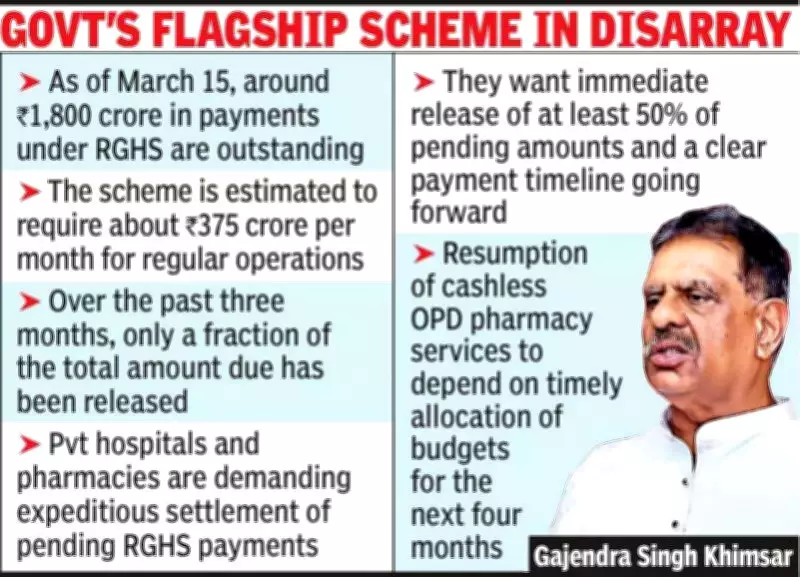
Jaipur: Rajasthan's flagship cashless medicine network under the Rajasthan Government Health Scheme (RGHS) is headed for significant disruption starting Wednesday, with the Rajasthan Alliance of Hospital Associations (RAHA) announcing the suspension of cashless medicine distribution at OPD pharmacies in private hospitals across the state. The decision comes as a direct response to unpaid dues that have accumulated over several months, creating financial and operational challenges for healthcare providers.
Minister Claims Ignorance Amid Growing Crisis
When questioned about this development, Health Minister Gajendra Singh Khimsar stated on Tuesday that he had no knowledge of RAHA's decision to halt service delivery under the scheme. Responding to reporters at a press conference during a World TB Day event at SMS Medical College, Khimsar said, "I am not aware of it; my officials have not told me. I will check with them and resolve the issue."
This statement from the health minister reveals a concerning disconnect at the highest levels of Rajasthan's health administration, even as thousands of beneficiaries face the imminent prospect of losing access to free medicines under a government-backed scheme that was designed to provide essential healthcare support.

Hospitals Issue Ultimatum Over Unpaid Dues
Reacting to the minister's statement, a RAHA office-bearer explained that representatives had met with officials of the Rajasthan State Health Assurance Agency – the government body managing the cashless medicine scheme – and formally notified them through a written letter. The communication clearly stated that cashless medicine facilities at RGHS OPD pharmacies in private hospitals would be suspended from 8 am Wednesday unless immediate relief was provided on pending payments.
The office-bearer emphasized that this difficult decision was taken under pressing circumstances due to persistent delays in government payments over the past several months. These financial constraints have made it increasingly challenging for private hospitals and OPD pharmacies to continue providing cashless medicine distribution, affecting both their financial stability and operational capacity to serve patients effectively.
Minister Announces Overhaul Amid Payment Crisis
Despite his claimed ignorance of the immediate crisis, Minister Khimsar did signal a major overhaul of the RGHS scheme, revealing plans to transition it to an insurance-based model similar to the Mukhyamantri Ayushman Arogya Yojana. He stated that this change was intended to address corruption and abuse within the current system. "I know many people who misuse the scheme will not like it, but this is what we are going to do in the coming days," Khimsar declared during the press conference.
The minister also made claims about the financial performance of the RGHS scheme, insisting that the state government had significantly reduced losses since the health department took control from the finance department in 2025. "We have reduced losses under RGHS by Rs 700 crore since we took over the scheme. We will not tolerate losses," Khimsar asserted, highlighting the government's commitment to financial discipline.
Political Implications and Beneficiary Concerns
These developments occur at a politically delicate moment for the Rajasthan government, which appears to be defending the financial health of a scheme that has simultaneously failed to clear payments to private healthcare providers. The suspension of cashless medicine services threatens to disrupt healthcare access for countless beneficiaries who rely on the RGHS program for essential medications and treatment.
The situation raises serious questions about administrative coordination, financial management, and the government's ability to maintain critical healthcare infrastructure. As private hospitals prepare to implement the suspension, patients across Rajasthan face uncertainty about their continued access to free medicines through a scheme that was established to provide healthcare security to vulnerable populations.