Mumbai Couple's Legal Ordeal Highlights Critical Flaws in India's Abortion Law Framework
A distressing legal battle faced by a Thane couple seeking to terminate a 31-week pregnancy has brought to light significant implementation gaps in India's amended Medical Termination of Pregnancy (MTP) legislation. The case underscores how administrative delays and inconsistent medical board interpretations continue to create barriers for women requiring late-term abortions despite legal reforms.
The Personal Tragedy Behind the Legal Challenge
Abhaya, 37, and her husband Kiran (names changed for privacy) decided to expand their family after their daughter turned eight years old. Their journey was already marked by profound loss—their first-born child died immediately after birth due to meconium poisoning, and Abhaya had previously experienced an ectopic pregnancy.
During the 30th week of her current pregnancy, routine ultrasound screening revealed abnormal skeletal development. Subsequent evaluation at Wadia Hospital confirmed a diagnosis of skeletal dysplasia, a rare disorder affecting cartilage and bone growth. In severe manifestations, this condition causes chest deformities that typically prove fatal shortly after birth.

"Doctors explained our child would suffer from brittle bones, experience repeated fractures, and endure severe chronic pain," Abhaya recounted while recovering from her procedure. "I could not bear the thought of my child experiencing such relentless suffering."
The Medical Board Rejection That Sparked Legal Action
On March 17, the couple approached the medical board at Thane Civil Hospital seeking permission for pregnancy termination. The board delivered its opinion the following day, stating that "considering the advanced gestational age (31+ weeks) and the absence of lethal anomaly, termination of pregnancy is not justified at this stage."
This rejection prompted consultation with prominent gynaecologist Dr. Nikhil Datar, who had previously campaigned to extend India's MTP limit from 20 to 24 weeks. Recognizing the legal grounds for intervention, Dr. Datar assisted the couple in approaching the Bombay High Court.
Contrasting Experiences Between Medical Boards
The High Court directed the couple to the medical board at J.J. Hospital in Byculla, where they underwent comprehensive testing and specialist examination. This board reached a fundamentally different conclusion, determining that the fetal abnormalities met the legal standard for termination beyond 24 weeks under the amended MTP Act.
"The difference between the two boards was stark," Abhaya observed. "Doctors at J.J. Hospital demonstrated genuine sympathy and maintained a non-judgmental approach, unlike our initial experience in Thane." Her husband added, "If accessing this procedure proved so challenging in Thane, which neighbors Mumbai, conditions in smaller cities could be substantially worse."
Systemic Issues in MTP Law Implementation
Dr. Datar performed the medical termination with foeticide in utero on March 30 after court approval. He identified two systemic problems highlighted by this case.
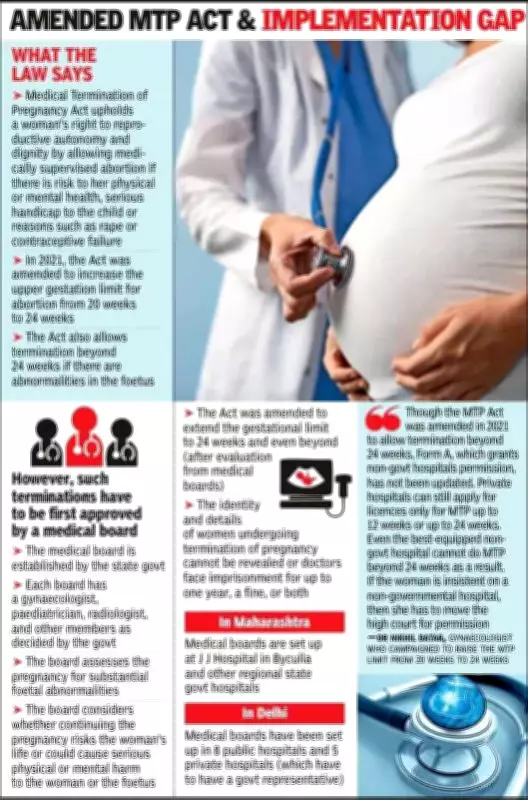
First, inconsistent interpretation of legal provisions: The 2021 amendments extended the gestation limit for certain abortions to 24 weeks and permitted termination beyond that threshold in cases of substantial fetal abnormalities following medical board review. Dr. Datar contends the Thane board failed to properly apply these provisions, noting that the law encompasses serious abnormalities likely to cause severe disability and suffering, not exclusively lethal anomalies.
Second, administrative gaps in regulatory frameworks: Form A, the registration document enabling non-governmental hospitals to conduct MTP procedures, remains unupdated since the law's amendment. Consequently, private hospitals cannot formally obtain approval for terminations beyond 24 weeks, effectively restricting such procedures to government facilities.
"Even the best-equipped non-governmental hospital cannot legally perform MTP beyond 24 weeks due to this regulatory gap," Dr. Datar explained. "Women insisting on private hospital care must petition the High Court for permission."

Broader Implications for Healthcare Access
This case reveals how regulatory inertia creates practical barriers despite legislative progress. While the Maharashtra government maintains that Form A falls under central jurisdiction requiring Union government amendment, central authorities have asserted no amendment is necessary.
Dr. Datar further advocates for expanding medical board infrastructure, suggesting Mumbai should establish multiple boards similar to Delhi's system, which operates across eight government and five private hospitals. Such expansion could reduce geographical barriers and interpretation inconsistencies.
The couple's experience ultimately demonstrates how legal reforms require parallel administrative updates and consistent medical training to achieve their intended purpose of expanding reproductive rights while protecting women's health and autonomy.