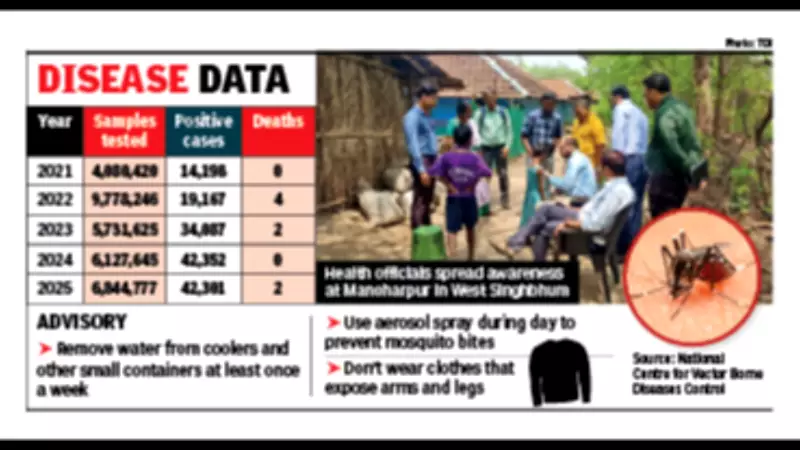
Ranchi: The state has recorded a sharp rise in malaria cases over the past five years, with the surge largely concentrated in districts with dense forest cover, according to data. Nearly 95% of the cases reported annually come from Khunti, Godda, Pakur and West Singhbhum districts.
Challenges in Affected Areas
These districts, marked by inadequate road connectivity, difficult terrain and, at times, a shortage of frontline health workers, continue to report the majority of malaria cases. In response, the health department has initiated measures to ensure the presence of frontline workers and volunteers in forested and hard-to-reach villages, with a focus on promoting behavioural changes among residents to help curb malaria cases.
Health Department Initiatives
“The department has intensified spraying larvicide and distribution of long-lasting insecticide treated nets across the state to prevent people from contracting malaria and other vector-borne diseases. This year, the National Centre for Vector Borne Diseases Control (NCVBDC) selected an NGO, Child In Need India (CINI), to monitor cases in the four malaria-prone districts of Jharkhand. The NGO has engaged volunteers in the villages where sahiyas and village-level health workers are absent, for overall monitoring of malaria cases,” said Birendra Kumar Singh, state programme officer-cum-nodal officer of vector borne diseases.

The NGO’s volunteers are responsible for tracking fever cases in villages and ensuring malaria tests are conducted. “If found positive, the volunteers ensure the patient’s full treatment at the nearest government healthcare centre. They will also conduct mass fever surveys in June during the national anti-malaria month in villages that historically reported a large number of malaria cases,” Singh added.
Monitoring and Progress
He said that engaging the NGO has ensured the presence of volunteers, block, district and state level officers to continuously monitor the situation. “In 2026, till March, around 4,400 malaria cases were detected, which is lower compared to previous years. The majority of malaria cases are reported in hard-to-reach places, difficult terrains, forested and hilly areas. Now, we have planned to provide insecticide treated nets to the residents of these areas to curb malaria cases,” Singh said.
Ram Raj Singh, programme manager of CINI, said that 115 volunteers have been deployed, one in each village under the partnership. “These volunteers are selected from the local community. Besides facilitating early diagnosis and treatment, they also raise awareness among villagers and students about safe practices such as wearing full-sleeved clothes, using mosquito nets, and preventing water stagnation to stop mosquito larvae breeding,” he added.