The Ultimate Sacrifice: Dr. Jesse Lazear's Death Proved Yellow Fever Transmission
On September 25, 1900, Dr. Jesse William Lazear died of yellow fever in Cuba at the age of 34. He left behind a grieving wife in Maryland, a one-year-old son, and a newborn daughter who would never meet her father. Lazear was not a reckless adventurer but a highly trained physician and epidemiologist educated at Johns Hopkins University, working as part of a formal U.S. Army investigation into one of the deadliest diseases of the nineteenth century.
The Extraordinary Circumstances of Infection
What makes Lazear's death extraordinary is this: he allowed himself to be bitten by a mosquito that had previously fed on a yellow fever patient. Whether this infection was fully intentional or resulted from laboratory exposure remains debated by historians. What is beyond dispute is that his illness became pivotal evidence in proving that mosquitoes transmit yellow fever, a breakthrough that fundamentally reshaped global public health and made large-scale engineering projects like the Panama Canal possible.
Yellow Fever: A Disease That Terrified Cities
Yellow fever did not originate in the Americas but emerged in the rainforests of Africa. It was introduced to the Americas in the sixteenth century through European colonization and the transatlantic slave trade. In the so-called "New World," it thrived in the balmy tropical and subtropical regions of South America, Central America, and the Caribbean, where climate conditions and abundant mosquito populations allowed the virus to flourish.

The disease struck with terrifying unpredictability. After an incubation period of roughly three to six days, victims developed:
- High fever and severe chills
- Intense headache and back pain
- Nausea and vomiting
- Liver damage in approximately twenty percent of cases
This liver damage caused jaundice, the yellowing of skin and eyes that gave the disease its name, often followed by internal bleeding. Mortality rates were frighteningly high, and for centuries, devastating outbreaks erupted in port cities worldwide.
The Spanish-American War and Strategic Threat
The Spanish-American War of 1898 forced the United States to confront yellow fever as a strategic military threat. In Cuba, more American soldiers died from yellow fever and malaria than from Spanish bullets. The U.S. Army urgently needed answers about disease transmission.
The Yellow Fever Commission and a Dismissed Theory
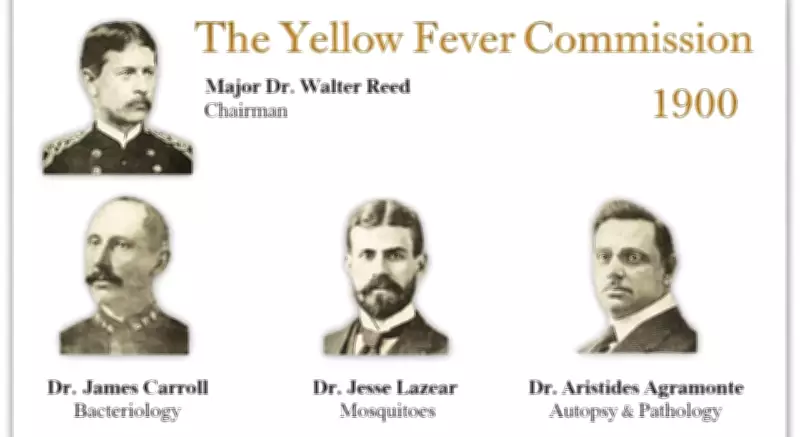
In June 1900, the U.S. Army's Surgeon General dispatched a team to Cuba: Major Walter Reed, Majors James Carroll and Aristides Agramonte, and Dr. Jesse Lazear. Together they formed the Yellow Fever Commission. Initially, they pursued the dominant bacteriological theory that yellow fever was caused by a bacterium called Bacillus icteroides, proposed by Italian researcher Giuseppe Sanarelli.
The Commission investigated this theory thoroughly and concluded that the bacterium was merely a contaminant, not the actual cause of yellow fever. This failure reopened consideration of an older, controversial hypothesis. In 1881, Cuban physician Dr. Carlos Finlay had argued that yellow fever was transmitted not by direct human contact or contaminated bedding, but specifically by mosquitoes of the Aedes genus.
When Finlay presented his hypothesis at the 1881 International Sanitary Conference, he was largely dismissed by the scientific community. The idea sounded speculative and unproven at the time. However, by 1900, scientific thinking had shifted significantly. British and Italian researchers had demonstrated that Anopheles mosquitoes transmit malaria, making vector-borne disease transmission a plausible concept rather than an absurd notion.
Self-Experimentation and the Fatal Bite
Dr. Lazear became convinced that Finlay might be correct. On September 8, 1900, he wrote to his wife: "I rather think I am on the track of the real germ." The Commission's early mosquito experiments, while clumsy by modern standards, were methodical for their time. Lazear had begun breeding Aedes mosquitoes and feeding them on confirmed yellow fever patients.

The team discovered a crucial detail: the mosquito could not transmit the disease immediately after feeding. It required an "extrinsic incubation period" of several days to become infectious. Early attempts to infect volunteers failed because researchers had not waited long enough. When they corrected this timing, results became dramatically clearer.
James Carroll allowed himself to be bitten by a mosquito that had fed on a yellow fever patient and completed the incubation period. Within days, he fell severely ill, surviving only narrowly. To rule out coincidence, a young soldier with no previous exposure to yellow fever was also bitten under controlled conditions. He too developed the disease and recovered.
These cases strongly suggested that mosquitoes were indeed the vector. However, ambiguity remained because Carroll had previously worked in a yellow fever hospital and could theoretically have contracted the disease elsewhere. Then came Lazear's own exposure.
On or about September 13, 1900, Lazear was exposed to a mosquito that had fed on a yellow fever patient after the appropriate incubation interval. Whether this exposure was fully deliberate remains debated. The official account maintained that he was accidentally infected while handling experimental insects. However, Walter Reed later claimed to have found references in Lazear's notebook suggesting intentional self-experimentation. That notebook remained in Reed's possession throughout his career and reportedly disappeared shortly after Reed's death, leaving the question permanently unresolved.
What is not disputed is what followed. Within days, Lazear developed symptoms consistent with yellow fever: fever, malaise, and progressive deterioration. On September 25, 1900, he died in Cuba at age 34.
Camp Lazear and the Experiments That Settled the Question
Lazear's death did not halt the Commission's work; if anything, it sharpened their sense of urgency. In November 1900, they established an experimental station outside Havana named Camp Lazear in his honor. Two simple wooden buildings were constructed to test competing theories of transmission.
In the first structure, known as the "infected clothing building," volunteers slept for weeks on bed linen deliberately soiled with the vomit, blood, urine, and feces of yellow fever patients. This direct attempt tested the long-standing "fomite" theory that contaminated fabrics and objects spread the disease. Remarkably, none of these volunteers became ill.
The second structure was the "infected mosquito building," divided into two chambers by a fine metal screen. On one side, volunteers were exposed to mosquitoes that had fed on yellow fever patients. On the other side, a control group remained protected from insects but shared the same air. Nearly everyone exposed to the infected mosquitoes fell ill, while none in the protected chamber did.
These results definitively ruled out both fomite transmission and airborne "effluvial" spread. The mosquito hypothesis was no longer speculation but scientifically demonstrated fact.
From Discovery to Public Health Revolution
In 1901, Walter Reed and his colleagues published their findings in the Journal of the American Medical Association. Reed's name became synonymous with the discovery, though to his credit, both he and Lazear had acknowledged Carlos Finlay's original insight. It was Lazear's infection and death, however, that gave the theory undeniable weight and urgency.
Scientific proof is one thing; implementation is another. Major William C. Gorgas, the Army's chief sanitarian in Cuba, was initially skeptical but once ordered to act on the Commission's findings, he moved with methodical discipline. His teams:
- Screened patients to prevent mosquitoes from feeding on them
- Drained marshes and covered water containers
- Treated standing water with kerosene to kill larvae
- Aggressively eliminated mosquito breeding sites throughout Havana
The results were swift and dramatic. Havana, which from 1762 until 1901 had averaged at least one yellow fever case per day, was declared free of the disease within ninety days of sustained mosquito control efforts.
Global Implications and Lasting Legacy
The implications were truly global. Yellow fever had long been one of the greatest obstacles to large engineering projects in tropical regions. Controlling mosquito populations would later prove decisive in enabling the construction of the Panama Canal, a project previously considered impossible due to disease mortality. A disease that had haunted port cities for centuries was rendered preventable not initially by a vaccine, but through systematic vector control.
The team's work earned them widespread scientific and public acclaim; they became known as "the conquerors of yellow fever." Walter Reed's tombstone would later be inscribed with the words: "He gave to man control over that dreadful scourge, Yellow Fever." Their contributions were further recognized in the Army Register, where participants were listed annually in a "roll of honor."
Beyond military recognition, the twenty-two members of the establishment involved in the experiments received formal recognition from the U.S. Congress and the President. Living members and the widows of those who had died, including Lazear's widow, were presented with gold medals commemorating their extraordinary contributions to public health. Dr. Jesse Lazear's ultimate sacrifice provided the crucial evidence that transformed our understanding of disease transmission and saved countless lives worldwide.