

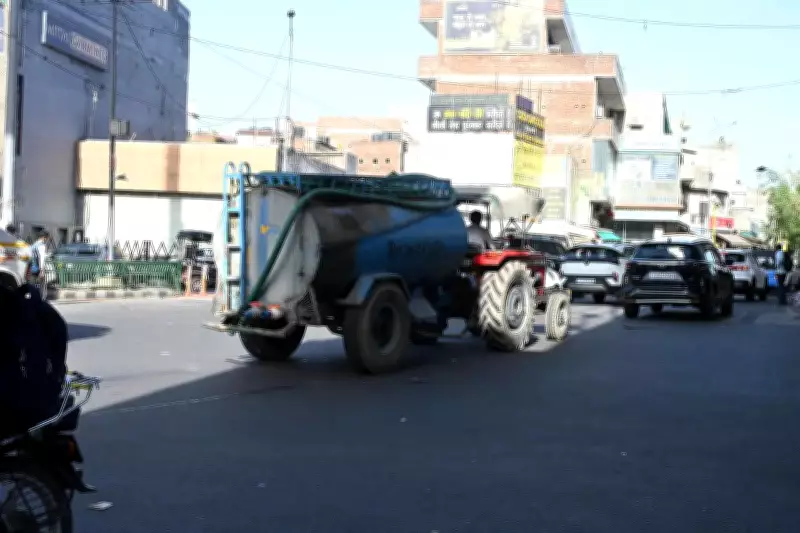
As temperatures in Jaipur reach 40 degrees Celsius, several parts of the city, particularly last-mile localities, are experiencing a severe water crisis. The shortage has significantly increased dependence on private water tankers, with prices skyrocketing well above normal rates.
Residents Struggle with Irregular Supply
Residents in numerous neighborhoods report that water supply has been irregular for days. In areas like Dadi Ka Phatak in Jhotwara, families are finding it difficult to secure enough water for daily needs. Manoj Sharma, a resident of Dadi Ka Phatak, stated, “For the last four to five days, the water supply in our locality has been scarce. To add on, private tankers are charging twice the normal rate.”
High-Rise Apartments Hit Hard
The crisis is more acute in high-rise apartments and residential complexes, where water demand is higher and reliance on groundwater or private tankers is common. With the Public Health Engineering Department (PHED) failing to meet household needs, many societies are forced to spend heavily on tanker water. Sushil Kumar Jain, president of a residents’ welfare association, said, “We relied on these tankers heavily. We need around four tankers of water a day. It costs us around Rs 800 per tanker. Now, a few tanker suppliers are charging no less than Rs 1,200 to Rs 1,500.”

Soaring Demand for Private Tankers
According to official estimates, Jaipur has nearly 2,000 private water tankers, each with a capacity of 4,000 litres. Under normal conditions, a tanker supplies water to 10 to 12 households per day. However, operators are now receiving more than 20 orders daily, reflecting the scale of the shortage and the mounting pressure on the city's fragile water supply system.
PHED Acknowledges Last-Mile Issues
Acknowledging the shortage, PHED officials stated that the problem is confined to last-mile localities. “We have sufficient supply from Bisalpur. There won’t be much problem in most households,” a PHED official added. Despite this assurance, residents in affected areas continue to face acute difficulties.






