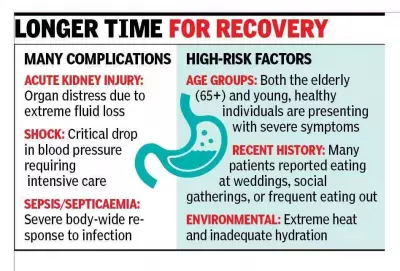
India recently faced outbreaks of diarrhoea in Indore and typhoid in Gandhinagar. These incidents reveal critical gaps in our public health response. The country's Integrated Disease Surveillance Programme provides weekly reports. However, as seen in Indore, reports about poor water quality did not trigger timely action. This represents a clear failure of intelligence gathering and application.
The Security Intelligence Parallel
We typically associate intelligence with security agencies. Their primary mandate involves gathering intelligence from multiple sources. They use human intelligence, electronic surveillance, and advanced technologies. Security agencies take preemptive or reactive actions based on this intelligence. Any explosion or terror attack often gets attributed to intelligence failure. One key reason for such failures is our inability to integrate intelligence from multiple sources. Lack of sharing and unified analysis creates vulnerabilities.
A New Paradigm for Public Health
Public health requires a similar paradigm shift. Public health intelligence means monitoring health threats systematically. It involves gathering and analyzing information on events of public health importance. The specific aim is early detection for effective response. Relevant signals include disease outbreaks or clusters. They also cover potential pandemics, including those originating from animals. Other signals involve outliers in health system performance. This includes coverage of health programmes, iatrogenic adverse events, and antibiotic sensitivities. Extreme weather warnings and many other factors also matter.

Data needed to identify these signals would cover multiple areas. It includes accidents, deaths, and admissions with their causes. Climate parameters, laboratory test results, and national programme outputs are crucial. Adverse events and pathogens in the environment provide additional insights. The data could come from diverse sources. Social media, the internet of things, and government portals offer valuable information. Clinical records from public and private health facilities contribute significantly. Non-health agencies and wastewater surveillance add further layers.
Current Surveillance Limitations
Our current disease surveillance suffers from several problems. Poor gathering of data creates fundamental challenges. Converting this data into meaningful intelligence remains difficult. The system continues to be fragmented and siloed. It remains limited and mainly focuses on reporting outbreaks. We still have a health management information system that is not fully digitalized. Access to information in this system is governed by privileges. These privileges are defined by vertical national programmes. Our surveillance system rarely leads to preemptive action. It seldom results in long-term course correction.
Lessons from the Covid-19 Pandemic
The Covid-19 pandemic taught us crucial lessons. We need to drastically improve our health security game. During the pandemic, we used multiple technologies to assist data collection. These included web-based epidemic intelligence tools. Machine learning and natural language processing proved valuable. Targeted public health messaging reached wider audiences. Social media and online searches provided real-time insights. Syndromic surveillance, wearable sensors, and digital diagnostics emerged as tools. Genomics, data visualization tools, and interactive geospatial maps helped analysis. Drones, computer vision, and contact tracing apps supported efforts. Chatbots, smartphone apps, and symptom-reporting apps became commonplace. Telemedicine, mobility pattern analysis, and privacy technologies played roles. These have now become standard processes in many contexts.

Has India reimagined its health security for present times? The document "Vision 2035: Public Health Surveillance in India" offers some direction. This white paper was prepared by NITI Aayog and the University of Manitoba in 2020. It re-imagines public health surveillance as a predictive, responsive system. It envisions an integrated, tiered system of disease and health surveillance. This system would include prioritised, emerging, and re-emerging health conditions. It expects surveillance to primarily use de-identified individual-level patient information. This information would come from healthcare facilities, laboratories, and other sources. An adequately resourced administrative and technical structure would support it.
Vision Document Shortcomings
For a vision document, it lacks sufficient vision and imagination. It fails to recognize rapid changes happening globally and nationally. The way information is collected, processed, and analyzed is evolving quickly. An exclusive focus on Electronic Health Records seems inappropriate. Modern disease surveillance requires a complex architecture. This system needs adaptability with non-linear data flow. Chaotic dynamics and emergent behavior must be accommodated. Multi-scalar nested systems are essential for comprehensive coverage.
The Next-Generation Surveillance System
The next-generation surveillance system must include multiple data sources. This requires sophisticated data fusion and storage capabilities. Data wrangling, analysis, and knowledge translation become critical. A real-time dashboard with interactive data sources is necessary. Analytic methods must operate on a real-time basis. We need to make these inter-relational datasets amenable to collective synthesis. This can only be achieved through artificial intelligence. AI can augment traditional epidemiology effectively. It helps public health professionals sort through large amounts of data. Machine learning enhances predictive modelling significantly. It improves cluster analysis and social network analysis. These improvements increase the sensitivity of surveillance systems. Natural language processing extracts meaning from unstructured data. Clinical notes, social media, and news reports contain valuable insights.
The Human Element Remains Crucial
The key challenge in any intelligence system will always involve humans. While we should invest in developing AI solutions, humans cannot be replaced. Our current approach of training Epidemic Intelligence Officers has limitations. While appropriate for traditional approaches, it proves inadequate for the future. We need more technology-trained people in the system. Given surveillance needs, architecture, and oversight requirements, a new approach is necessary. I suggest setting up an autonomous, well-resourced national surveillance authority.
Beyond the Routine Health System
Like a good security system goes beyond the police force, we need broader thinking. The police neither has the time nor capacity to handle all security issues. Similarly, we must look beyond the routine health system. A good quality public health intelligence system requires this expansion. While the health system can continue as its eyes and hands, it cannot remain the brain. We need specialized intelligence capabilities for public health. The writer is a Professor of Community Medicine at AIIMS, New Delhi. All views expressed are personal.