

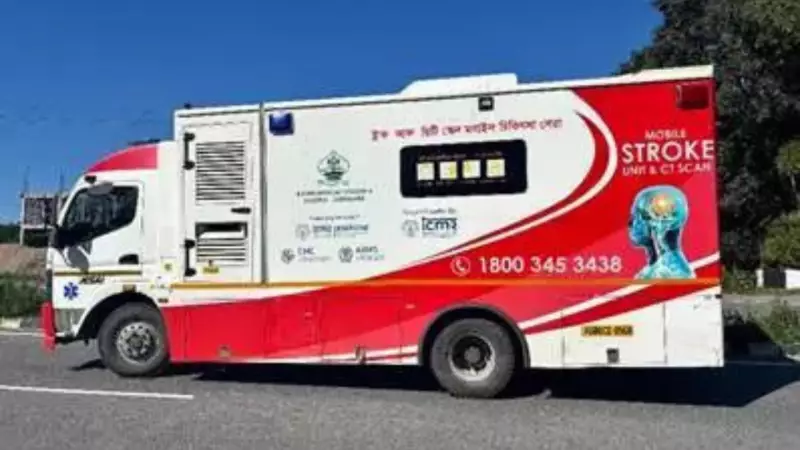
ICMR Revolutionizes Stroke Care in Assam with Mobile Hospital Units
In a groundbreaking development for healthcare accessibility, the Indian Council of Medical Research (ICMR) has officially transferred two state-of-the-art Mobile Stroke Units (MSUs) to the Government of Assam. This strategic handover represents a paradigm shift in stroke management across remote regions, transforming the traditional model where patients must travel long distances to hospitals into a system where advanced medical care reaches patients directly at their locations.
The Critical Need for Timely Stroke Intervention
Stroke remains one of India's leading causes of mortality and long-term disability, creating significant challenges for healthcare systems nationwide. During an acute stroke episode, medical research indicates that approximately 1.9 billion brain cells are lost every minute when treatment is delayed. This biological reality makes access to specialized care within the golden hour absolutely critical for patient outcomes. However, reaching stroke-ready hospitals has consistently presented formidable obstacles in rural areas and difficult terrains, particularly in regions like Northeast India.
International Innovation Adapted for Indian Context
During the formal handover ceremony, Rajiv Bahl, Secretary of the Department of Health Research and Director General of ICMR, highlighted the global significance of this initiative. "Mobile Stroke Units were first developed in Germany, but India has now successfully evaluated and adapted this technology for rural and remote settings in Northeast India," he explained. "Remarkably, India has become only the second country worldwide to report successful integration of MSUs with emergency medical services specifically for treating acute ischemic stroke patients in rural environments."

Government Leadership and Strategic Vision
This transformative healthcare initiative has been developed under the visionary leadership of Prime Minister Narendra Modi, with strategic guidance from Union Health Minister Jagat Prakash Nadda. The program's fundamental objective is to ensure that advanced medical technologies and treatments reach even the poorest and most marginalized populations, regardless of geographical challenges. P Ashok Babu, Secretary and Commissioner of Health and Family Welfare for the Government of Assam, emphasized how this handover strengthens the state's emergency response capabilities. "This transfer significantly enhances our emergency response system while ensuring the continuity of these life-saving services under state ownership and management," he stated.
Mobile Hospital with Advanced Capabilities
The Mobile Stroke Units function as comprehensive hospitals on wheels, equipped with sophisticated medical technology that includes:
- A fully functional CT scanner for immediate brain imaging
- Teleconsultation systems connecting patients directly with stroke specialists
- Point-of-care diagnostic equipment for rapid assessment
- Clot-busting medications for immediate treatment initiation
This integrated technological approach enables complete diagnosis and treatment initiation at or near the patient's home, eliminating the dangerous delays associated with transportation to distant medical facilities.
Demonstrated Impact and Statistical Evidence
The effectiveness of this innovative model has already been validated through extensive pilot testing and evaluation phases. The implementation of Mobile Stroke Units has achieved remarkable outcomes:
- Reduced average treatment time from nearly 24 hours to approximately 2 hours
- Decreased stroke-related mortality by one-third
- Reduced long-term disability rates by eight times compared to traditional approaches
Between 2021 and August 2024, these mobile units have responded to over 2,300 emergency calls, with an impressive 90% of patients receiving treatment directly from their homes following integration with the existing 108 ambulance service network. This seamless coordination between mobile stroke units and emergency response systems represents a new standard in rural healthcare delivery, particularly for time-sensitive medical conditions like stroke.






