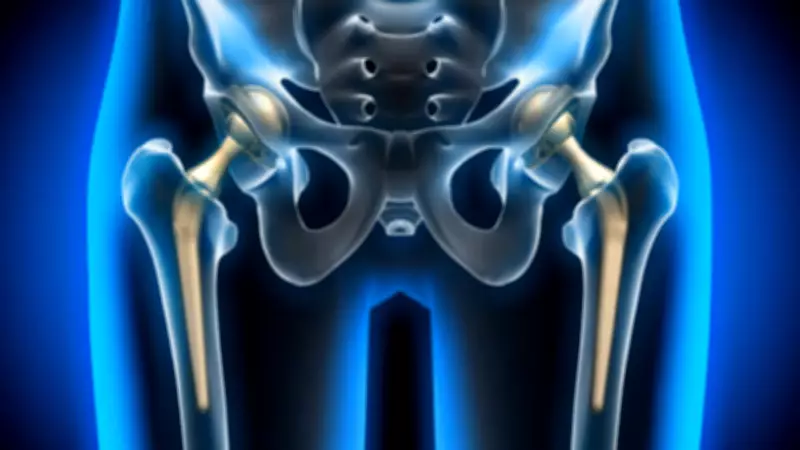
A 34-year-old patient from Durgapur, West Bengal, regained mobility within hours after undergoing a minimally invasive total hip replacement at Sarvodaya Hospital, Sector-8, Faridabad. The procedure addressed hip arthritis caused by ankylosing spondylitis, a chronic inflammatory condition affecting the spine and joints that can severely restrict movement around the hip joint and spine.
The patient, Sourav Chatterjee, had been experiencing severe symptoms for the past three to four months due to ankylosing spondylitis. In his case, the condition had begun to interfere significantly with his daily activities, making basic tasks like walking, climbing stairs, or riding a bike difficult and painful.
Innovative Surgical Technique
The procedure was performed by Dr. Pankaj Walecha, Director and Head of Robotic Knee and Minimally Invasive Hip Replacement at Sarvodaya Hospital, Sector-8, Faridabad. He used the Direct Anterior Approach (DAA), a minimally invasive technique. The surgery was supported by North India's first hip navigation technology for hip replacement surgeries, a computer-assisted system that provides real-time guidance to help position the hip replacement implants more accurately.

Following detailed evaluation and pre-surgical planning, the procedure was carried out with precision. Within three hours, the patient was able to stand and begin walking with support, while restoring equal limb length.
Expert Insights
Commenting on the procedure, Dr. Pankaj Walecha said, “In patients with ankylosing spondylitis, especially those with associated spinal fusion, total hip replacement presents unique technical challenges related to positioning the patient for surgery, restoring leg length, and biomechanics of the hip. The Direct Anterior Approach allows us to work through an intermuscular plane, which helps preserve soft tissue integrity as no major muscles are cut in this technique. When combined with computer-assisted navigation, it enables us to achieve even more accurate implant positioning and reliably correct limb length discrepancy, both of which are critical for stability and long-term functional outcomes.”
Patient Recovery
The patient, Sourav Chatterjee, expressed his relief: “Before the surgery, even basic activities like walking, climbing stairs, or riding a bike had become difficult, and I was constantly in pain. It was physically and mentally exhausting. Being able to stand and walk within a few hours after surgery, that too without any pain, has brought back so much happiness and joy in life.”
In the days following the surgery, the patient showed steady improvement, with improved mobility. With guided physiotherapy and rehabilitation, he gradually regained strength and confidence, enabling a smoother return to daily activities.