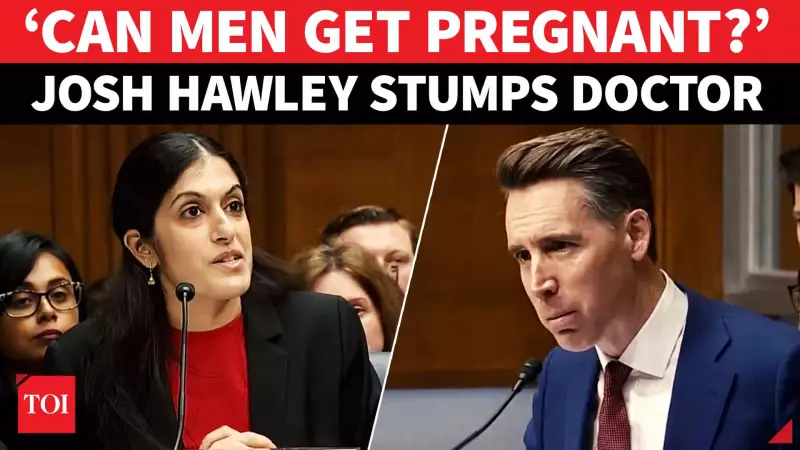
A fiery confrontation erupted during a US Congressional hearing this week. Senator Josh Hawley, a Republican from Missouri, directly challenged a medical expert with a provocative question. He asked whether men can get pregnant.
The Tense Exchange Unfolds
Dr. Nisha Verma, a board-certified obstetrician and gynecologist, appeared before the committee. She serves as a professor at a medical school and represents Physicians for Reproductive Health. When Senator Hawley posed his question, she hesitated to provide a straightforward answer.
Dr. Verma explained that the question itself carries political weight. She argued it oversimplifies complex biological and social realities. Her response focused on the need to consider broader contexts rather than giving a simple yes or no.

Hawley Demands Biological Truth
Senator Hawley immediately pushed back against this approach. He insisted he was seeking basic biological facts. The senator emphasized his desire for what he called "the truth" about human reproduction.
"I'm asking for a fundamental biological reality," Hawley stated during the exchange. He expressed frustration with what he perceived as evasion from the medical professional.
Credibility and Polarization Clash
The discussion quickly escalated into a debate about medical credibility and political polarization. Dr. Verma accused the senator of deliberately polarizing a sensitive medical issue. She suggested his questioning style ignored important nuances in healthcare.
In response, Senator Hawley questioned Dr. Verma's credibility as a physician. He implied that her reluctance to answer directly undermined her professional standing. This back-and-forth created a visibly tense atmosphere in the hearing room.
The Broader Implications
This confrontation highlights ongoing national debates about:
- How medical professionals discuss gender and biology
- The intersection of politics and healthcare
- What constitutes factual information in reproductive health
- The challenges of having scientific discussions in political forums
The exchange demonstrates how seemingly simple questions can become flashpoints in larger cultural discussions. Both participants maintained their positions throughout the heated dialogue.
Observers noted the symbolic nature of this confrontation. It represents broader conflicts about language, science, and ideology in American public discourse. The hearing concluded without resolution on the central question, leaving the issue open for continued debate.