Haryana Human Rights Commission Calls for Policy to Ensure Dignified Body Transport for Poor Families
The Haryana Human Rights Commission (HHRC) has issued a strong recommendation to the state health department, urging the creation of a formal policy to guarantee free and dignified transportation of bodies for economically disadvantaged families when patients die during treatment in civil hospitals. The commission described the current absence of such support as a profound failure of both governance and basic human compassion.
Suo Motu Action Triggered by Distressing Incident
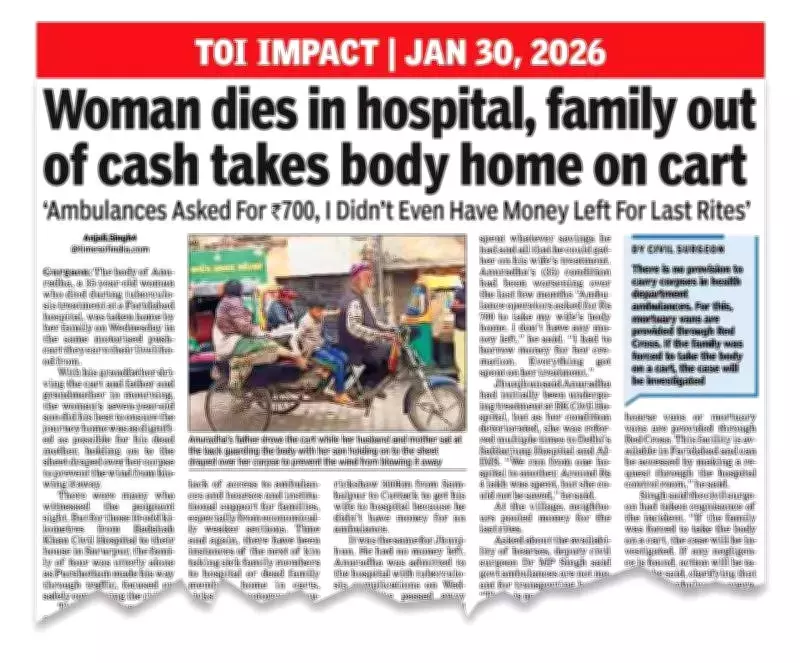
The commission took suo motu cognisance based on a Times of India report published on January 30, titled 'Woman dies in hospital, family out on cash takes body home on cart'. This report documented a heartbreaking incident in Faridabad's Sarurpur village, where a grieving family was forced to transport the body of a 35-year-old woman named Anuradha using a motorised pushcart after she died during tuberculosis treatment at Badshah Khan Civil Hospital on January 28.
The family reportedly could not afford the Rs 700 required for private transport and allegedly received no ambulance support from the hospital. They had exhausted their savings after seeking treatment at multiple government facilities, including AIIMS and Safdarjung Hospital.
A Grave Affront to Human Dignity
In a detailed order issued on Friday, a panel headed by Chairperson Justice Lalit Batra, with members Kuldip Jain and Deep Bhatia, characterized the episode as "a grave affront to human dignity" that exposed deep systemic gaps in the public health and administrative framework. The commission emphasized that the family had to transport the body a distance of merely 7-10 kilometers without any logistical, institutional, or financial assistance from the hospital or any state agency.
"The fact that such indignity occurred even within a short distance underscores not only the absence of any effective mechanism to ensure continuity of care and dignified handling of deceased persons, particularly indigent patients, but also reflects a disturbing apathy of both society and state instrumentalities towards a human being beyond death," the commission stated.
Constitutional and Moral Dimensions Highlighted
The commission underscored the ethical and constitutional dimensions of the case, asserting that the state's obligation to uphold human dignity does not cease with death. It declared that failing to provide even basic post-death support amounts to a serious abdication of constitutional and moral responsibility.
"The right to life under Article 21 of the Constitution includes dignity even after death. Forcing families to transport dead bodies in such conditions reflects failure of the State's constitutional and moral responsibilities," the commission firmly stated.
Vivid Description of the Incident
Quoting directly from the newspaper report, the commission noted the poignant details: "...the motorised open pushcart was driven by the aged father-in-law of the deceased, with the husband and mother-in-law accompanying in mourning. The woman's seven-year-old son held firmly onto the sheet covering his mother's body to prevent it from being blown away by the wind, striving to preserve whatever dignity he could for her final journey."
The commission observed that such circumstances were "wholly incompatible with the standards of humane governance expected in a welfare state."
Pattern of Neglect, Not Isolated Lapses
The HHRC noted that similar distressing incidents have been reported across the country, where impoverished families are forced to carry sick relatives or deceased bodies on carts, motorcycles, or rickshaws due to a complete lack of institutional support. The commission stressed that these recurring episodes point to a broader, systemic pattern of neglect rather than isolated administrative lapses.
Criticism of Official Responses and Policy Gap
While acknowledging that Haryana already provides free ambulance services for pregnant women, the commission was highly critical of the explanations offered by health officials in this specific case. Some authorities claimed there was no provision to transport bodies in health department ambulances, while others suggested the family had not formally requested such a service.
The commission labeled these responses as revealing a clear "policy gap" and a troubling lack of sensitivity and proactive responsibility from the administration.
Official Notices Issued for Action
To address this critical issue, the commission has issued formal notices to the Additional Chief Secretary (Health and Family Welfare), the Director General of Health Services, and the Civil Surgeon of Faridabad. It has directed these officials to submit detailed action taken reports at least one week before the next hearing, which is scheduled for April 2.
The HHRC's recommendation aims to establish a permanent, compassionate mechanism to prevent such indignities from recurring, ensuring that the state fulfills its duty to protect human dignity from life through to a respectful final journey for all its citizens, regardless of economic status.