

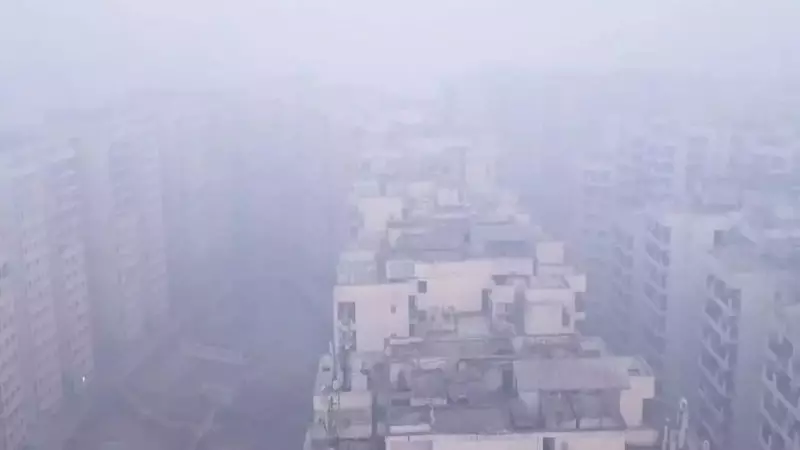
Delhi residents woke up to another day of hazardous air on Sunday morning. The city's air quality remained firmly in the severe category, causing widespread concern among health officials and citizens alike.
Pollution Levels Reach Critical Point
The Central Pollution Control Board recorded an Air Quality Index of 439 at 7 am on Sunday. This marked a further deterioration from Saturday night's reading of 432. Both measurements fell squarely within the severe classification, indicating extremely dangerous conditions for human health.
Widespread Severe Pollution Across Delhi
Multiple monitoring stations across the capital reported alarming numbers throughout Sunday morning:

- Dwarka Sector 8 registered 469
- Wazirpur recorded 478
- Punjabi Bagh measured 476
- Anand Vihar reached 489
- Ashok Vihar showed 463
- Bawana reported 467
- Chandni Chowk recorded 464
- ITO measured 448
- RK Puram showed 467
- Narela registered 412
Every single one of these locations fell into the severe category, demonstrating how widespread the pollution crisis has become.
Understanding AQI Classifications
The Air Quality Index uses a clear scale to communicate pollution levels:
- 0-50 represents good air quality
- 51-100 indicates satisfactory conditions
- 101-200 falls into the moderate range
- 201-300 qualifies as poor
- 301-400 becomes very poor
- 401-500 reaches the severe category
Delhi's current readings place it firmly in the most dangerous bracket, where even healthy individuals can experience breathing difficulties.
Weather Conditions Worsen the Situation
Visibility remained extremely poor across Delhi as cold wave conditions persisted. Dense fog blanketed large parts of the city throughout Sunday morning. The India Meteorological Department reported moderate fog at several locations and dense fog at isolated spots.
Minimum temperatures dropped to between 5°C and 7°C, remaining 1.6°C to 3°C below normal seasonal averages. These weather conditions trap pollutants close to the ground, preventing their dispersion and worsening air quality.
Authorities Take Emergency Measures
In response to the deteriorating situation, the Commission for Air Quality Management reinstated Stage-IV measures under the Graded Response Action Plan on Saturday. These measures apply across Delhi and the entire National Capital Region.
The CAQM order stated clearly: "Keeping in view the prevailing trend of air quality and relevant factors and in an effort to prevent further deterioration of air quality in the region, the CAQM Sub-Committee on GRAP unanimously decides to invoke all actions as envisaged under Stage-IV of the extant GRAP."
This Stage-IV implementation represents the most stringent level of pollution control measures available under the GRAP framework. It comes into effect when Delhi's AQI exceeds 450, which multiple monitoring stations have already recorded.
Additional Actions and Directives
The order specifically mentioned that Stage-IV measures would be implemented "with immediate effect" across the entire NCR. These actions supplement existing measures already in force under Stages I, II, and III of the GRAP system.
Authorities have directed NCR Pollution Control Boards and other concerned agencies to escalate preventive measures immediately. Their goal remains preventing any further deterioration of air quality in the region.
Health Concerns Mount
The persistent smog and severe pollution levels have raised serious health alarms. Medical experts express particular concern for vulnerable populations including:
- Children whose lungs are still developing
- Elderly individuals with reduced respiratory capacity
- People with existing respiratory conditions like asthma
- Those with cardiovascular problems
Authorities have issued urgent advisories urging residents to limit outdoor activities as much as possible. They recommend following all health guidelines and taking necessary precautions against the hazardous air quality.

The combination of severe pollution, cold wave conditions, and dense fog creates a perfect storm of health risks for Delhi's residents. People are advised to monitor official updates and follow all recommended safety measures until conditions improve significantly.





