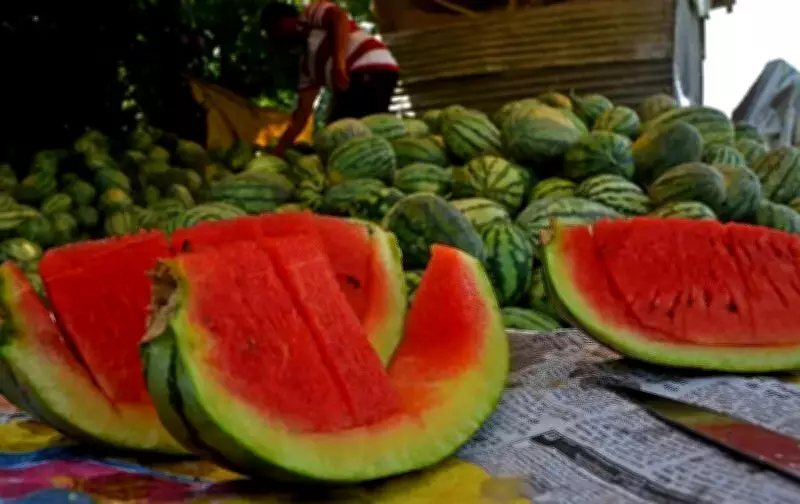
The recent deaths in Mumbai allegedly linked to watermelon consumption have prompted the UT food health department to initiate random sampling of fruits across the city. However, health experts warn that even if samples reveal contamination from oxytocin hormones or artificial coloring, proving a direct link to gastrointestinal infections remains a significant challenge.
Sampling Teams Deployed
Sukhwinder Singh, designated officer-cum-licensing authority for the Food Safety, UT, said, 'Teams have been formed to collect random watermelon samples from both street vendors and wholesalers, specifically targeting artificial sweeteners and coloring agents.'
Challenges in Linking Contamination to Illness
This difficulty stems from a lack of coordination between hospitals and the food analysis wing. Currently, if the food department identifies microbial pathogens like viruses or bacteria in a sample, the evidence remains incomplete because the corresponding fecal matter from the infected patient is not shared for comparison. For authorities to take stringent legal action, hospitals and the food wing must operate as a unified team.

'Establishing a definitive link requires the food sample and the patient's stool sample to undergo simultaneous bacterial culture tests and PCR (Polymerase Chain Reaction). Specifically, genotyping must be performed to prove that the exact same organism found in the fruit is responsible for the patient's infection,' said an official in the health department. At present, food laboratories are not equipped to perform this type of genotyping, leaving a gap in the chain of evidence.
Seasonal Trend of Gastroenteritis
Meanwhile, gastroenterologists at PGI and GMCH report a consistent summer trend where 'perfect-looking' watermelons and cut fruits are identified as the primary culprits behind severe gastroenteritis cases. The dangers of these 'enhanced' fruits are well-documented.
Case Study from British Medical Journal
A previous report in the British Medical Journal documented a medical emergency involving a family of six who consumed a 'perfectly ripe' watermelon that was artificially modified. Within four hours, all family members, aged 11 to 61, were hospitalized with severe food-borne illness. The 61-year-old grandfather, who consumed the largest portion, suffered from toxic shock and a complete shutdown of kidney function, requiring three days of intensive treatment and intravenous fluids to stabilize.
Injection of Contaminants
Investigations into such cases revealed that the vendors use long needles to inject a mixture of sweeteners and red dyes into the core of the fruit to make it appear more appealing without cutting it open. In the BMJ instance, the injection solution was stored in a contaminated earthenware bowl, which introduced a dangerous, non-motile variety of Enteroinvasive Escherichia coli — a bacteria that causes severe diarrhea, directly into the center of the fruit. Unlike typical food poisoning, this strain invades the intestinal lining, causing symptoms similar to dysentery.
'While healthy adults may recover quickly, infants, the elderly, and those with compromised immune systems remain at the highest risk for these life-threatening complications. But melons cannot be fatal unless the patient ignores,' said a doctor in PGI.
Symptoms and Simple Test
Symptoms such as severe abdominal pain, persistent vomiting, or diarrhea shortly after consuming watermelon warrant immediate medical attention. As per FSSAI, you can check the adulteration in watermelon through a simple cotton ball. Cut the watermelon into half. After this, take any one of the two parts. Then rub the cotton ball on the red pulp of the watermelon a few times. If it is adulterated, the cotton ball will become red. It can be estimated that the chemical called erythrosine has been added to this watermelon. If it attains no color, then the watermelon is safe for consumption.