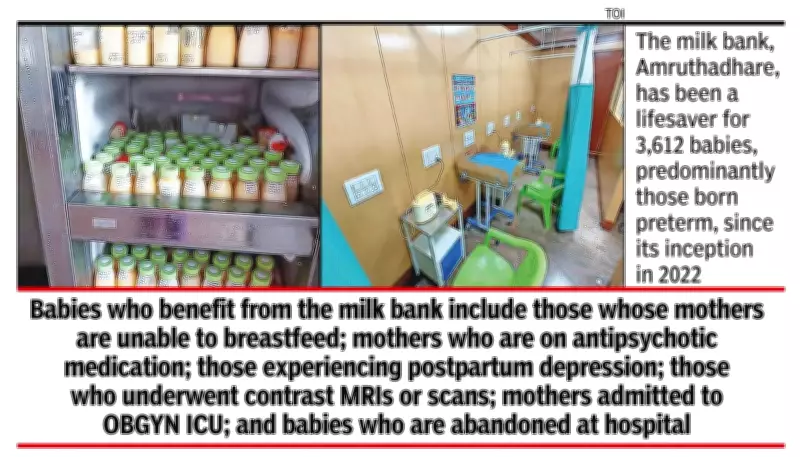
Bengaluru's Vani Vilas Hospital operates a human breast milk bank named Amruthadhare, which has been a lifeline for 3,612 infants, primarily those born prematurely, since its inception in 2022. The facility has collected a total of 863 litres of breast milk from over 3,982 donors.
Life-Saving Support for Vulnerable Newborns
The bank provides milk to babies admitted to neonatal intensive care units (NICUs). The hospital houses four NICUs: one for preterm infants, two for in-born babies, and one for out-born babies referred from other hospitals. Beneficiaries include infants whose mothers cannot produce milk, those on antipsychotic medication, mothers experiencing postpartum depression, those who have undergone contrast MRIs or scans, mothers admitted to the OBGYN ICU, and abandoned babies.
Breast milk in the neonatal stage is not merely sustenance; it offers essential nutrition, immunity, and protection. Milk banks ensure that even the most vulnerable newborns receive these critical benefits.

Addressing Dependency and Encouraging Maternal Feeding
A clinician at the hospital noted that when the milk bank first started, some mothers developed a dependency on donor milk. While babies recovered with bank milk, some mothers continued relying on it after returning home, neglecting regular breastfeeding. To address this, the hospital now encourages mothers to express milk at the bank while their babies are in the NICU, so that donor milk serves only as a supplement rather than the primary source.
“Even if a mother can express just a few millilitres, we encourage her to feed it to her baby and supplement the rest with donor milk,” the clinician explained. Observations also indicate that mothers on a meat-based diet tend to produce more milk than those on a plant-based diet.
Stringent Screening and Storage Protocols
The bank follows rigorous screening and storage procedures. Donors are tested for HIV, hepatitis B, and venereal disease, and undergo RT-PCR if they have a fever. Milk is rejected if the donor has lesions or infections on the breast, nipple, or areola.
Human breast milk can be stored for up to six months under proper conditions. “The milk always gets utilized before six months, as demand and supply are balanced,” said Dr. Savitha C, the medical superintendent. She added that while many mothers require counseling before donating excess milk, awareness is growing. “Some mothers now walk in and express willingness to donate if they have excess milk. After thorough screening, if they meet criteria, we accept the donation,” she said.