

Why One Must Be Careful in Dense Forests
Ever wonder why walking into dense forests is always prohibited? Experts believe that the deepest jungles in the world hold the deadliest secrets eagerly waiting for their prey, and you won't see them coming. The world's old-growth forests and dense tropical jungles are highly complex ecosystems where survival requires absolute specialization. While many venomous snakes adapt well to urban edges or agricultural fields, a few dangerous species remain fiercely tied to the undisturbed interiors of the jungle. Hidden beneath thick leaf litter or perfectly camouflaged high in the trees, these reclusive predators rarely cross paths with humans.
The South American Bushmaster (Lachesis muta)
These deadly predators can be found deep within the rainforests of the Amazon and Atlantic zones. Known as the Bushmaster, it is the longest venomous snake in the Americas. It can grow up to 10 feet or more; this massive pit viper relies entirely on the humid, undisturbed floor of the jungle to hunt. Its pinkish-tan body is covered in striking black diamond patterns that mimic the shadows of fallen leaves. Because it is highly sensitive to habitat disruption, it is almost never found near human cities. A single bite can deliver a devastating volume of hemotoxic venom, which destroys tissue and disrupts blood clotting.
The King Cobra (Ophiophagus hannah)
The king cobra is native to the dense jungles and bamboo thickets of South and Southeast Asia. As the world's longest venomous snake, it can reach lengths of up to 18 feet and lives a largely hidden life, actively hunting other snakes. It requires intact, expansive canopies near water sources to build its unique leaf-nest shelters. When confronted in the wild, it can lift a third of its body straight off the ground and look an adult human in the eye. While its venom is technically less toxic drop-for-drop than some other species, the sheer volume it can inject in a single strike is enough to bring down an Asian elephant.

The Eyelash Viper (Bothriechis schlegelii)
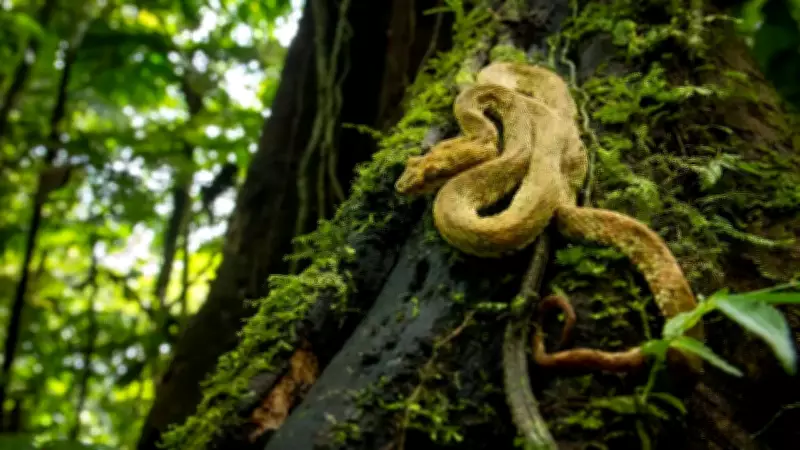
An absolute master of the rainforest canopy, the eyelash viper is a small, arboreal snake found in the dense jungles of Central and South America. It gets its name from the modified scales above its eyes that look exactly like eyelashes, helping to break up its silhouette among the foliage. These snakes exhibit a wide variety of colors, ranging from bright banana yellow to mossy green, allowing them to blend seamlessly with orchids, bromeliads, or lichens. They spend their lives waiting patiently on branches for unsuspecting birds or frogs to pass by. Despite their small size, their hemotoxic bite is exceptionally painful and medically significant.
The Banded Krait (Bungarus fasciatus)
The banded krait is a nocturnal predator highly dependent on the dense, moist forests, mangrove swamps, and foothill jungles of Southeast Asia. By day, it hides away in dark burrows or under thick roots, becoming active only under the cover of night to hunt other reptiles. While it is incredibly shy and often tucks its head beneath its coils when disturbed during daylight, its midnight demeanor changes. Its neurotoxic venom attacks the nervous system directly, causing muscular paralysis and respiratory failure if antivenom is not administered quickly.
The Eastern Congo Basin Bush Viper (Atheris nitschei)
The Eastern Congo Basin bush viper is another deadly reptile confined to the high-altitude, dense mountain forests and swampy woods of Central Africa. This beautiful yet dangerous viper has heavily ridged, overlapping scales, giving it a rough, dragon-like appearance, usually colored in deep velvet greens and blacks to match the thick forest understory. Equipped with a prehensile tail, it navigates the tangled vines and low bushes with ease. Because it lives in such remote, intact forest habitats, human encounters are incredibly rare, and scientists have not yet developed a specific antivenom for its destructive, tissue-destroying bite.






