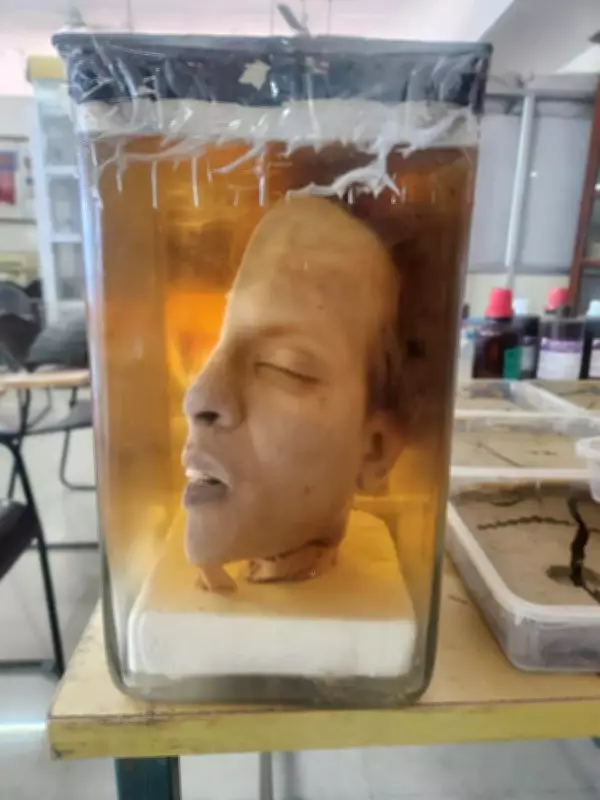
In a corner of the forensic museum at Madras Medical College, inside an old wooden, glass-fronted cupboard, a jar holds the sawn-off half of a human head with a small label reading M 11. There are no records or documents describing the specimen, but professors say it belonged to C Alavandar, a pen salesman murdered in 1952.
The Crime and Initial Investigation
Most of what today's forensic teachers know is drawn from a brief chapter on the case in the Textbook of Forensic Medicine and Toxicology and from newspaper archives. On August 29, 1952, a foul smell from a green steel trunk on the Indo-Ceylon Express, also called the Boat Mail, led railway police to a headless male torso at Manamadurai. A few days later, a severed head was found buried at Royapuram beach. The head and torso were taken to Madras Medical College, one of the city's main teaching hospitals, for postmortem examination.
Identification Without DNA
This was the era before genetic profiling. Assistant professor of forensic medicine Dr. C B Gopalakrishnan worked with what he had. He matched the neck vertebrae of the head and torso, bone against bone. When satisfied they belonged to the same person, he examined other basics such as age and build, along with small personal details like ear-piercing. Dr. C Manohar, a retired professor of forensic medicine, noted that Alavandar had a distinctive pattern of ear-piercing: two holes on the right lobe and one on the left, and a mark on his leg. Dr. Manivasagam Muthusamy, associate professor of forensic medicine at Government Kumaramangalam Medical College Hospital in Salem, added that the wife's identification of the face helped confirm his identity. Finally, fingerprints were taken and compared with his British-era service records. Alavandar had worked in the Army during World War II before joining Gem & Co in Parrys as a salesman.

Building the Case
There was no DNA or fancy scientific test, but at that time there was no room for doubt about who the head and torso belonged to, Dr. Manohar said. Police used corroborative evidence, including the missing-person report filed by Alavandar's wife and witness accounts of his last visit to a small house on Cemetery Road, to build their case. Two people were arrested and convicted of his murder: his former lover, Devaki Menon, and her husband, Prabhakara Menon.
The Motive and Verdict
According to the prosecution and later accounts, Alavandar, who also ran a small sari business, cultivated relationships with several women and continued to press Devaki for sexual favors after her marriage. On August 28, 1952, she invited him home, where he was killed. Justice A S Panchapakesa Aiyar sentenced Prabhakara Menon to seven years' rigorous imprisonment and Devaki to three years in prison.
Legacy in Forensic Education
Years later, the head suspended in formalin is displayed in the forensic museum to show students how careful anatomy and documentation can solve a seemingly impossible case. The story appears in textbooks, on lecture slides, and in conference talks as a standard example of decapitation and identification. At some point later, no one can say when, the original head was cut again and divided. Half stayed in Chennai, while the other half, professors say, was shipped to Madurai, where the torso had been moved, so another medical college could teach from the same head.