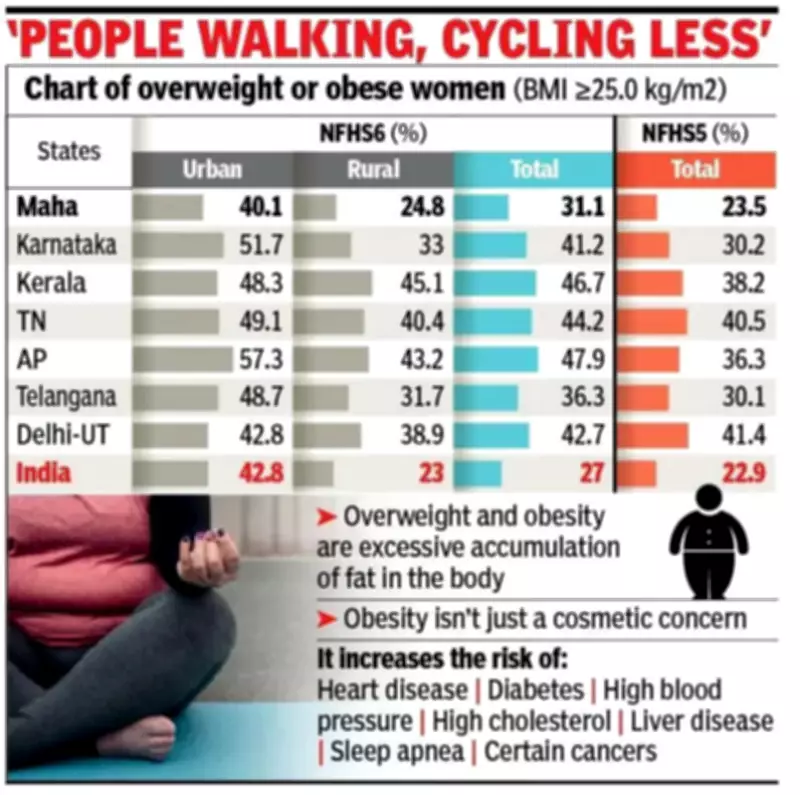
Nearly one in three women in Maharashtra (31.1%) is now overweight or obese, according to data from the National Family Health Survey-6 (NFHS-6), released on Friday. This marks a significant increase from 23.5% in the previous NFHS-5, representing a 32% rise in just a few years.
Urban Obesity in Maharashtra
The situation is more concerning in urban Maharashtra, where 40.1% of women have a body mass index (BMI) of 25 or above, the threshold used to classify overweight and obesity in Indians. This means four in every 10 women living in Maharashtra cities are overweight or have obesity, a condition that has emerged as an underlying cause for over 200 diseases, including cancer.
Comparison with National and Southern States
While Maharashtra's obesity rate is higher than the national figure (27% of women are overweight or obese across India), the state's prevalence remains significantly lower than that of southern states. Obesity rates range from 36.3% in Telangana to 47.9% in Andhra Pradesh in South India. Urban obesity among women in Andhra Pradesh stands at 57.3%, followed by 51.7% in Karnataka, 49.1% in Tamil Nadu, 48.7% in Telangana, and 48.3% in Kerala.

Senior endocrinologist Dr Shashank Joshi, who consults at Lilavati Hospital in Bandra, attributed the higher obesity rates in South India to diets rich in carbohydrates and fat but deficient in protein. He noted that the higher BMI across India over the last five years results from a combination of biological, dietary, and lifestyle factors. Women are naturally predisposed to have a higher body-fat percentage than men, and pregnancy-related weight gain also contributes to the burden. In recent times, low physical activity has worsened the weight-gain story across urban hubs.
Urban-Rural Divide
Public health experts say the data suggest that southern states have entered a more advanced stage of the obesity epidemic, where excess weight is common not only in cities but also in rural areas. Kerala is a striking example, with 45.1% of rural women classified as overweight or obese. In contrast, Maharashtra continues to display a sharp urban-rural divide. While 40.1% of urban women are overweight or obese, the figure drops to 24.8% in rural areas, indicating that the burden remains concentrated in cities and larger towns.
Obesity Among Men
Dr Joshi added that increasing mechanisation and sedentary lifestyles are contributing to rising obesity across both sexes. People are walking and cycling less and relying more on motorised transport, leading to substantially reduced physical activity in urban areas. The NFHS-6 data also show that obesity is no longer predominantly a women's issue, at least in Maharashtra. About 32.8% of men in Maharashtra are overweight or obese, compared with 31.1% of women, reflecting a broader trend of rising excess weight across both genders. Men in more developed states are becoming increasingly sedentary, and the near-equalisation of obesity rates between men and women in Maharashtra is a reflection of changing lifestyles and reduced physical activity, Dr Joshi said.