

Tiger's Extended Stay Near Hyderabad Highlights Forest Department's Readiness Shortcomings
The tiger traversing through Yadadri Bhuvanagiri district has transformed from a fleeting, unsettling sighting into a persistent presence that starkly reveals the forest department's preparedness deficiencies. As the majestic feline inches closer to densely populated landscapes on Hyderabad's periphery, the gaps in wildlife management strategies become increasingly apparent.
From Turkapally to Bhuvanagiri: A Steady Advance
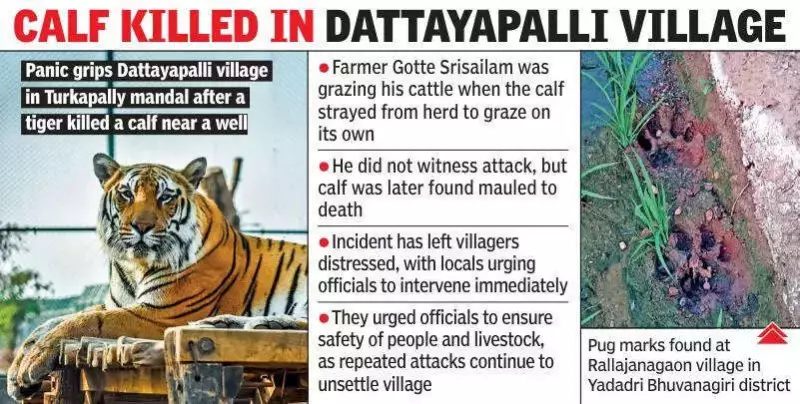
Originating from Turkapally mandal, where the first confirmed cattle kill occurred in Ibrahimpur village, the tiger has now progressed into Bhuvanagiri mandal. Fresh pugmarks discovered near Ralla Jangaon and Baswapur reservoir over the weekend confirm that the animal is not retreating along a predetermined corridor. Instead, it is dispersing through fragmented forest patches interspersed with farms, grazing lands, and villages, bringing it into closer proximity with human activity than at any point since its presence was initially confirmed nearly 60 kilometers from Hyderabad. This movement represents the closest such occurrence recorded in five decades.
Official Assurances Versus Ground Realities
Forest officials maintain that the situation remains under control. District Forest Officer Sudhakar Reddy asserts that the tiger's movement is being closely monitored by three teams, each comprising five personnel. He insists that the animal is unlikely to remain in the area due to the absence of a viable prey base. Officials also emphasize that the tiger is not a man-eater, citing its nocturnal habits and the lack of direct encounters with humans.

However, the pattern of livestock kills, including a calf tied with a nylon rope and the suspected lifting of a dog, suggests a predator adapting to human-dominated terrain rather than merely passing through it. This adaptation raises significant concerns about potential conflicts.
Reactive Measures and Limited Resources
On the ground, the response remains largely reactive and limited in scope. Camera traps are being deployed only where fresh pugmarks appear, a strategy that follows past movement instead of anticipating future routes. Despite weeks of confirmed tiger activity across northern and central Telangana, spanning from Asifabad and Mancherial to Siddipet and Kamareddy, there has been no comprehensive landscape-level assessment of potential movement paths or conflict zones beyond immediate kill sites.
Critically, officials acknowledge that the tiger has not yet been captured on any trap camera. This has fueled speculation within the department that the animal may be deliberately altering its route to evade detection, indicating a mature and experienced tiger. Even so, there has been no escalation in monitoring, no deployment of additional tracking teams, and no utilization of advanced tools such as drone-based thermal imaging, which is standard protocol in high-risk wildlife movement situations elsewhere.
Gaps in Equipment and Expertise
More revealing is what the department currently lacks. There are no cages positioned in the district, no tranquilizing equipment on standby, and no specialized rapid response team trained to handle large carnivores. Senior officials privately admit that if the tiger intensifies livestock attacks or shows signs of aggression, equipment and expertise would have to be requisitioned from the Hyderabad zoo, a process that could take precious hours or even days.
Historical Significance and Habitat Assessment
This lack of readiness stands in sharp contrast to the unusual nature of the situation. Forest officials themselves have described the tiger's arrival in Yadadri Bhuvanagiri as historically significant, given that the Ibrahimpur reserve forest spans just 259 hectares, far short of the 5,000-plus hectares a resident tiger typically requires. Beat officers suggest the animal may be assessing habitat suitability while searching for territory or a mate. However, its continued presence near water bodies, including ponds inside the reserve and the Baswapur reservoir, suggests it can sustain itself longer than initially expected.

Villagers' Daily Struggles and Growing Anxiety
For villagers, uncertainty has become a daily routine. In Ibrahimpur, Ralla Jangaon, Baswapur, and surrounding habitations, doors are shut before dusk, farm work is compressed into daylight hours, and cattle are guarded overnight with fires and group patrols. Elders recall tiger movements from half a century ago, but today's landscape is denser, more fragmented, and far more volatile.
An equally grave threat now looms over the tiger itself. Fear-driven retaliation poses a greater danger than official intervention. Anxiety is growing that villagers may poison carcasses, electrify fences, or contaminate water sources to protect lives and livestock. Warnings have been issued, but without sustained engagement, compensation clarity, or visible containment measures, they risk ringing hollow.
Recent Incident in Dattayapalli Village
Panic gripped Dattayapalli village in Turkapally mandal after a tiger killed a calf near a village well. Farmer Gotte Srisailam was grazing his cattle in the area when the calf strayed from the herd to graze on its own. He did not witness the attack, but the calf was later found mauled to death, triggering fear among residents. The incident has left villagers distressed, with locals urging forest officials to intervene immediately, capture the tiger, and ensure the safety of people and livestock, as repeated attacks continue to unsettle the community.
For now, the department appears to be relying on the tiger to leave on its own. The animal remains unseen, unphotographed, and uncontained, yet undeniably present, exposing the fragile edge where wildlife management, administrative readiness, and human tolerance intersect uncomfortably close to the city.





