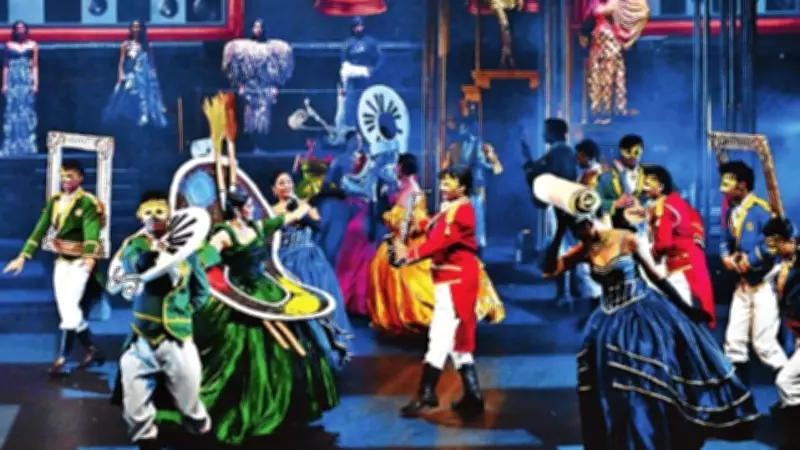
Tesseract: A Theatrical Revolution by The Times of India
In a week marked by actor Timothée Chalamet's controversial remarks dismissing opera and ballet as "obsolete" and claiming "no one cares," The Times of India offered a powerful, non-verbal rebuttal. Their production, Tesseract, did not engage in debate but instead presented an elegant and assertive inclusion of ballet, transforming it into a living, breathing art form rather than a relic of the past. This performance was not merely a response but a revelation, reframing legacy as a dynamic force integrated into the present.
An Immersive Journey Beyond Time
The experience began at the entrance, where interstellar music warped the hallway into a temporal tunnel, surrounded by a galaxy of TOI headlines and archival materials. These elements served as whispers of the multidimensional theatre ahead. Within minutes, ordinary time dissolved; three and a half hours passed with the hush and rush of a lucid dream, leaving audiences in a state of reflection and dreaming long after the curtain fell.
Central to the narrative was Sophia, the protagonist, whose journey and that of her alter ego formed a double helix of identity. Their seamless oscillation created a flickering flame between two bodies of light and intention, showcasing a quiet triumph of performance craft and directorial design. This interplay lingered as after-effects, adhering to the mind's inner surfaces and continuously releasing new layers of meaning.

Restraint and Spectacle in Harmony
Even in moments of grand spectacle, Tesseract shone through restraint. The discipline ensured technology served emotion rather than overwhelming it, light revealed instead of blinded, and movement functioned as syntax rather than mere ornament. This balance made the show an exquisite narcotic for the soul—a benevolent, satsang-like experience charged with the vibrations of a congregation seeking truth.
The production evolved into a civic ritual, aligning seekers around timeless questions older than nation-states yet fresh as each new dawn. It infiltrated sleep with dreams and visions, reminding that inner archives can be as unruly and luminous as external ones. The finale, like origami, converged each crease and fold to reveal the tesseract not as a stunt but as the geometry of a thought quietly forming all night.
Cutting-Edge Stagecraft Rooted in Indian Ethos
Tesseract's stagecraft was pioneering, prioritizing ideas over electronics. It wove journalism's archive with theatre's alchemy and technology's sleight of mind, integrating live performance with large-scale LED displays, augmented reality environments, illusion design, and sweeping sound architecture. This interdisciplinary rigor did not imitate international standards but set them, all while being rooted in an Indic grammar of courage that views truth as a discipline rather than a decree.
The show's detail was relentless, particularly in sections on beauty and art, which offered an aria on humanity and the aesthetic as essential oxygen. It transformed beliefs and mythologies into a theatre of belonging, suggesting that TOI's motto might evolve from "Let Truth Prevail" to "The Geometry of Truth," encouraging inquiry and polyphonies of opinion.
A Vision for the Future and Global Impact
If destiny permits, Tesseract should tour the country, cross oceans, and reach for the stars. Future iterations could expand into meditations on planetary intelligence, biodiversity, and human-animal kinship, moving from archival intelligence to an epoch of global empathy. Inspired by Carol Hanisch's "The Personal is Political," the show transmuted personal experiences into political statements and sublime art, scaling love into responsibility and pain into purpose.
As a work of language and light, Tesseract oscillated between surrealism, pop art, and Kafkaesque narratives, creating a composograph of cosmic intelligence. Its architectonic, symbolic, and haptic elements gathered into a grammar of grandeur, tinged with spiritual reverence and multi-sensorial engagement. It pulsed with a transcorporeal rhythm, echoing the oldest theatre: the human mind convincing itself it can hold more truth than yesterday.

The evening's lineage was disclosed in Meera Jain's opening invocation, revealing a vision born of travel, agency, care, curiosity, beauty, empathy, love, and familial imagination. Not perfect, but pure; not bound, but beautiful; not tangible, but true. Tesseract stands as a testament to art's enduring power to challenge, inspire, and transform.