From Science Fiction to Scientific Reality: How Interstellar's Time Dilation Mirrors Einstein's Universe
In Christopher Nolan's cinematic masterpiece Interstellar, astronauts land on a planet orbiting perilously close to a gargantuan black hole. After spending what feels like mere hours on its hostile surface, they return to their spacecraft only to discover that a staggering 23 years have elapsed on Earth. Children they left behind have grown into adults, and entire lifetimes have slipped away in what seemed like moments.
The Science Behind the Fiction: Einstein's Theory Comes to Life
While this scenario appears as pure science fiction, it is firmly rooted in scientific reality. Albert Einstein's revolutionary theory of relativity demonstrated conclusively that time is not an absolute, universal constant. Instead, time slows down dramatically when approaching the speed of light or when subjected to intense gravitational fields. The closer one ventures to a massive celestial object like a black hole, the more spacetime curves, causing time to pass significantly slower compared to observers at a safer distance.
This phenomenon isn't confined to theoretical physics or blockbuster films. Atomic clocks mounted on high-speed aircraft have been measured ticking slightly slower than their identical counterparts on Earth's surface. Our global positioning satellite systems require constant relativistic adjustments to maintain accuracy; without these corrections, navigation errors would accumulate to kilometers each day, rendering modern GPS technology useless.

The Multi-Layered Nature of Time: Physical, Psychological, and Generational Relativity
Gravity fundamentally bends time, proving that our universe operates without a single master clock. Yet concepts like the "fourth dimension" or "time relativity" are often dismissed as abstract, purely academic ideas. However, a profound generational shift is occurring quietly but unmistakably. We are transitioning from merely contemplating these concepts to experiencing their tangible reality in our daily lives.
This exploration, inspired by watching a 12-year-old grandson become completely absorbed in Interstellar, reveals multiple layers of relativity operating simultaneously. Hans Zimmer's haunting organ theme from the film became his favorite piano piece, its slow, expansive, architectural quality feeling like time itself unfolding and circling through dimensions beyond ordinary perception.
When Children Become Teachers: Origami and the Fourth Dimension
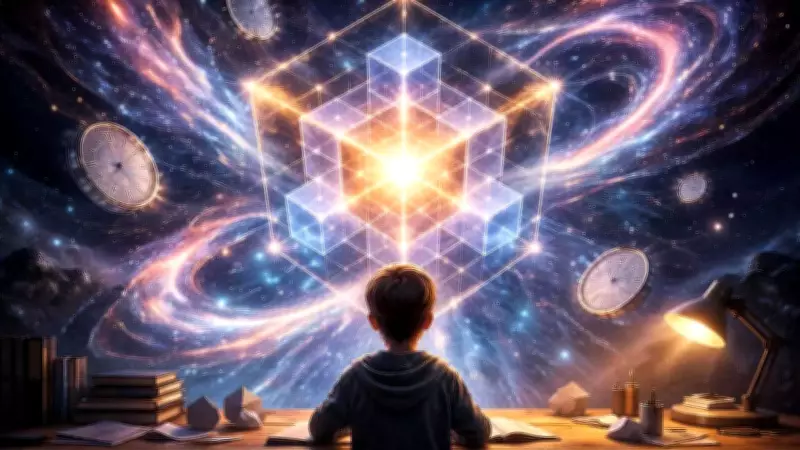
One evening, conversation turned to the film's most mind-bending concept: the tesseract, a theoretical four-dimensional hypercube where time manifests as a physical dimension navigable like space. To explain this abstract idea, the grandson reached for paper, demonstrating through simple origami folds how a two-dimensional square unfolds into a three-dimensional cube. He then posed a profound question: if a cube can unfold into something beyond itself, why can't we imagine a four-dimensional version unfolding in ways our three-dimensional perception cannot fully comprehend?
This was curiosity in motion—a physics lecture from a child who consistently teaches something new during every encounter. For many adults, such multidimensional concepts remain abstract intellectual exercises. But younger generations are growing up immersed in them through films, video games, scientific simulations, educational channels, and advanced digital visualizations.
The Intuitive Understanding of Time Across Generations
Today's youth comfortably imagine spacetime as malleable fabric, dimensions extending beyond the visible spectrum, and entire universes bending under gravitational forces. Perhaps more importantly, they intuitively grasp relativistic principles long before encountering formal mathematical equations.
Consider a simple experiment: ask ten children to meditate for five minutes and open their eyes when they believe time has elapsed. None will stop simultaneously, because while five minutes on a clock remains fixed, five minutes in the mind proves remarkably elastic. When bored, time drags interminably; when immersed in music, coding, or captivating conversation, it vanishes entirely. Psychologists term this phenomenon "flow," a state of complete attention where temporal awareness dissolves completely.

We experience at least three distinct forms of relativity: physical relativity (Einstein's bending of spacetime through gravity and velocity), psychological relativity (the stretching and compression of time through emotion, mental state, and attention), and generational relativity (how different generations internalize these concepts uniquely).
From Theoretical to Experiential: How Media Shapes Perception
For those raised before the digital revolution, the fourth dimension often feels theoretical. For those maturing within immersive storytelling and interactive media environments, it becomes experiential. They don't merely read about warped spacetime; they visualize it, feel it, hear it, model it digitally, and in meaningful ways, inhabit it.
Many adults assume children must be taught these complex concepts from foundational principles. Frequently, however, children are already contemplating them, simply using different vocabulary. They might not discuss "spacetime curvature," but they understand instinctively that time feels different during various activities. They may not derive mathematical equations, but they can vividly imagine traversing additional dimensions.
Children will engage deeply with these ideas, but only when they sense genuine, reciprocal curiosity. When we approach them not as authoritative teachers but as humble students; when we ask how they envision the fourth dimension; when we inquire what specific music evokes emotionally; when we demonstrate willingness to learn authentically from their perspectives.
Science Fiction as Cultural Vocabulary for Reality
Science fiction once represented speculative visions of distant futures. Increasingly, it serves as shared cultural vocabulary for interpreting reality itself. Einstein bent time through mathematical genius. Filmmakers like Nolan visualized these abstractions. Composers like Zimmer gave them auditory form. And children are quietly absorbing these concepts not as fantasy, but as genuine possibility.
Perhaps time's elasticity represents not merely a feature of black holes, but equally a characteristic of human imagination, stretching across generations, awaiting unfolding. Sometimes, the doorway into the fourth dimension opens not through complex equations, but through simple curiosity—and a humble sheet of paper folded into something far greater than its original appearance suggested.