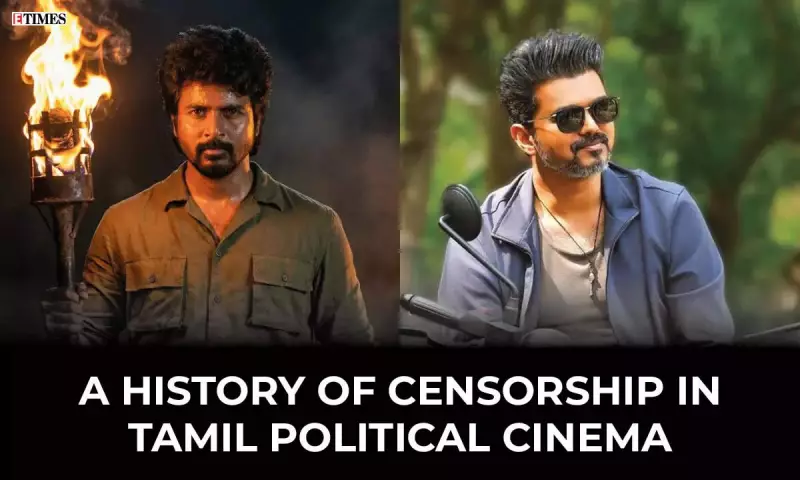
The delicate balance between creative freedom and societal responsibility in Indian cinema is under the spotlight once again. Recent controversies surrounding high-profile Tamil film releases have reignited the long-standing debate on the role and impact of the Central Board of Film Certification (CBFC). The board, tasked with ensuring films consider societal harmony, national integrity, and public morals, often finds itself at the centre of storms, especially when films tackle political or historical themes.
Current Flashpoints: 'Jana Nayagan' and 'Parasakthi'
The latest films to encounter certification hurdles are 'Jana Nayagan' starring Thalapathy Vijay and 'Parasakthi' featuring Sivakarthikeyan. Vijay's film, speculated to be his final cinematic venture before a political plunge, faced significant delays in its censor certification process. The situation escalated to the point where the production team sought legal recourse. The Madras High Court had to intervene, ultimately allowing the film's release, though it missed its intended Pongal festival slot.
Simultaneously, 'Parasakthi', a film set against the backdrop of the 1965 anti-Hindi imposition protests, has seen its classification held up. The CBFC has reportedly demanded cuts to certain scenes, leading to a stalemate. These instances demonstrate how films with political undertones can face considerable resistance, potentially leading to legal battles that directly impact their public release.

A Long History of Censor Battles in Tamil Cinema
This is not a new phenomenon for the Tamil film industry, which has a storied history of clashes with the censor board. Several films have been shelved or heavily edited for years due to content deemed sensitive.
- 'Kuttrapathirikai' (1992): Director R. K. Selvamani's film depicting the assassination of former Prime Minister Rajiv Gandhi was blocked. It took a staggering 15 years before it saw a limited release in 2007.
- 'Gypsy' (2018): Starring Jiiva and directed by Raju Murugan, this film faced protests over its portrayal of identity and religious prejudice. Despite significant hype, it was shelved and only released in 2020 after undergoing cuts.
- 'Aaranya Kaandam' (2010): Thiagarajan Kumararaja's directorial debut was subjected to 52 cuts, losing about 10 minutes of runtime, before it could be certified for adult audiences.
- 'Pulan Visaranai 2' (2005) was stuck for a decade due to objections over 26 scenes, finally releasing in 2015 to poor box office returns.
- 'Manushi' (2022), directed by Gopi Nainar and starring Andrea Jeremiah, remains unreleased after the board found its content to be socially sensitive.
Voices from the Industry: Art Versus Regulation
Prominent filmmakers have consistently voiced their concerns about the censorship process. Acclaimed director Vetri Maaran has pointedly remarked, "Reality is awkward. And that awkwardness is equated to a threat by the censor."
Filmmaker and activist Pa Ranjith recently took to social media to state, "When cinema talks about caste, power or politics, it gets louder with censorship. While silence is always non-threatening, the truth has never been."
Reacting to the ongoing issues with 'Jana Nayagan' and 'Parasakthi', veteran actor and filmmaker Kamal Haasan wrote, "Cinema is not mere art; it is a reflection of the world. If the reflection is distorted, it is clearly because the truth is hidden."

The core debate continues to revolve around whether CBFC's actions are a necessary regulation for societal equilibrium or an undue limitation on artistic expression. This distinction becomes highly subjective when films attempt to mirror real-life socio-political issues. From the historical cases of 'Kuttrapathirikai' and 'Gypsy' to the contemporary hurdles faced by 'Jana Nayagan' and 'Parasakthi', the censor board remains a contentious authority in Tamil cinema. The ongoing challenge is to find that elusive middle ground—a space where public consciousness and artistic integrity can coexist, allowing cinema to fulfil its dual role as both a cultural mirror and a responsible storyteller. As filmmakers continue to test boundaries, the discussion on censorship and its impact on the cinematic voice is certain to persist.