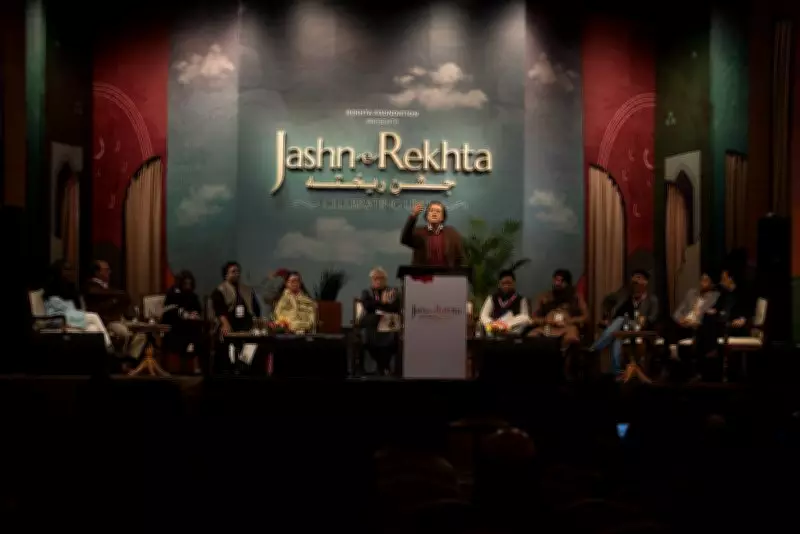
Rekhta Foundation Revives Urdu Language for a New Generation
Urdu, historically known as the language of adab (literature), romance, and culture, has undergone a remarkable revival thanks to the Rekhta Foundation. Founded in 2013 by entrepreneur Sanjiv Saraf, the foundation has transformed Urdu from a language confined to scholarly circles into a vibrant, accessible medium for millions worldwide. The Rekhta website now stands as the largest online repository of Urdu literature globally, offering over 300,000 books freely accessible in Urdu, Devanagari, and Roman scripts.
Origins and Decline of Urdu
Urdu originated in military camps during the conquest of North-west India by Muslim rulers, deriving its name from the Turkish word 'Ordu' meaning army. It is an amalgamation of Persian, Arabic, and vernacular languages like Khadi Boli and Braj Bhasha. Until Partition in 1947, Urdu served as the lingua franca and medium of instruction in many parts of India. However, Partition divided not only the subcontinent but also its languages and cultures. Urdu was branded as the language of 'the Other' and disappeared from schools, literature, and public life. For decades, it survived only in scholarly and reclusive circles, kept alive by Bollywood Muslim socials like 'Chaudhvin Ka Chand' and 'Pakeezah', and ghazal artists such as Begum Akhtar, Mehdi Hassan, and Jagjit Singh. Hindi publishers like Rajpal & Sons also helped by printing Urdu literature in Devanagari script.
Sanjiv Saraf's Vision
In 2012, Sanjiv Saraf, founder of Polyplex Corporation Limited and an IIT graduate, decided to learn Urdu at age 52 to access original Urdu content not available in Devanagari or Roman scripts. He started the Rekhta Foundation as a passion project in 2013, which quickly grew beyond expectations. “Urdu is such a beautiful language, specially the poetry. I felt it should reach everyone. The initial idea was to provide a platform where reliable and complete content is accessible to people who can’t read Urdu,” Saraf told The Tribune in 2023. The foundation's website has become a global hub for Urdu literature, offering tools like an inbuilt dictionary that provides meanings in Urdu, Devanagari, and English, along with word origins and grammar.

Jashn-e-Rekhta: A Cultural Movement
First held in Delhi in 2015, Jashn-e-Rekhta has been a game-changer in lending mass appeal to Urdu. Urdu poet and academic Farhat Ehsas, who has been with the foundation since its inception, notes: “It has become a huge cultural and revolutionary movement that has changed the ownership of Urdu. Not only non-Muslims, but a large number of young poets have also learnt the language and script and are writing poetry in Urdu.” The festival features a Grand Mushaira for established poets and a Young Poets Mushaira for emerging voices. Despite criticism from purists about the festival becoming a mela with Bollywood stars, poet Khushbir Singh Shaad defends it: “Even if youngsters are coming to listen to these celebrities, they are also being exposed to all kinds of poets and poetry.”
Digital Expansion and Learning
Rekhta's creative director Huma Khalil, Saraf's spouse, emphasizes that the website remains the foundation's biggest contribution. “More than three lakh books are freely accessible. Another significant feature is an inbuilt dictionary which provides the meaning of any word at a click in Urdu, Devanagari and English, along with its origin, grammar, etc.” The foundation also launched a 'Qafiya' dictionary two years ago to help poets check metre and rhyme. Its publishing wing, active since 2018, has released 250 books, from Amir Khusro to contemporary poets. The learning division offers online courses in script, pronunciation, ghazal writing, and poetry appreciation, with students aged 20 to 90 from around the world. Teacher Mahendra Kumar Sani, a poet who left a corporate job, says, “There are students from all parts of the world. The youngest is 20 and the oldest perhaps 90.”

Rekhta's YouTube Channel and Future Plans
Rekhta launched its YouTube channel in February 2026, and within four months, it amassed over 2.4 million subscribers. “By leveraging technology, we seek to preserve the language. The idea is to keep Urdu experiential on a day-to-day basis in engaging formats so that it stops being perceived as an inaccessible, alien language,” says Huma. Plans include a Rekhta Studio similar to Coke Studio, with a 50-song album already shot using lesser-known forms like manqabat and naat. The foundation also aims to produce short films, documentaries, and biopics.
Global Reach and Preservation of Other Languages
Accessible in 120 countries, Rekhta is equally popular in Pakistan. US-based Pakistani poet Ikram Basra calls its contribution second only to John Gilchrist's English to Urdu dictionary from 1790. “I use it a lot for reference. For readers in Pakistan, whether they are students, researchers, or writers, this is an important literary medium, and a valuable source. Rekhta has secured our joint literary heritage.” The foundation has replicated its preservation model for Hindi, Gujarati, and Rajasthani. In the coming months, it will launch a Punjabi website featuring works of Sikh Gurus like Guru Nanak Dev and Guru Arjan Dev, Punjabi Sufi poets such as Baba Farid and Waris Shah, and modern voices like Amrita Pritam and Shiv Kumar Batalvi. UK-based Punjabi poet Amarjit Chandan is helping curate works from both sides of the border, including Najam Hussain Sayed and Munir Niyazi.