In a decision that would unexpectedly reshape South Asia's auditory landscape, India's Union Minister for Broadcasting, B V Keskar, imposed a ban on film songs from All India Radio (AIR) in 1952. Deeming the popular tunes too 'erotic', the minister decreed that only classical music would be relayed. This left the masses, for whom gramophones were an unaffordable luxury, without access to their beloved film music. This pivotal moment created a vacuum that a broadcaster from a neighboring island was perfectly poised to fill.
The Rise of a Radio Giant
Radio Ceylon, which had already been on air for over two decades, seized the opportunity with remarkable speed. It began relaying Hindi film songs, sometimes even before the movies themselves hit theatres. The impact was immediate and profound. The Indian film industry swiftly shifted its affiliations to the Colombo-based station, which responded by launching a dedicated Hindi language service to cater to the booming demand for Bollywood music.
Programmes like 'Binaca Geet Mala', the legendary countdown show curated by the charismatic radio presenter Ameen Sayani, became a nationwide sensation. By 1957, facing a massive listener exodus, AIR was forced to relent and begin broadcasting film songs again in a bid to compete. At that point, Radio Ceylon had been in operation for 32 years—a full decade longer than AIR itself.

A Cultural Bridge and a Tamil Voice
"Thanks to strategies like this, Radio Ceylon became a cultural bridge between India, Pakistan and Burma," explains T Jaisakthivel, an assistant professor at the University of Madras who is writing a book on the station's history. "The reception to these programmes made Indian business houses advertise on Radio Ceylon." The station, which began as Colombo Radio on December 16, 1925, is Asia's first and the world's second oldest broadcasting service, turning 100 recently.
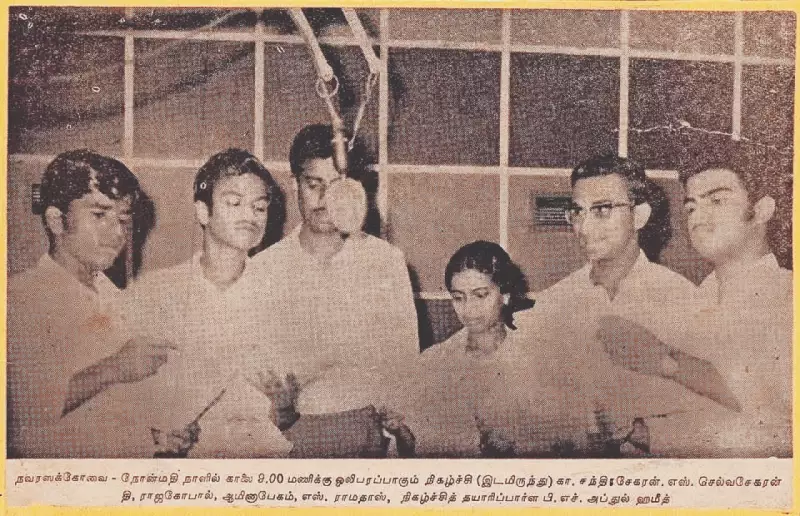
For Tamil listeners, in particular, Radio Ceylon held a special appeal. "In the 1950s and 60s, Tamils preferred Radio Ceylon to Akashvani or Vividh Bharti," says Tamil writer A A H K Ghori. The signal was clearer, especially in regions like Kanyakumari and Tirunelveli in southern Tamil Nadu. Announcers like S P Mylvaganam became superstars, celebrated for their clear pronunciation of pure Tamil.
They were followed by a cadre of beloved voices—Rajaguru Senathipathi Kanakaratnam, S K Pararajasingam, Sara Immanuel, Visalakshi Hameed, K S Raja, and B H Abdul Hameed—who earned a permanent place in the hearts of Tamils on both the island and the mainland. "We learned to speak good Tamil by listening to them," recalls long-time listener Kondegoundenpalayam Muthukumar. The fan following was so intense that the Radio Ceylon station became a tourist stop for Tamilians visiting Ceylon.
From SEAC to SLBC: A Century of Evolution
The station's origins trace back to Edward Harper, a British chief engineer who founded the Ceylon Wireless Club. During World War II, it operated as 'Radio SEAC' (South East Asia Command) under Lord Mountbatten. After Ceylon's independence, it was handed to the government and rebranded as Radio Ceylon in 1949. Its powerful Commercial Service, launched in September 1950, used shortwave transmitters that reached across Asia and as far as North America.
The station's golden era began to fade in the 1980s amid Sri Lanka's ethnic conflict, which led to the death, layoff, or exile of several Tamil announcers. Its editorial stance during the war, which differed from the BBC's, also contributed to its changing role. In 1972, it was renamed the Sri Lankan Broadcasting Corporation (SLBC), though for generations of listeners, it remained 'Radio Ceylon'.
Its legacy, however, endures. Inspired by its classic programming, former listeners have launched online radio initiatives on platforms like WhatsApp. The SLBC itself is now reaching out to a new generation through podcasts. As Sivaraja Thakeesan, a new-generation Tamil announcer at SLBC, notes, the core values of quality and linguistic integrity established by its pioneering announcers continue to guide the broadcaster. It's a fitting tribute to a station that once lived up to its motto: "Entertainment at your fingertips."