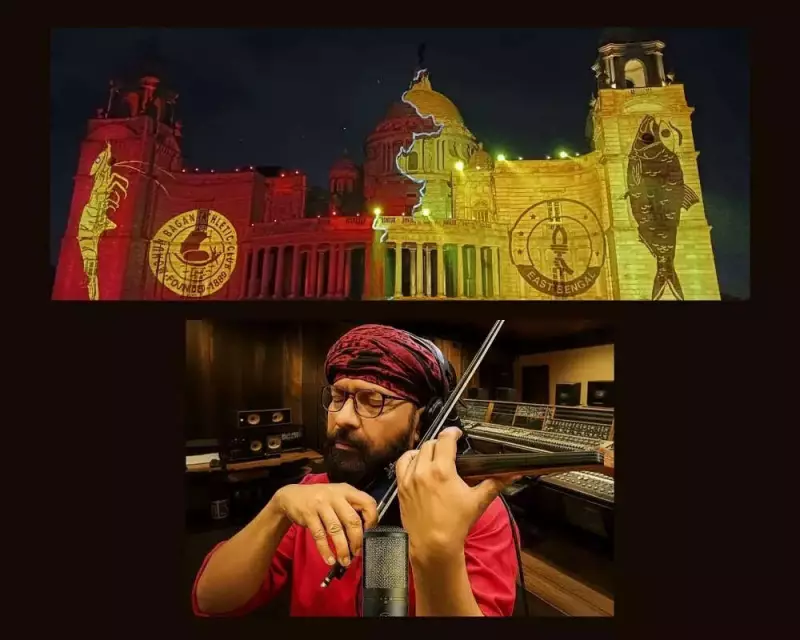
Acclaimed composer Debojyoti Mishra is reshaping how India experiences its historical legacy. Through innovative light and sound productions, he is adding profound auditory dimensions to the country's most iconic monuments, creating immersive journeys that connect the past with the present.
A Southern Soul at Ramappa Temple
Mishra's most recent and notable work illuminates the UNESCO World Heritage Site, the Ramappa Temple in Telangana. This project stands out as a deeply immersive sonic experience, uniquely conceived as a dialogue between stone, silence, and sound. For the first time in his career, Mishra crafted a complete narrative rooted entirely in the musical traditions of southern India.
The soundscape features an ensemble of celebrated maestros, including violinists Kumaresh Ramgopal and Ambi Subramaniam, Rajhesh Vaidhya on the veena, and S Sekhar on mridangam and ghatam. This masterful blend of percussion and string instruments creates a luminous harmony that pays direct homage to the region's rich musical soul, allowing the ancient temple to resonate with its cultural heritage.

Symphonic Journeys from Khajuraho to Agra
Mishra's pioneering approach to heritage storytelling began earlier with large-scale symphonic works. At the Khajuraho temples, under the creative direction of Himaanshu Sabrewal of Tri Color, he orchestrated a grand musical journey. The composition featured a hundred-piece string orchestra and a live choir, seamlessly interwoven with classical Indian instruments like the tabla, sitar, and shehnai. This fusion explored profound themes of spirituality, sensuality, and devotion inherent to the site.
Similarly, at the historic Agra Fort, again guided by Sabrewal, Mishra designed a soundscape that captured the monument's Mughal grandeur. He blended the evocative sounds of the bansuri, sarangi, and dholak with Western string arrangements, crafting an auditory narrative that reflects the fort's timeless legacy and architectural majesty.
The Foundation and Future of Sonic Storytelling
The project that formally introduced Mishra to the world of light and sound storytelling was the Victoria Memorial in Kolkata. This experience marked a significant turning point in his career. Subsequent works at locations like Gandhi Bhavan and Chanderi Fort further refined and strengthened his distinctive approach, which focuses on bridging historical narrative with contemporary musical expression.
Reflecting on his creative journey, Mishra credits his mentors, the legendary composer Salil Chowdhury and sound designer Pratik Biswas, for their guidance. He also acknowledges the invaluable contributions of his numerous collaborators, including historians and musicians from across India. Together, they have helped shape his vision: to create immersive heritage experiences that truly transcend time, allowing monuments to speak through music.
Through these initiatives, Debojyoti Mishra is not just preserving history; he is making it resonate for a new generation, turning stone and silence into a living, breathing sonic tapestry.