Tamil Nadu has long mastered the art of turning movie stars into political giants. But what Vijay achieved in the 2026 Assembly elections feels fundamentally different. This was not simply an actor entering politics. It was the dismantling of a 50-year-old political duopoly through a campaign that blended celebrity, digital mobilisation, welfare politics, and cinematic storytelling into an entirely new electoral blueprint.
No months of on-ground campaigning, no marathon media interviews, and no elaborate public promises. Vijay targeted a younger Tamil Nadu. With nearly 2.5 crore voters under 40, his campaign spoke directly to the concerns of a new generation — graduate stipends, collateral-free business loans, women’s safety, and employment-driven welfare.
More importantly, he understood that political battles are now fought as much on social media as on the streets. Long before launching Tamilaga Vettri Kazhagam (TVK), Vijay’s fan networks were already involved in blood donation drives, medical camps, and disaster relief initiatives. The fan clubs evolved into digital war rooms, especially on Instagram, transforming admiration into political participation. But Vijay’s biggest innovation was that he did not abandon his cinematic identity after entering politics. He weaponised it.

Breaking convention, Vijay chose the Jawaharlal Nehru Indoor Stadium for his swearing-in ceremony instead of the formal setting of the Raj Bhavan. The symbolism was unmistakable: this was not merely a constitutional event, but a ‘first day, first show’ moment for those who had followed him from theatres to polling booths. And the followers are hooked.
The ‘mass entry’ continued immediately after. Within hours of taking oath, Vijay signed three headline-grabbing executive orders — free electricity measures, the creation of the Singa Pen Special Force for women’s safety, and an Anti-Narcotics Task Force targeting the drug crisis he had repeatedly criticised in his films. In the Vijay era, governance arrived with punch-dialogue energy.
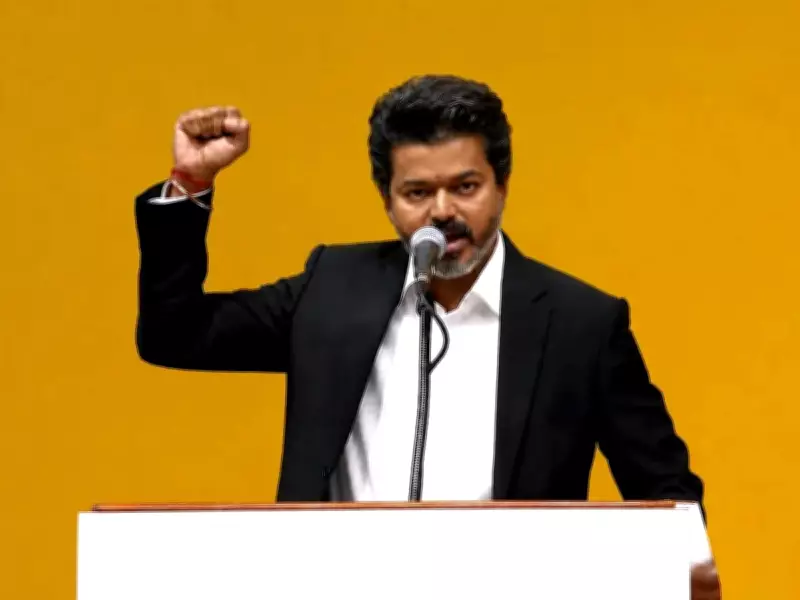
Before the swearing-in, Vijay’s signature look was the now-iconic white shirt and beige trousers — a style that even rival politicians began adopting. But at the oath-taking ceremony, he shifted to an Ambedkar-inspired black coat and black trousers - a statesmanlike political image.
While this may come across as performative politics, Vijay appears to understand that today’s voters consume leadership visually. His choreographed appearances, emotionally charged speeches, and direct-to-voter communication style blur the line between political administration and mass entertainment. Perhaps Vijay’s greatest political advantage is narrative control. He projected himself not as a politician seeking power, but as a reluctant disruptor compelled to enter politics because the system had failed ordinary people. It is the same archetype that powered many of his films: the ordinary man stepping into chaos when institutions collapse. While earlier actor-politicians eventually transitioned into conventional governance, Vijay appears determined to retain the ‘actor tint’ as part of his governing style itself.
But the real challenge begins now. Tamil Nadu’s mounting debt, governance pressures, and political complexities cannot be resolved with background music or carefully staged visuals. For nearly three decades, Vijay solved problems within a film’s runtime. Now, the interval is officially over. The actor tint may have carried him to the Chief Minister’s chair. Whether the administrator’s ink can keep him there will define not just his legacy, but perhaps the future template of Indian politics itself.