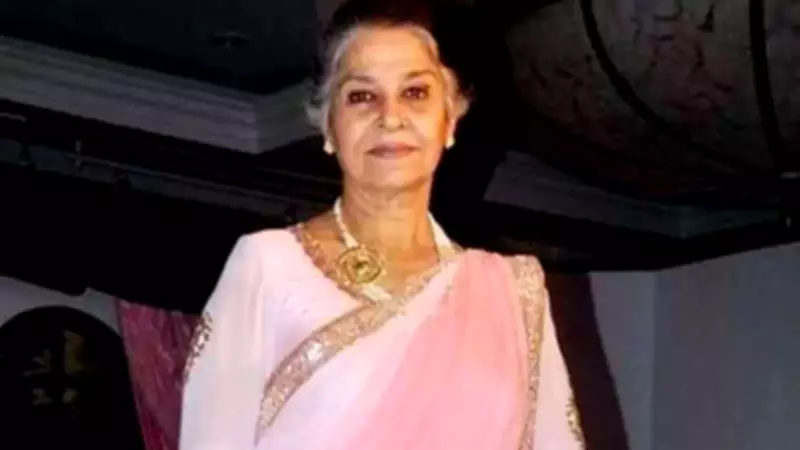
As the iconic film 'Lagaan' approaches its 25th anniversary on June 15, veteran actor Suhasini Mulay has opened up about her journey to becoming part of one of Indian cinema's most celebrated movies. Mulay, who played Yashodamai, the mother of Aamir Khan's character Bhuvan, revealed that director Ashutosh Gowariker went to great lengths to cast her after being impressed by her performance in the film 'Hu Tu Tu'.
The Search for Yashodamai
According to PTI, Mulay shared that Gowariker happened to see a promotional clip of 'Hu Tu Tu' on television and was immediately intrigued. 'Who is that woman?' he reportedly asked after watching the promo. What followed was an unexpected connection that led to a film marking the beginning of Mulay's acting journey in a significant way.
The filmmaker's mother, who was present at the time, instantly recognized Mulay from her debut performance in Mrinal Sen's acclaimed 1969 film 'Bhuvan Shome'. That recognition set the search in motion. 'So, they had to actually track me. The guy who plays Kachra, Aditya Lakhia, I know his mother very well, they got Lakhia and through his mother got my phone number and contacted me,' Mulay recalled.

The coincidence was particularly striking: decades after making her debut in 'Bhuvan Shome', Mulay would go on to play the mother of another character named Bhuvan in 'Lagaan'.
A Film Demanding Total Commitment
Set in colonial India, 'Lagaan' revolves around a village's battle against oppressive taxation through an unlikely cricket challenge thrown down by British rulers. The ambitious scale of the project required extraordinary dedication from everyone involved. Mulay revealed that the cast had to reserve nearly seven months exclusively for the film, a condition that was non-negotiable for both Gowariker and Aamir Khan.
'Not everybody was in a position to give seven months for a film. But both Ashutosh and Aamir were not willing to compromise on that. If you got onto the project, you had to give them seven months straight or forget it,' she said.
Ashutosh Gowariker's Eye for Detail
Mulay described Gowariker as a filmmaker with a remarkably clear vision, someone who paid attention to even the smallest details of character presentation. While he welcomed suggestions from actors, he remained firm whenever he felt an idea did not align with his vision. She remembered how he rejected Aamir Khan's proposal to give Bhuvan a moustache and also turned down her own request to alter the colour of her costume.
'We were just in the backdrop in many scenes but he said, 'Whenever you stand you won't stand straight with your hands hanging on your side. Please put one hand in front or back or hold your dupatta. I don't want Bhuvan's mother to look like she's straight and defeated, you have to stand in an interesting manner',' Mulay shared.
One aspect that stood out to Mulay was the extensive script-reading process involving the entire ensemble cast. She believes those sessions helped actors understand one another's performances long before the cameras started rolling. 'When you're reading together, you automatically begin to understand the rhythms of where other people are coming from. Each person is coming in with their own interpretation of their character so then it falls like a painting on a larger canvas,' she explained.
The film featured an ensemble that included Gracy Singh, Kulbhushan Kharbanda, Raghubir Yadav, Rajendra Gupta, Raj Zutshi, Akhilendra Mishra, Yashpal Sharma, AK Hangal, Shrivallabh Vyas, Pradeep Rawat, Rachel Shelley, and Paul Blackthorne, among others.
Life Beyond the Cameras
Although filming involved early mornings and demanding schedules, Mulay remembers the atmosphere on set as warm and collaborative. Cast members would begin their day before sunrise, often travelling together to the location. She fondly recalled the bus rides where the Indian actors would chant the Gayatri mantra, leaving the British actors somewhat puzzled. Once the workday ended, however, the mood shifted completely, with the cast unwinding through games, conversations, and friendly competitions. Among her colleagues, Mulay singled out Raghubir Yadav for special praise, describing him as both an exceptional performer and a wonderful person.

Why 'Lagaan' Didn't Change Everything for Suhasini Mulay
Upon release, 'Lagaan' became a phenomenon, winning multiple honours and earning an Academy Award nomination in the Best Foreign Language Film category. Yet Mulay believes the film's cricket-centric narrative overshadowed several supporting performances, including her own. 'For the cricket team, for Ashutosh and some of the crew, it changed everything but not for people like me, who were women. Like, in a murder mystery, people remember the murder but they don't remember the build-up to the murder,' she said.
She further explained that many scenes involving her character were eventually trimmed because of the film's length. 'So, I was part of the build-up but not part of the cricket.' Interestingly, Mulay revealed that another film released in the same year proved more significant for her career. Her role as Akshaye Khanna's mother in 'Dil Chahta Hai' generated greater visibility and led to more acting offers. 'I didn't get much work after 'Lagaan' even though it was a super duper hit. I got more work after 'Dil Chahta Hai' because of the work I did in it, but that has to do with the storyline. The fact is that cricket was such a memorable thing and the film was well-known for that, so I can understand that completely,' she said.
Despite that, her association with Gowariker remained strong. The filmmaker later cast her in projects such as 'Jodhaa Akbar', 'Mohenjo Daro', 'Panipat', and the television series 'Everest', continuing a creative partnership that began with one of Hindi cinema's most iconic films.