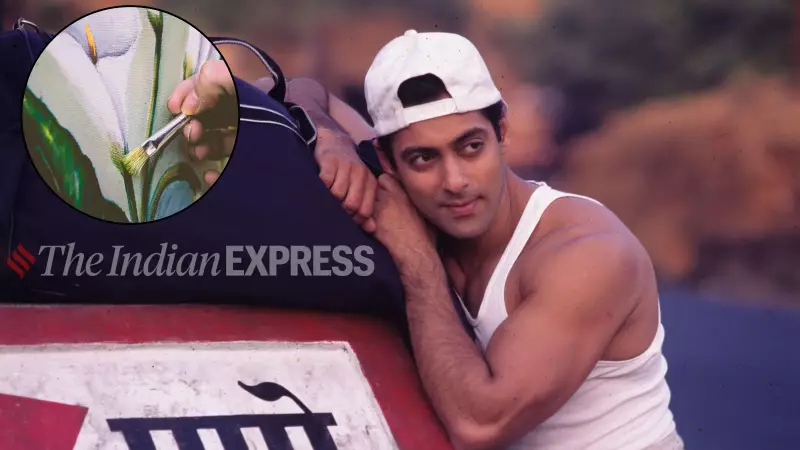
Bollywood superstar Salman Khan has opened up about the unintended side-effects of fame, revealing that his personal hobby of painting is often subjected to intense and unwanted psychological analysis simply because of his celebrity status. In a candid conversation, the actor expressed frustration at how his creative expressions are over-interpreted.
The 'Auto-Pilot' Creative Process
Khan, in an interview with noted film critic Anupama Chopra, described his artistic journey as something that now comes naturally to him, almost like being on 'auto-pilot'. He traced his beginnings back to a painting of his late dog, Myson. "I didn't know anything about shading and colours. I made him in gold and black," Khan recalled, adding that the skill eventually became instinctive.
This concept of creating art on auto-pilot is not merely casual talk. Psychologists affirm it as a legitimate mental state. S. Giriprasad, a psychologist at Aster Whitefield Hospital, explains that when a creative act is repeated consistently, the brain transitions it from a conscious effort to a familiar routine. Neural pathways for movement, colour choice, and expression become well-practised.

"This allows a person to slip into a flow state," Giriprasad states. "Flow is a mental space where they are deeply absorbed, self-critical thoughts quieten, and actions feel automatic. Painting becomes meditative—the mind relaxes, emotions find a channel, and the act feels grounding."
The Unwanted Spotlight of Fame
However, the ease of his creative process starkly contrasts with how his artworks are received by the public and critics. Khan pointed out the excessive scrutiny, stating, "Because my name is Salman Khan, I am an actor, so again I have been analysed by artists and psychiatrists for my emotional conditions."
He mimicked the kind of analysis his work receives: "What mind frame was he in? How much angst is in his work? His strokes are very wrong..." The actor's blunt retort to such over-analysis was simple and dismissive: "Acchha dikhta hai na? Khatam ho gayi baat." (It looks good, right? The discussion ends there.)
Giriprasad identifies this as a classic collision between fame and creativity. When a public figure creates, the audience often ceases to see it as a personal outlet. "People no longer see the art as a simple creative outlet but rather as a 'statement' made by the artist in the viewer's mind," he explains. The artwork becomes a canvas for public projection, judgment, and imagined psychological depth.
Psychology Behind the Frustration
The psychologist underscores that Khan's irritation is a natural response. "Too much critical observation is capable of removing the creative play and the feeling of security from the creative expression," Giriprasad warns. This external pressure can transform a safe, therapeutic activity into a performative act, where the creator feels watched and may start creating to explain rather than to express freely.
Importantly, Giriprasad clarifies that there is no single 'correct' emotional state for creating art. "Some people paint to express strong emotions—sadness, joy, anger—while others paint precisely to escape overthinking. Auto-pilot painting often happens when the goal isn't perfection but presence. The brush moves before the mind has fully 'decided', and that's completely healthy."
He frames this automatic creativity as a form of emotional regulation, where the brain processes complex feelings through action and colour, bypassing the need for verbal articulation. Salman Khan's experience, therefore, highlights a universal creative truth often magnified under the lens of celebrity: art can be a private sanctuary, and its interpretation is not always a measure of its worth.