On Monday, numerous synagogues and homes in the New York borough of Queens were vandalised overnight, according to the city council speaker. Photos going viral online showed black swastikas spray-painted on synagogue walls, a garage door with the symbol circles in red and on a window of a nearby residence. Moreover, the Rego Park Jewish Center was spray-painted with swastikas alongside the word 'Hitler' in red paint.
NYC Mayor Responds
NYC mayor Zohran Mamdani took to X to share his disappointment and concern over the incident. 'I am horrified and angered by the swastikas painted on homes and synagogues in Queens, including on a plaque honouring survivors of Kristallnacht. This is not just vandalism — it is a deliberate act of antisemitic hatred meant to instil fear,' he wrote while adding that antisemitism in Queens or anywhere in the city. 'I stand in solidarity with our Jewish neighbours. Their safety, dignity, and belonging are non-negotiable. The NYPD Hate Crimes Task Force is investigating and I am confident those responsible will be held accountable,' he added.
Controversy Over Terminology
While Mamdani's post was vital and earned him respect for his quick addressal of the seriousness of the matter, it angered some Hindu advocacy groups over the use of the word 'swastika' as a hate symbol. The Coalition of Hindus of North America (CoHNA) took to X to call out the NYC Mayor for his incorrect terminology. 'It is horrific to see homes and synagogues in NYC become the target of hate crimes. We trust swift action will be taken to tackle the issue. But Mayor Mamdani, we urge you to use the correct terminology and call these symbols of hate by the right name - the Hakenkreuz and not Swastika!' said the post.

They added that with Mamdani's South Asian Heritage, he is aware that the Swastika is an ancient Sanskrit word, sacred to 'millions of Hindus, Buddhists, Jains-many of whom call NYC home.' It also revealed that between 2020 and 2021, the New York Legislature debated bills to label the word Swastika as a hate symbol. 'We met with many of your colleagues to educate them on the accurate usage and they understood. We urge you to refer to the same and call Hitler's symbol of hate by the term he always used--the Hakenkreuz. Context & Accuracy Matter. We are happy to meet with your office and explain the issue in more detail,' said the post.
Hakenkreuz vs Swastika
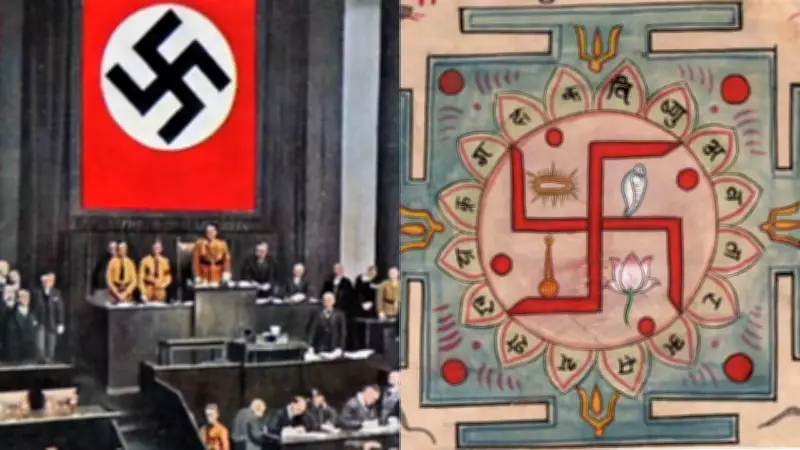
Swastika is a Sanskrit word derived from the roots 'su' and 'asti', meaning 'that which brings good luck and well-being.' The word 'swasti' also appears in the Vedas and across Hindu literature. Its design has many different meanings, denoting the movement of the universe, the four Vedas and the four-fold goals of life. In Hinduism, the symbol is pious and is used to decorate homes and temples. In US and Canada, there are towns named Swastika. In 1896, Thomas Wilson, a curator at the US National Museum even wrote a book on the symbol, tracing its origin and migration, titled 'The swastika: the earliest known symbol, and its migrations: with observations on the migration of certain industries in prehistoric times'.
However, with World War II and the holocaust, the connotation of Hitler's emblem of hatred overshadowed the swastika. Hakenkreuz, the symbol used by the Nazis is a German word meaning hooked cross. The symbol became popular in the country after archaeologist Heinrich Schliemann discovered it on the site of ancient Troy in 1872 and wrote about it in his 1891 book. He connected it with similar shapes and misinterpreted it as a valuable symbol of their ancestors and of a master race known as 'Aryans'. Hitler recognised the power of symbols. In Mein Kampf, he recounted his experience at a Marxist rally in Berlin, noting the impact of symbols: 'More than once in my youth, the psychological importance of such a symbol had been clearly evident to me from the point of view of sentiment. In Berlin, after the War, I was present at a mass demonstration of Marxism in front of the Royal Palace. A sea of red flags, red scarves, and red flowers, gave an outward appearance of power to that crowd, which I estimated at about 120,000 persons. I felt and understood how easily the man in the street is impressed by the suggestive magic of such a grandiose piece of play-acting.'

Hitler made the use of numerous crosses during his regime, for instance Ritterkreuz and Balkenkreuz. Gerhard Hahn, a prominent leader of the Lutheran Church of Hanover, Germany also spoke of the solidarity between the Hakenkreuz and the Christian cross: 'The cross of Christ and the [Hakenkreuz] do not need to oppose each other, and must not do so, but rather they can and should stand together. One should not dominate the other, but rather each should maintain its own meaning and significance…Both together, however, the cross of Christ and the [Hakenkreuz], admonish us: Remember that you are German Christian people and should become ever more whole German Christian people, and remain so!' Moreover, in the original version of Mein Kampf written in German, Hitler only made use of the word Hakenkreuz and not once did he mention a Swastika.