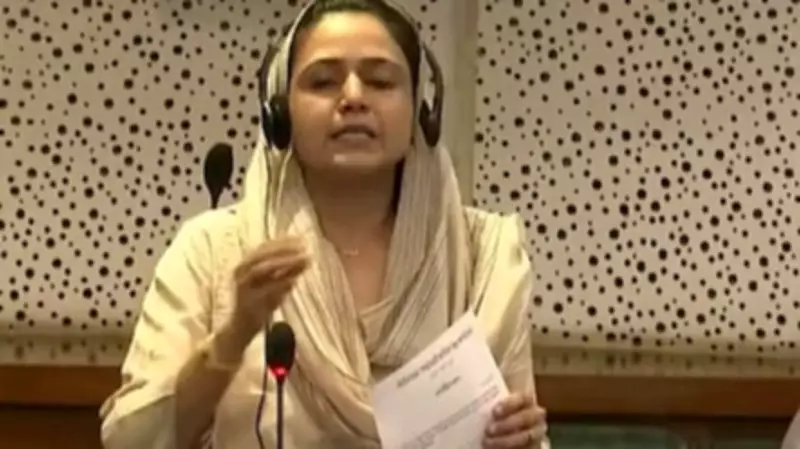
NCP MLA Sana Malik from Maharashtra has ignited a political and social firestorm by calling for the legalization of polygamy in India, a practice currently permitted only for Muslim men under personal law. Her remarks, made in Mumbai on June 25, 2026, have drawn sharp criticism from political rivals and social media users who question the logic of adopting policies akin to neighboring Pakistan.
Malik's Argument: Women's Issues vs. Religion
Speaking to reporters, Malik clarified that her objection was twofold: first, that women's issues should not be conflated with religion, and second, that the polygamy debate had been raised in a context that unfairly targeted Muslim personal law. She emphasized that her advocacy was for a uniform civil code that respects gender equality, not for the blanket imposition of polygamy. However, her comments were widely interpreted as a call to legalize polygamy across all communities.
Social Media Backlash and Political Reactions
Critics, including BJP supporters and Hindu activists, lambasted Malik's stance. Social media user Tushar KN posted, "If everything is to be like Pakistan, then why not leave this country and relocate to Pakistan?" The post went viral, amassing thousands of retweets within hours. Others accused Malik of undermining India's secular fabric and promoting regressive practices.

Political opponents from the BJP and Shiv Sena demanded an apology, calling her remarks "anti-national" and "divisive." They argued that polygamy is inherently discriminatory against women and has no place in modern India.
Context: The Polygamy Debate in India
Polygamy is currently legal only for Muslims in India under the Muslim Personal Law (Shariat) Application Act, 1937. However, the practice has been increasingly challenged in courts and public discourse. The All India Muslim Personal Law Board has defended it as a religious right, while women's rights groups argue it violates constitutional guarantees of equality.
In 2024, the Supreme Court had refused to entertain a petition seeking a uniform civil code, leaving the issue to Parliament. Malik's comments come amid renewed calls for a Uniform Civil Code (UCC) by the ruling BJP, which has made it a key electoral promise.
Impact on Maharashtra Politics
Maharashtra's political landscape is already volatile, with the ruling alliance of Shiv Sena (UBT), NCP, and Congress facing challenges from the BJP-led opposition. Malik's statement has provided fresh ammunition for the BJP to attack the Maha Vikas Aghadi government. Deputy Chief Minister Devendra Fadnavis said, "Such statements expose the regressive mindset of our political opponents. They want to drag India back to the 7th century."
Meanwhile, NCP chief Sharad Pawar has distanced his party from Malik's remarks, stating that it is her personal opinion and not party policy. However, the controversy has put the NCP on the defensive, especially with assembly elections due in 2027.
Women's Rights Groups Weigh In
Several women's rights organizations have condemned Malik's proposal. The National Federation of Indian Women called it "a dangerous step backward" and urged the government to instead focus on criminalizing polygamy for all communities. Lawyer and activist Flavia Agnes argued that "polygamy is inherently patriarchal and violates women's rights to equality and dignity. Legalizing it would be a disaster for gender justice."
However, some Muslim women's groups have expressed support for Malik, saying that the debate must be had without stigmatizing the community. They argue that a uniform civil code should not be used to target minorities.
Conclusion: A Divisive Issue with No Easy Answers
Sana Malik's remarks have once again brought the polygamy debate to the forefront, highlighting the deep divisions in Indian society over personal laws and gender equality. While critics see her stance as an endorsement of regressive practices, supporters view it as a call for a nuanced discussion on women's rights within religious frameworks. With the UCC debate intensifying, Malik's comments are likely to fuel further polarization in the run-up to the next general elections.