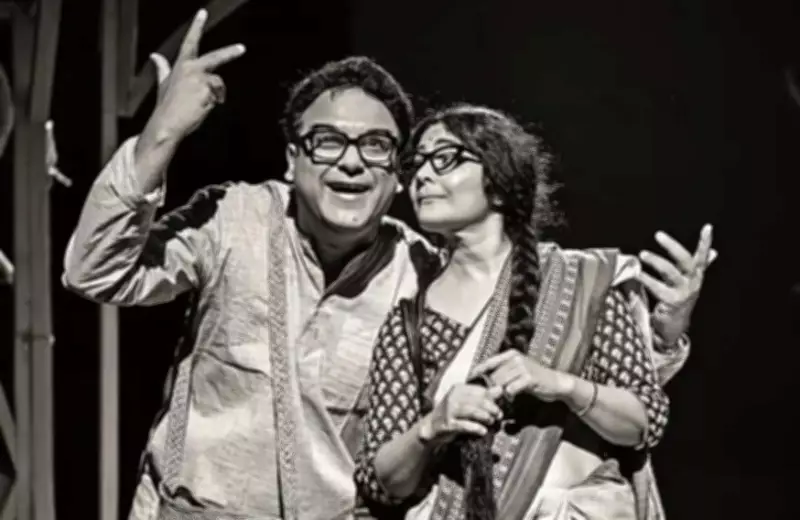
Cast: Sujan Mukhopadhyay, Nibedita Mukhopadhyay, Tarun Bhattacharya, Agnijet Sen, Rajat Narayan Bhattacharya, Mary Acharya. Director: Sujan Mukhopadhyay. Duration: 135 min. Language: Bengali. Rating: 3.5.
Based on a play by Jeet Satragni and directed by Sujan Mukhopadhyay, Meghe Dhaka Ghatak is less a conventional biography and more an emotional excavation of the life and contradictions of filmmaker Ritwik Ghatak. The production traces the intersections of love, artistic obsession, political conviction, professional disappointment, and self-destruction that shaped one of Indian cinema's most uncompromising auteurs.
A Relationship at the Core
At the heart of the play is Ghatak's relationship with his wife, Suroma Ghatak, portrayed with remarkable depth and sensitivity by Nibedita Mukhopadhyay. The narrative begins with the tenderness of their early romance, presenting Suroma not merely as a spouse but as a witness, companion, critic, and, ultimately, the person forced to bear the consequences of Ghatak's turbulent genius and self-destructive tendencies. References to films such as The Great Dictator and Battleship Potemkin illuminate the cinematic influences that shaped his worldview.

Performance and Direction
Sujan Mukhopadhyay delivers a compelling performance as Ghatak, capturing the restless energy of a man perpetually at war – with the film industry, with society, and, most painfully, with himself. The play's exploration of Ghatak's uneasy relationship with the Bombay film industry, particularly around projects such as Madhumati, reveals a filmmaker increasingly disillusioned with commercial cinema. His return to Kolkata emerges not as romantic martyrdom but as a difficult choice driven by artistic conviction.
Mukhopadhyay's direction is most effective when it blurs the boundaries between life and art. Characters, memories, and echoes from Ghatak's films inhabit the stage alongside the filmmaker himself, aided by strong performances from Rajat Narayan Bhattacharya, Agnijit Sen, Mary Acharya, and Ankita Das. The fragmented, haunted structure mirrors Ghatak's own aesthetic and reflects the personal impact of Partition, displacement, communism, and loss on his work.
A Descent into Darkness
The second half grows darker as depression and alcoholism take centre stage. The scenes between Sujan and Nibedita are particularly moving as love gradually gives way to exhaustion and helplessness. Ultimately, Meghe Dhaka Ghatak succeeds because it presents Ghatak not as a saint or martyr, but as a brilliant, flawed, deeply human artist whose legacy emerged from the very contradictions that consumed him.