The Enduring Wisdom of Giorgio Armani
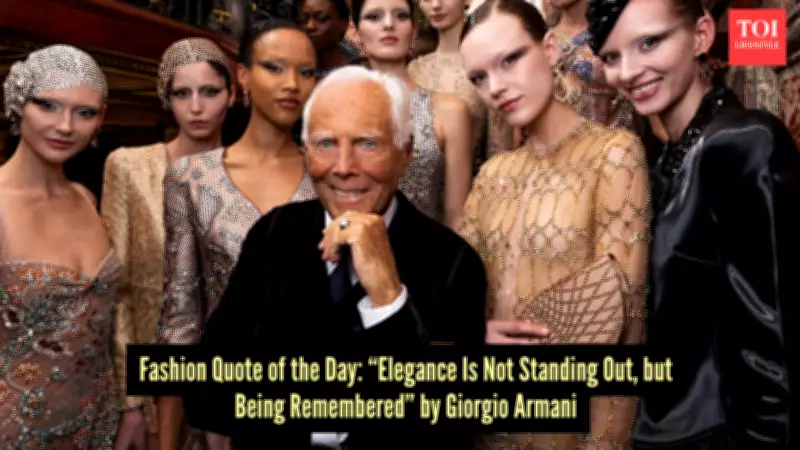
Have you ever entered a crowded room and immediately noticed someone—not because their outfit was loud or heavily embellished, but because they simply owned the space? That quiet, magnetic pull is exactly what Giorgio Armani articulated when he shared one of fashion's most profound truths: "Elegance is not standing out, but being remembered." In an era where our social media feeds are relentlessly flooded with fleeting micro-trends, this quote is experiencing a massive cultural resurgence. It is far more than a catchy soundbite for a motivational mood board. According to retrospectives at the recent Giorgio Armani Privé 2005-2025 exhibition, this specific philosophy served as the literal blueprint for Armani's revolutionary approach when he founded his label in 1975. It was a direct, calculated rebellion against the chaotic, ephemeral trends of the late 20th century.
Dismantling the Architecture of Fashion
Let us examine the garments themselves. Before Armani entered the scene, traditional heritage tailoring was incredibly rigid. It was built on stiff canvases, heavy linings, and pronounced shoulder padding that forcefully dictated the shape of the body. Armani looked at that standard and completely dismantled it. He stripped away restrictive padding and swapped stiff, unforgiving materials for softer, highly fluid textiles. The result was revolutionary: the "unstructured jacket." This garment draped over the body naturally, feeling less like a stiff uniform and more like a second skin. Luxury suddenly ceased to be about artificial, heavy embellishment. Instead, it became entirely about structural subtlety, mastery of the drape, and profound respect for raw materials.
The Psychology of Subtle Authority
Flashy, trend-heavy outfits demand immediate visual attention, but often, the clothes end up wearing the person. There is a deeper psychological layer here. Armani understood something fundamental about human nature: what you wear profoundly impacts your emotional resilience and shapes how competent others perceive you to be. Flashy clothing demands attention, but Armani's understated refinement pulls a brilliant psychological trick. It shifts cognitive focus away from the garment and places it directly onto the individual. The "memory" he references in his famous quote is the lasting impression of a cohesive, confident, and grounded human being. By prioritizing natural lines and physical comfort, his designs foster internal assurance, which projects a subtle yet undeniable authority in any high-stakes environment.

Redefining Power Dressing
If you seek proof of how this philosophy works in the real world, look at historical milestones. Armani frequently used his softened tailoring to actively shift public discourse around both gender and power dressing. At the 1978 Academy Awards, Diane Keaton stepped up to accept her Oscar wearing an oversized, softly tailored Armani men's suit. It was a radical departure from the expected sea of traditional evening gowns. That look remains cemented in cultural memory far longer than any standard dress from that era. Similarly, at the 1990 Golden Globes, Julia Roberts appeared in a relaxed, menswear-inspired Armani suit to claim her award. She proved once again that thoughtful, comfortable tailoring leaves a more enduring legacy than overt, try-hard glamour.
Quiet Confidence is the Loudest Statement
In a world currently obsessed with doing the absolute most, there is profound power in doing just enough. Changing the physical construction of a garment—something as simple as removing a stiff shoulder pad—managed to shift our entire cultural understanding of elegance. It turns out, quiet confidence truly is the loudest statement one can make.