To understand the enduring myth of Tom Cruise and his character Maverick, we must begin in 1986. Cultural commentators have often hailed 1986 as the greatest year for pop culture, a year that defined bold and beautiful trends. In the Western world, television soaps like Blackadder II and Yes, Prime Minister captivated millions. In Mexico, Argentina won the World Cup thanks to Diego Maradona's 'Hand of God.' Madonna ascended to pop royalty with 'Like a Virgin,' while George Michael left Wham! for a solo career. Elsewhere, 1986 marked the last time Freddie Mercury performed live with Queen. Iconic music videos from Robert Palmer, Peter Gabriel, Whitney Houston, and Madonna dominated screens. Then came Tony Scott's Top Gun, the must-see movie of the year, instantly elevating Tom Cruise to superstar status and beginning his journey to becoming the last great movie star.
1986: A Pivotal Year for India Too
India was equally vibrant in 1986. Bollywood united in a historic strike against heavy state taxation on cinema tickets and equipment, with stars like Dilip Kumar, Raj Kapoor, and Mithun Chakraborty delivering rousing speeches. The biggest films included Subhash Ghai's Karma and Harmesh Malhotra's Nagina, starring Sridevi, which introduced the iconic snake dance. Pankaj Udhas's song 'Chitthi Aai Hai' took the nation by storm. Cable TV and VHS tapes began entering Indian homes, allowing audiences to watch Top Gun repeatedly, fueling the legend of Maverick and Tom Cruise in India.
The Birth of a Legend
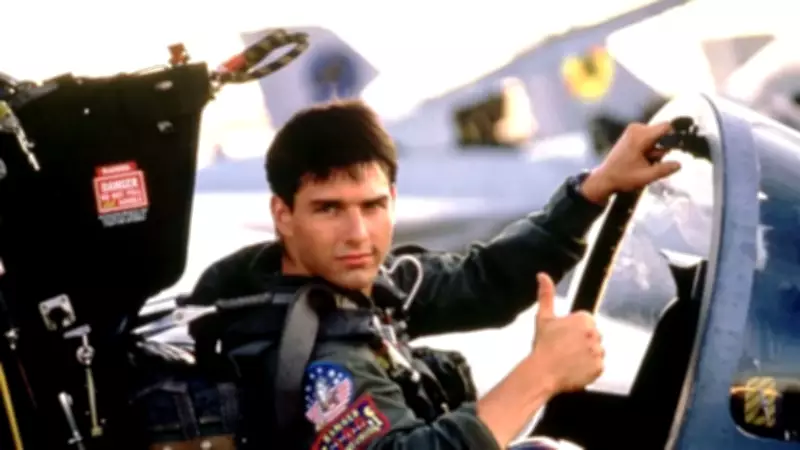
In Top Gun, there is a moment when Maverick walks across the tarmac in aviators and a bomber jacket, with fighter jets roaring behind him. That moment defined the essence of a movie star. Hollywood had many handsome and charismatic actors, but few radiated the cinematic electricity that makes audiences believe they are watching someone larger than life. Tom Cruise had it in 1986, and nearly forty years later, he still does.

How Does He Do It?
Maverick is not just a nostalgic character; he is a modern myth. In an era of franchises and streaming, Maverick's character feels startlingly alive because he represents unapologetic movie-star cool—something that cannot be manufactured. Top Gun created one of the last universally recognizable cinematic myths of the analogue age. Cruise built on this through his choice of movies, acting prowess, and sheer star power, crafting a brand as big as Maverick himself. The result was Top Gun: Maverick (2022), which earned approximately $1.496 billion worldwide, becoming Cruise's highest-grossing film and the second-highest-grossing film of 2022.
Cultural Detonation
When Top Gun released in 1986, it became the highest-grossing movie of the year, transforming Cruise into a global phenomenon. But its impact went beyond box office numbers. It altered fashion, music, advertising, masculinity, action cinema, and the visual grammar of 'cool.' The hyper-stylized action montages, music-video editing, and emotionally charged spectacle became foundational to modern pop culture. Maverick's aviators, bomber jacket, and motorcycle became iconic symbols of attitude and freedom.
Outliving the Decade
What makes Top Gun and Tom Cruise extraordinary is that both have outlived the 1980s. Younger audiences rediscover the film with genuine excitement, not nostalgia. TikTok edits of Maverick go viral, and Gen Z treats the film's aesthetic as a mood board. The myth survives because of timing—the mid-1980s were perfect for a film obsessed with confidence, spectacle, and technological supremacy. Tony Scott shot the film like a fever dream of speed and desire, using sunsets, faces in twilight, and fighter jets slicing through the sky. He understood that audiences were absorbing atmospheres, and he made that atmosphere revolutionary.

The Emotional Fracture
Maverick's charisma differs from earlier icons like Steve McQueen or Clint Eastwood. He is emotionally transparent beneath the swagger—competitive, needy, fearful, hungry, and restless. His confidence feels performed rather than inherited. This contradiction makes him modern. Today's younger generations understand performative confidence because social media has turned identity into performance. Maverick spends the film trying to convince himself he is fearless, but the movie dismantles that illusion when Goose dies and Maverick freezes midair. That emotional fracture elevates the character from poster icon to enduring myth.
Universal Aspiration
Top Gun sold aspiration better than almost any blockbuster of its era. It offered a fantasy of beauty, velocity, competence, romance, and glamour that transcended borders. The soundtrack amplified this global portability—'Danger Zone' and 'Take My Breath Away' became cultural touchstones. The film avoided realism because realism ages; myth survives. The aerial sequences remain astonishing due to genuine physical danger, contributing to the Maverick myth. Cruise's stardom depends on the audience believing he risks himself for spectacle, and his physical commitment is evident in every role.
Merging of Man and Myth
Over time, Cruise and Maverick merged into a single cultural figure. As the traditional movie-star system collapsed, Cruise resisted digital abstraction by doubling down on physical cinema—real stunts, real locations, real risk. This commitment made him the last major star behaving like movie stars once did. To Gen Z and Gen Alpha, Cruise feels almost mythological. He remains elusive, controlled, and slightly unknowable, arriving as an event rather than content. That old-school mystique feels radical in the age of oversharing.
A Meditation on Ageing
Top Gun: Maverick deepened the myth by transforming Maverick into a meditation on ageing. Cruise played him as a man stranded between eras—younger pilots see him as a living legend, while institutions view him as obsolete. Audiences responded with overwhelming emotion because the character symbolized human instinct surviving technological efficiency. The sequel's success proved that younger generations hunger for sincerity. Modern blockbuster culture often hides behind irony, but Top Gun believes in emotion without embarrassment, heroism, and spectacle that inspires awe.
Why the Myth Endures
Both Maverick and Cruise thrive because Top Gun was emotional, not ideological. Maverick represents the fantasy of the gifted rebel who refuses domestication. He matures but does not become dull, learning responsibility without losing danger. This fantasy becomes powerful in contemporary life, where younger generations feel trapped by corporate culture, economic instability, and algorithmic pressure. Cruise never stopped feeding the myth—his Mission: Impossible franchise transformed him into the embodiment of commitment. When younger audiences watch the original Top Gun, they witness the origin story of the last great analogue movie star.
Emotional Symbols
Great movie myths condense emotional desires into recognizable forms. Superman represents moral hope, James Bond represents elegant power, and Maverick represents velocity against fear. The imagery of Maverick racing beside a fighter jet, grinning through danger, and walking into sunsets with synth music are emotional symbols. Tony Scott filmed emotions like weather, turning movement into mythology. Without his visual genius, Maverick might have remained just another charismatic hero.
Forty years later, the world that created Maverick barely exists. The Cold War is over, MTV has faded, and cinema competes with fragmented digital attention. Yet Maverick still flies across generations because the fantasy he embodies remains eternal: being exceptional without losing humanity, remaining free inside systems demanding obedience, confidence masking fear, movement defeating stillness, and coolness feeling authentic. Tom Cruise is not just an actor anymore—he is an idea. And between Tony Scott's glowing sunsets, Cruise's impossible charisma, roaring fighter jets, heartbreak, aviators, synth music, and pure cinematic confidence, that idea has become immortal.