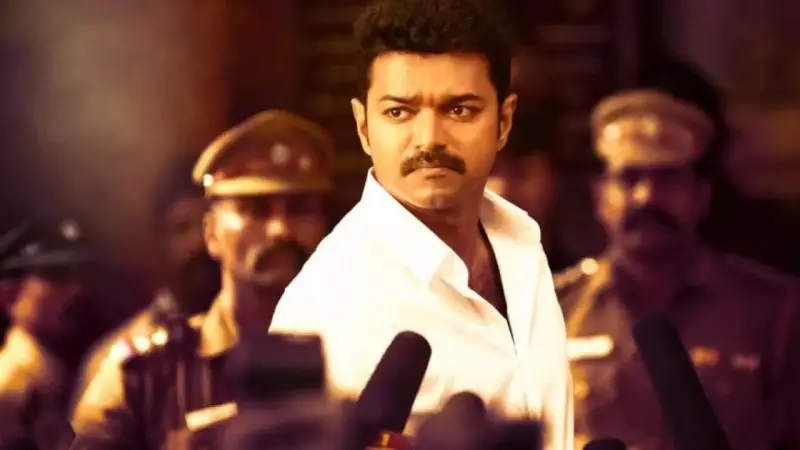
Long before 'Jana Nayagan' encountered censor board hurdles, Thalapathy Vijay's 2017 blockbuster 'Mersal' weathered a significantly larger and more complex storm. The film found itself in the crosshairs of multiple entities, facing objections not from a single source but from a combination of political parties, medical associations, and official regulatory boards. The controversy swiftly shifted public discourse away from the film's cinematic merits and squarely onto the fiery debates it ignited.
A Multifaceted Controversy Erupts
The film's pointed critiques of the Goods and Services Tax (GST), certain medical practices, and the Digital India initiative became a flashpoint, drawing sharp reactions from various quarters. However, one of the most substantial and protracted battles was fought with the Animal Welfare Board of India (AWBI). The board raised a critical objection, stating it had not issued the necessary No Objection Certificate (NOC) for the film's use of animals, a mandatory clearance required before a movie can receive certification from the Central Board of Film Certification (CBFC).
Despite this, the film's makers created confusion by announcing on October 6, 2017, that 'Mersal' had received a U/A certificate. The CBFC was quick to counter this claim, with official MM Mathialagan clarifying that no certificate had been issued at that time. He expressed bewilderment at the team's social media announcement, stating that for such a high-profile project, the makers' actions were difficult to comprehend.

The Animal Welfare Board's String of Allegations
An AWBI source, in a 2017 explanation to TOI, detailed how the problems began. While the production team had obtained pre-shoot permissions for using animals in parts, a specific shoot at Binny Mills allegedly proceeded without clearance for several creatures. The board claimed that animals and birds, including macaques, cockatoos, pigeons, and snakes, were used on set without the required permits. By the time officials arrived to investigate, the animals had been removed, but evidence like feathers and droppings led to a filed case.
The situation grew more tangled when the makers later applied for permission for scenes that had already been filmed. The AWBI rejected this retroactive request, citing the clear violation of shooting first and asking later. The board also found the team's explanation about animal suppliers lacking credibility. Further issues emerged during review:
- Horses and camels were shown performing actions, though permission was granted only for their background presence.
- For a scene involving birds, the makers claimed the use of Computer Graphics but failed to provide proof.
- A critical discrepancy arose in a snake scene: while documentation mentioned a king cobra, the actual footage featured an Indian cobra, a species protected under the Wildlife Protection Act, making permission impossible to grant.
Consequently, the AWBI rejected the NOC application multiple times based on these violations.
Stormy Release and Lasting Legacy
Despite the whirlwind of pre-release controversies surrounding animal permissions and political commentary, 'Mersal' eventually hit the big screens with tremendous force. It was met with massive audience approval and went on to become one of Vijay's most successful commercial entertainers, a title it holds firmly to this day. The film's impact was such that it was later remade in Hindi as 'Baby John', though the Bollywood adaptation failed to replicate the original's success and tanked at the box office.
The saga of 'Mersal' remains a notable chapter in Tamil cinema, highlighting the intricate challenges a major film can face when navigating the intersecting realms of entertainment, regulation, and social commentary.