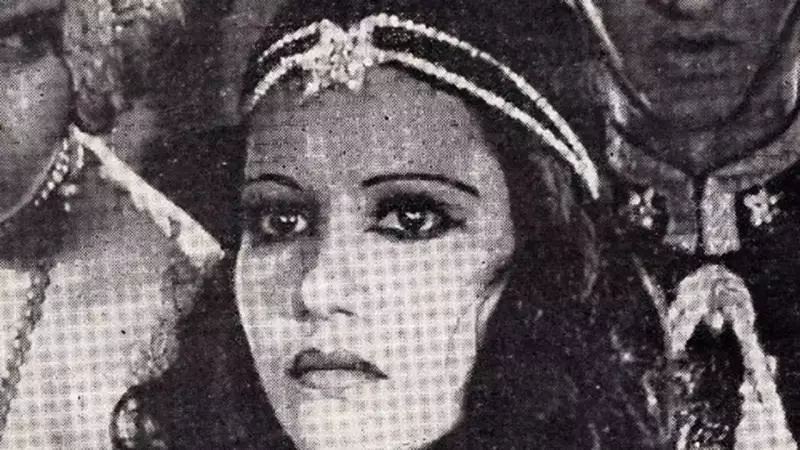
In the glittering history of Indian cinema, names like Helen, Bindu, and Zeenat Aman are often celebrated as the original 'item girls.' But decades before they set the screen on fire, a trailblazing artist named Madam Azurie had already defined the genre. Appearing in over 700 films, she was India's first true item dancer, a phenomenon whose legacy includes a rare performance at Buckingham Palace.
The Original Phenomenon: Defining Item Dance Before Bollywood
Madam Azurie was a pioneer who made dance her primary identity in an era when actresses were confined to conventional roles. She wasn't just a performer in a song; she was the standalone attraction that elevated musical sequences. Her influence was so foundational that subsequent generations of dancers unknowingly walked the path she carved in the 1930s and 40s, long before the term "item girl" was popularized by Bollywood.
A Cross-Cultural Upbringing That Forged a Unique Style
Azurie's artistic uniqueness was rooted in a fascinating and complex childhood. She was born to a Hindu Brahmin mother and a Jewish German father. After her parents separated, she lived with her father, who, as reported by India.com, encouraged her to learn Western ballet but disapproved of Eastern dance forms. This cultural contradiction, however, did not limit her. Instead, Azurie embraced both worlds, synthesizing them into a distinct, fluid style that would later captivate Indian audiences and filmmakers alike.

Rewriting Cinema History: The True Origin of Item Songs
Many film enthusiasts credit the dancer Cuckoo for popularizing item numbers with her performances in classics like 'Awaara' (1951) and 'Aan' (1952). However, Madam Azurie's career proves that bold, standalone dance sequences were an integral part of Indian cinema much earlier. Her work establishes that the item song is not a modern invention but a cinematic tradition with a legacy stretching back to the black-and-white era of the 1930s.
Her extensive training in multiple dance forms made her an instant standout in the Bombay film industry. Her debut film, 'Nadira', led to numerous roles in movies such as 'Pardesi Saiyaan', 'Qatl-e-Aam', 'The Bombay Talkies', and 'Naya Sansar'. Filmmakers relied on her to elevate any scene, and her fame reached such heights that she received the extraordinary honour of performing at Buckingham Palace.
A Legacy That Crossed Borders
After India's independence, Azurie began a new chapter. She married a Muslim man and moved to Rawalpindi, Pakistan. There, she continued her artistic journey by appearing in Pakistani films. Passionate about preserving her art, she opened a classical dance academy and trained countless students. Her silent yet powerful influence continued to shape the evolution of dance and item numbers on both sides of the border, ensuring her pioneering spirit lived on.
Madam Azurie's story is more than a trivia footnote; it is a crucial chapter in the history of Indian popular culture. She was the original architect of a cinematic tradition that continues to thrive today, reminding us that the most iconic trends often have a forgotten, extraordinary beginning.