Randeep Hooda Advocates for Contextual Understanding of Historical Figures Like Savarkar
Actor and director Randeep Hooda delivered a compelling address at the Nagpur Film Festival (NFF) on Saturday, emphasizing the critical need to comprehend historical personalities such as Vinayak Damodar Savarkar within the framework of their respective eras. Hooda articulated that storytelling must strike a delicate balance between rigorous research and contemporary relevance to authentically portray complex figures.
Savarkar: A Man of Contradictions and Nuance
During an interactive session on the festival's second day, Hooda described Savarkar as "a man of contradictions" whose ideas and literary works were profoundly shaped by the circumstances of his time. He stressed that depicting such multifaceted individuals demands depth and nuanced interpretation, moving beyond simplistic characterizations.
Hooda, who both directed and starred in the biographical film "Swatantrya Veer Savarkar," revealed that the project originated from a sense of anger and urgency to present a more layered understanding of the freedom fighter. He noted that Savarkar was a significant social reformer and influencer, yet much of his work, particularly in Marathi, remains insufficiently accessible at the national level.

"Initially, I had said no to the film, but then I started reading about him. I made Savarkar in anger. People don't really know much about such a towering figure and often reduce him to social media labels," Hooda stated. He added that the film represented his endeavor to offer a researched and multifaceted perspective, despite receiving advice against undertaking the project.
Cinematic Narratives: Global Lessons for Indian Filmmaking
The discussion expanded to the power of cinematic narratives, with Hooda drawing comparisons between global and Indian storytelling approaches. He observed that nations like the United States have effectively constructed robust national narratives through cinema, frequently influencing worldwide perceptions.
"We end up believing those narratives because they consistently speak about their governance, army, law and order everything," Hooda remarked. He urged Indian filmmakers to craft stories that resonate universally while authentically reflecting the country's cultural and social realities.
Advocating for greater cohesion within the industry, Hooda commented, "Hollywood works collectively to establish its narrative, while Bollywood often remains divided in fighting narratives among ownself." He emphasized that Indian cinema should transcend internal debates and concentrate on producing compelling narratives that connect with audiences internationally.
Empowering New Creators and Digital Age Filmmaking
Addressing aspiring filmmakers, Hooda highlighted the improved accessibility to filmmaking tools, noting that even short-form content like vertical reels has emerged as a potent storytelling medium. He encouraged creators to document local culture, traditions, and untold stories, affirming that not every narrative necessitates a full-length feature film.
Festival discussions also centered on filmmaking in the digital era. Actor-director Yogesh Soman pointed out that while smartphones have democratized filmmaking, creating meaningful cinema still requires structured training and an understanding of audience engagement. He asserted that content must be shaped with viewer behavior in mind, where format and presentation are as crucial as the storyline.
Music composer Shreyas Puranik underscored the expanding role of technology, particularly artificial intelligence, in enhancing creative output, while maintaining that human creativity remains central to filmmaking. Speakers highlighted burgeoning opportunities across various industry roles, stressing that adaptability and hands-on experience are essential for newcomers navigating a rapidly evolving cinematic landscape.

Ramtek Film City: Boosting Regional Filmmaking Infrastructure
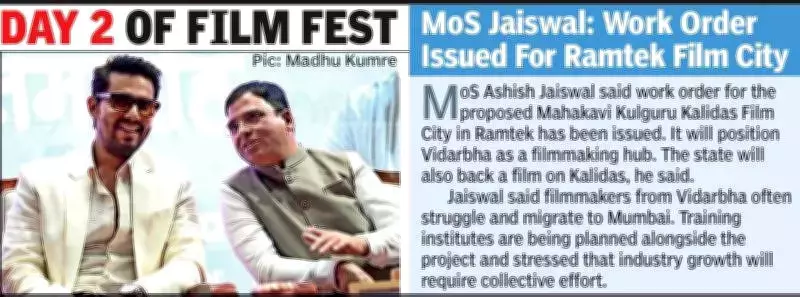
In related developments, Minister of State Ashish Jaiswal announced that a work order has been issued for the proposed film city at Ramtek. The Mahakavi Kulguru Kalidas Film City aims to position Vidarbha as a filmmaking hub, with the state also supporting a film on Kalidas.
Jaiswal noted that cinema can help revive cultural narratives at a time when reading habits are declining. Addressing infrastructure gaps in the region, he mentioned that filmmakers from Vidarbha often migrate to Mumbai, but training institutes are being planned alongside the project. He also pointed to OTT platforms as new avenues for regional creators to showcase their work.