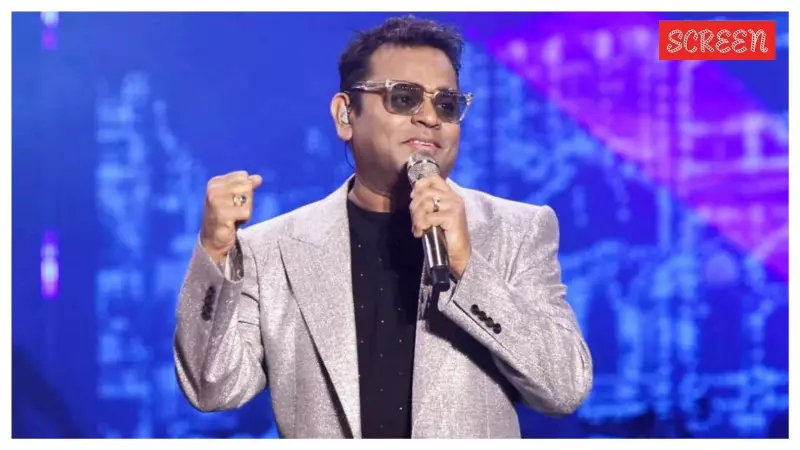
AR Rahman's daughter Raheema has launched a sharp critique of what she calls a "blind society" and "toxic politics." This comes as the entire Rahman family rallies to defend the celebrated composer. Rahman recently faced significant backlash for comments he made about the Hindi film industry.
Family Rallies with Videos of National Pride
Rahman's children—son Ameen and daughters Khatija and Raheema—have taken to social media to showcase their father's legacy. They posted a series of old videos highlighting Rahman's moments representing India on the world stage.
Ameen shared an Instagram story featuring Rahman waving to fans in a packed stadium with his iconic song "Jai Ho" playing. He also posted clips from a massive stadium concert where Rahman took selfies with a sea of admirers. Other photos showed the composer posing respectfully with President Droupadi Murmu.

A Clip of Prime Minister Modi's Praise
The family also shared a notable video clip of Prime Minister Narendra Modi publicly praising AR Rahman. In the clip, PM Modi tells a crowd, "Be it AR Rahman's music or Rajamouli's storytelling, it has become a voice of Indian culture and won the hearts of crores of people worldwide."
Further videos highlighted Rahman's professional accolades. One showed him receiving the National Award for Best Music Director from the President for his work on "Ponniyin Selvan: Part 1." Another clip revisited his experience at the Oscars, where he won for Original Score for "Slumdog Millionaire" in 2009. Sister Khatija reshared all these posts, amplifying the message of her father's accomplishments.
Raheema's Fiery Social Media Posts
While Ameen and Khatija focused on achievements, daughter Raheema directly addressed the online critics. She reshared a powerful note that read, "They don't have time to read the Bhagavad Gita, the Qur'an or the Bible – the sacred words that teach love, peace, discipline, and truth. But they have all the time in the world to argue, mock, provoke, abuse, and disrespect each other."
The note continued with a stronger indictment: "This isn't religion. This is what blind society, half-baked education, toxic politics, and broken parenting have created – a generation more loyal to hate than to humanity." Another shared statement offered a poignant observation: "Bhagvat Gita and Quran never fight in library. But, ironically those who fight over them are those who never went to library."
What Sparked the Controversy?
The family's defense stems from an interview Rahman gave to BBC Asia Network. When asked if he felt discriminated against in Bollywood, Rahman offered a nuanced response. "Maybe in the past eight years because a power shift has happened and people who are not creative have the power now," he said. "It might be a communal thing also… but it is not in my face."
He mentioned hearing "Chinese whispers" about being passed over for work but maintained a philosophical stance. "I say good, I have more time to chill with my family. I am not in search for work... Whatever I deserve, I get."
Comments on the Film 'Chhaava'
Rahman also discussed composing for the film "Chhaava," acknowledging its divisive nature. "It is a divisive film. I think it cashed in on divisiveness, but I think the core of it is to show bravery," he stated. He explained that the director insisted only he could score the film. Rahman expressed honor in scoring a movie with "the pulse and soul of every Maratha," referencing the moving poetry at its conclusion.
Following the backlash, Rahman issued a video clarification. He reaffirmed India as his inspiration and his commitment to creating music that "honours the past, celebrates the present and inspires the future." His family's public support now adds a personal dimension to this ongoing public debate about creativity, community, and commentary in India's cultural landscape.