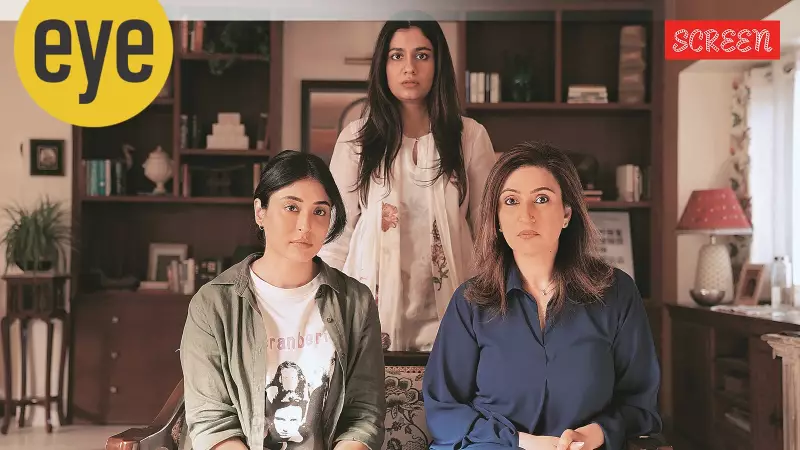
While big-budget spy thrillers dominate screens, a quiet, intimate film set entirely within a Delhi apartment is making a significant impact. 'The Great Shamsuddin Family', recently released on JioHotstar, turns the spotlight inwards, using a confined domestic space to tell a sprawling story about contemporary urban life.
An Intimate Lens on a Chaotic World
Writer-director Anusha Rizvi, speaking from her south Delhi office, explains the deliberate choice of setting. "This is an intimate story, it had to be told in a more intimate set-up," she says. The film follows Bani, played by Kritika Kamra, a divorced Muslim writer racing against a deadline for a US application. Her focus is shattered by a parade of uninvited guests: friend Amitav (Purab Kohli), a young student, bickering aunts, and her cousin Zoheb, who arrives with Pallavi, the Hindu woman he was to marry, after their court wedding is thwarted by an ill registrar.
Rizvi, a former TV journalist renowned for reviving the Urdu storytelling tradition of Dastangoi, draws inspiration from current headlines. "At the end of the day, I am a storyteller... when you set off to tell their story, you also have to tell the story of her surroundings, her times," she states. The film's genesis was Amitav's character, inspired by a real incident where a friend's acquaintance overstayed for three weeks. "I found that fascinating because it came from my life... a whole lot of things are pushed your way which are not necessarily constructive," Rizvi adds.

Ensemble Cast and the Delhi Dialect
The film boasts a stellar ensemble including Farida Jalal, Dolly Ahluwalia, and Sheeba Chaddha. Rizvi recalls the unique energy on set, which featured 14 women actors in a small setup. "It was amazing. Nobody would go to their vanities, they would hang out there, chatting, discussing problems, sharing gharelu nuskhe," she laughs.
Daughter of a linguist, Rizvi meticulously crafted the dialogues to sound authentically Delhi. "I was very consciously trying to create a Delhi conversation because the way people speak English in Bombay is different," she notes, giving examples like 'aksing' instead of 'asking'. The film was shot primarily in Chattarpur, with a key scene on a Nizamuddin terrace overlooking Humayun's Tomb, which Rizvi envisioned not as a landmark but as "a witness... somebody witnessing the act of the times."
Humour, Fear, and the Politics of Our Times
As with her debut 'Peepli Live' (2010), which tackled farmer suicides, Rizvi uses humour to explore grave issues. The absurdity of Zoheb and Pallavi's failed court wedding, based on a real incident, is a prime example. "It is very serious for the person going through it but it's also absurd, and how do you overlook that?" she questions.
Despite the apartment's confines, the threats of the outside world loom large. A pervasive fear of mob violence runs through the narrative, affecting the characters' mental state. "This fear... will have certain consequences, it will have effects over their mental makeup and anxiety levels. It seeps through so many parts of life," Rizvi observes.
The film also touches on debates like triple talaq, with a character casually asking Bani if she received a 'TT'. Rizvi criticizes the "saviour complex" surrounding Muslim women and calls the triple talaq debate "quite misinformed," arguing that more urgent issues like access to education and jobs deserve attention.
Despite underlying tensions, the film concludes on a hopeful note with the family singing a wedding song. Rizvi sees her work as part of a larger cinematic documentation. "Your intent is always to tell the story you want to. It is the story of our times... we are preserving our times, we are documenting our times. A lot of filmmakers are doing that," she concludes, drawing a parallel to filmmakers like Neeraj Ghaywan ('Homebound').