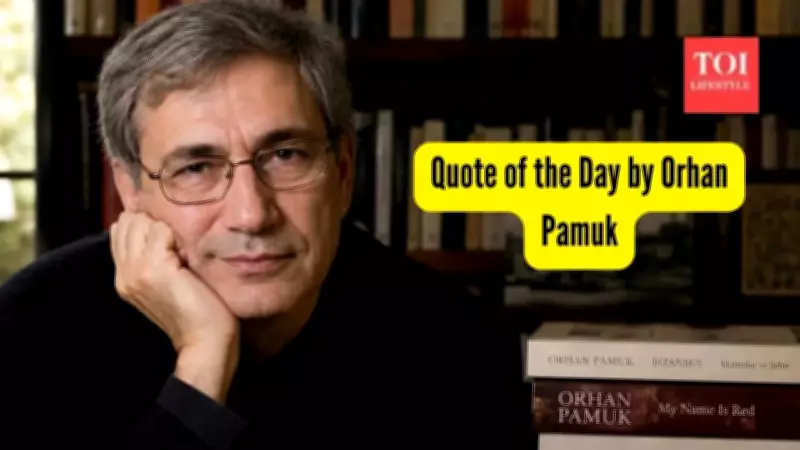
Orhan Pamuk stands as one of the most significant and intellectually stimulating writers of the contemporary era. Born in 1952 in Istanbul, Turkey, into an upper-middle-class family that was secular and heavily influenced by Western culture, Pamuk's upbringing was marked by a lack of religious belief. The city of Istanbul, straddling Europe and Asia with a rich history of empires, later became a central character in many of his narratives, profoundly shaping his literary imagination.
Early Life and Education
Pamuk initially pursued architecture at Istanbul Technical University, bowing to family expectations, but soon abandoned this path to dedicate himself to writing. He later earned a degree in journalism from Istanbul University, though he never practiced as a journalist, focusing exclusively on fiction for years before gaining recognition.
Literary Breakthroughs
His debut novel, Cevdet Bey and His Sons (1982), chronicles the lives of a Turkish family over generations. Pamuk achieved international fame with My Name Is Red (1998), a novel blending mystery, historical fiction, and art criticism. Another pivotal work, Snow (2002), explores the conflict between secularism and Islamism in modern Turkey. His writings tackle pressing global issues such as free speech, identity, and the role of religion in public life.

Istanbul: Memories and the City
In his 2003 memoir, Istanbul: Memories and the City, Pamuk blends autobiography with cultural history, reflecting on his childhood and the pervasive sense of melancholy, or hüzün, that defines Istanbul. This concept is central to understanding his worldview and literary output.
Nobel Prize and Global Impact
In 2006, Pamuk became the first Turkish writer to win the Nobel Prize in Literature. The Nobel Committee praised his ability to discover new symbols for the clash and interweaving of cultures. This achievement cemented his status as a global literary figure and brought greater attention to Turkish literature worldwide.
Themes and Writing Style
Pamuk's work explores cultural identity, memory, and history, often focusing on the experience of living in a place caught between two worlds—geographically, culturally, and historically. His postmodern style features complex structures, multiple perspectives, and genre blending, challenging the notion of a single truth. He employs symbols, metafiction, and intertextuality, creating narratives that are both emotionally resonant and intellectually rigorous. His vivid descriptions of Istanbul capture the city's beauty, decay, and melancholy.
Recurring Concerns
His characters frequently grapple with loneliness and the search for meaning in a rapidly changing world, reflecting broader historical and cultural shifts. This makes his work both personally and socially significant.
Public Intellectual and Controversies
Beyond writing, Pamuk has been an outspoken public figure, addressing controversial issues like freedom of speech and historical memory. In Turkey, he has faced legal challenges and public criticism, yet he has steadfastly defended his beliefs, embodying the role of an engaged thinker.
Legacy
Orhan Pamuk's life and work represent a unique fusion of personal experience, cultural insight, and literary innovation. His writing bridges past and present, East and West, reality and imagination, offering readers profound insights into identity and collective history. His novels, essays, and speeches have left an enduring mark on world literature, establishing him as one of the most influential writers of his time.

Quote of the Day
One of Pamuk's most iconic lines is: "We live but for a short time, we see but very little, and we know almost nothing; so, at least, let's do some dreaming. Have yourself a very good Sunday, my dear readers." This statement reflects deep contemplation on human responsibility and the ripple effects of our actions. It urges us to live with awareness that every deed has lasting consequences, not in a physical sense, but in how actions shape people, relationships, and circumstances over time. The core message emphasizes accountability: individuals are defined by the effects they create, forming an unbroken chain of events. Intentions alone are insufficient; what matters is the real-world outcome. A careless choice, even if unintended, can have enduring repercussions, just as a kind act can generate lasting positivity. This idea carries a moral dimension, encouraging deliberate and thoughtful living where decisions consider future impact. It promotes ethical awareness and a deeper, more meaningful freedom—one requiring reflection and responsibility. Rather than inducing fear, it fosters mindfulness, compassion, and prudence, reminding us that our actions matter both now and in the long run.
About the Author
The TOI Lifestyle Desk is a dynamic team of dedicated journalists who, with unwavering passion and commitment, sift through the pulse of the nation to curate a vibrant tapestry of lifestyle news for The Times of India readers. At the TOI Lifestyle Desk, we go beyond the obvious, delving into the extraordinary. Consider us your lifestyle companion, providing a daily dose of inspiration and information. Whether you're seeking the latest fashion trends, travel escapades, culinary delights, or wellness tips, the TOI Lifestyle Desk is your one-stop destination for an enriching lifestyle experience.