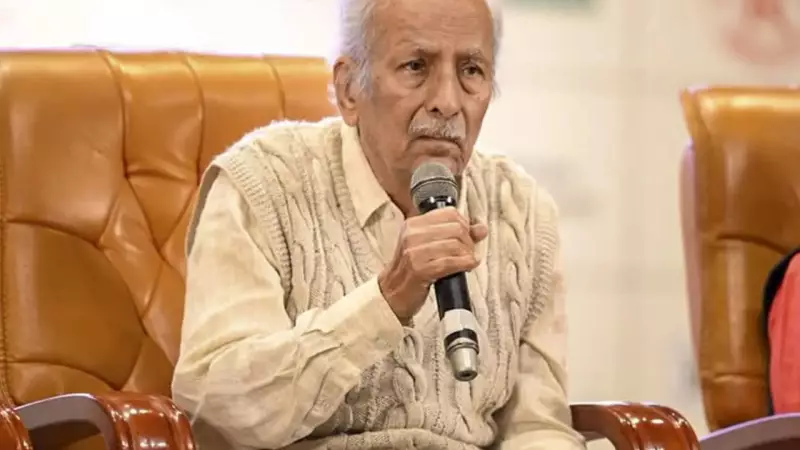
The world of Hindi literature lost one of its most graceful voices with the passing of Vinod Kumar Shukla on Tuesday. The celebrated writer, who became the first Jnanpith awardee from Chhattisgarh last year, was 88 years old. He breathed his last in Raipur after a prolonged battle with a lung ailment.
A Writer's Resolve Until the Very End
Shukla had been undergoing treatment in the Chhattisgarh capital since December 2 and was on ventilator support from December 19. Despite his weakening physical state, his spirit to create remained unbroken. His son, Shashwat, revealed a poignant detail to the Times of India: the writer carried a writing pad even inside the ICU.
Inspired by his surroundings, he composed his final poem from his hospital bed on December 6. The lines, written in an infirm hand, read: "Batti maine pehle bujhayee / Phir tumne bujhayee / Phir dono ne mil kar bujhayee." This encapsulated his lifelong, quiet observation of the world.

In a conversation with Prime Minister Narendra Modi a few weeks prior, Shukla had said, "Writing is like breathing for me." The PM later condoled his death on X, stating the writer would be remembered for his invaluable contribution to literature.
A Legacy of Quiet Profundity and Accolades
Vinod Kumar Shukla's writing was marked by a rare, understated depth. He wrote sparingly but with profound impact, illuminating the inner worlds of ordinary people. His most celebrated novel, "Naukar Ki Kameez" (1979), was adapted into a feature film by acclaimed filmmaker Mani Kaul in 1999.
Interestingly, the book saw a massive resurgence in popularity recently. Satyanand Nirupam of Rajkamal Prakashan noted that after 2020, it became a best-seller, with a remarkable 10,000 copies sold in 2025 alone—a staggering number for a book released decades ago.
His accolades were many and well-deserved:
- Sahitya Akademi Award (1999) for his novel "Deewar Mein Ek Khidki Rehti Thi."
- PEN/Nabokov Award (2023), making him the first Indian to receive this international honour.
- Jnanpith Award (2023), India's highest literary honour, which he received with characteristic humility, saying he had "a lot to write, but could write very little."
Remembering the Man Beyond the Words
Born in Rajnandgaon, Shukla was a post-graduate in Agriculture Science from Jabalpur. He remained remarkably detached from literary politics, with fame finding him slowly but surely. Fellow writers and associates remember him for his unique simplicity and empathy.
Sahitya Akademi awardee Mridula Garg described him as "articulate but not verbose, simple but not simplistic." Poet Anamika painted a vivid picture, comparing the persona in his works to "the Christ on cross in Rembrandt's painting."
Senior journalist Sunil Kumar, who knew him for decades, highlighted Shukla's grounded nature: "He was the most prominent Hindi writer of significance in the last half a century, but his feet remained solidly on the ground." Shukla's own philosophy, shared in a documentary, beautifully summed up his approach: "Forgetting is my nature... Since forgetting is my nature, so is remembering."
With his passing, the literary community and readers across India are left with a rich, illuminating body of work and the poignant wish for more from a writer who made the ordinary extraordinary.